
Substack Redesign/Organization, and Building "Education" That is Relevant When Machines Can Think
500 posts, 1 million page views, nearly 5,000 subscribers
AI Updates & AGI | Podcast Guests | AI “Literacy” |Instructional Redesign | Debate | Entrepreneurship | PBL | Societal Issues and Ethics | Unemployment, UBI, Social Contract | AI & Universities |
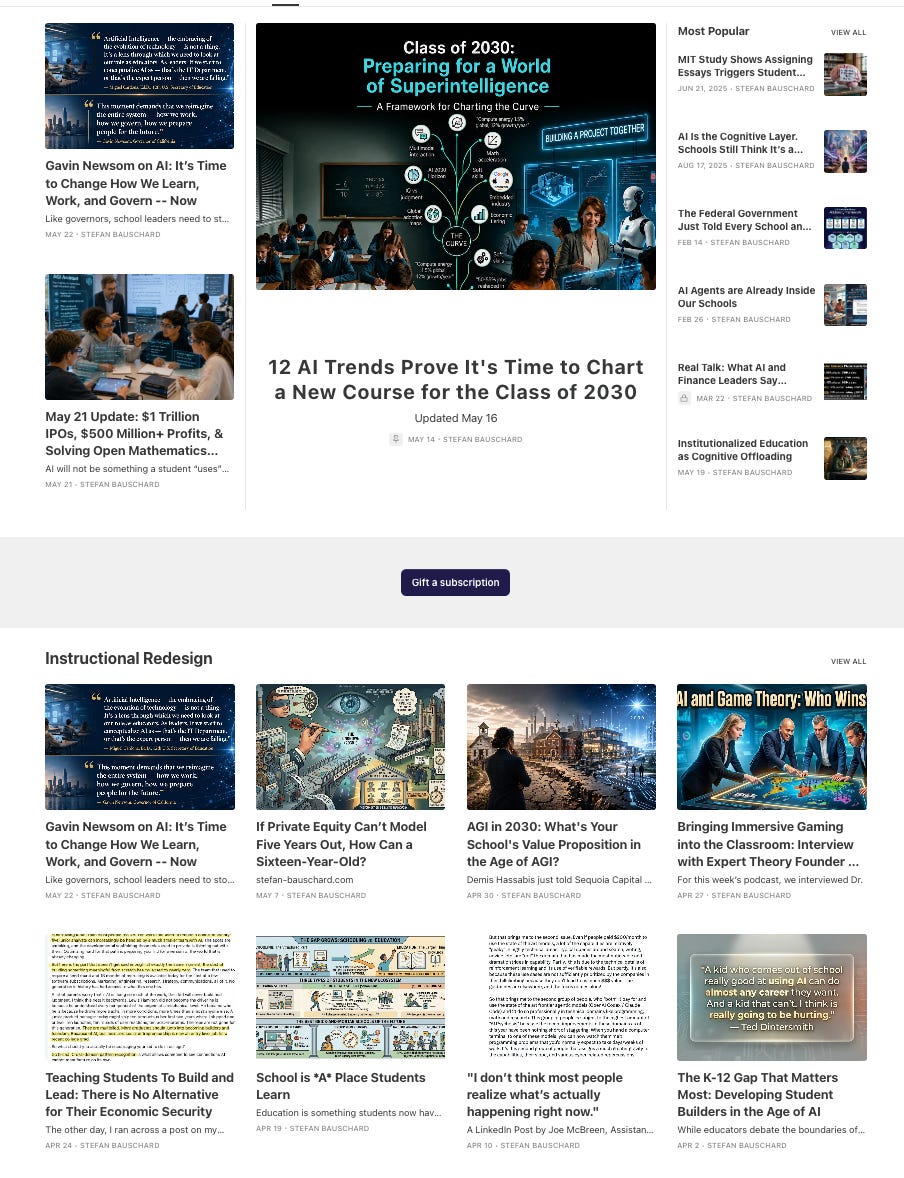
I spent some time today reorganizing and updating this Substack to make it easier for readers to engage with the material, which now includes 500 posts with over 1 million page views. Hopefully, the changes are obvious on the home page.
Thanks to everyone who has supported it, which is now almost 5,000 of you and 57 other Substacks.
I started this Substack a little three years ago yesterday to think through how AI will disrupt education — and how we might best prepare students for a world where machines, increasingly embodied, match or surpass human intelligence in many domains (AGI/ASI). This is something like to happen in the next 3-4 years (or a bit sooner or later). (Hassabis)
My sense is that many of my readers are education reformers who want to move schools beyond a model built around preparing students to become “knowledge workers,” especially when that model still relies heavily on short-term recall and the production of knowledge as the main signs of learning. The most popular post on the site is MIT Study Shows Assigning Essays Triggers Student “Brain Rot,” and the 5th most popular, published only a week ago, is Institutionalized Education as Cognitive Offloading.
The Substack is a push toward the kind of teaching and learning John Dewey called for long ago: active, social, experiential, problem-centered, and connected to life beyond school. These ideas move away from standardized curricula that value everyone learning the same thing via direct instruction and then pit students against each other to see who can learn it the fastest and a little more accurately, even though AI can already offset any difference (Everyone is Above Average).
This call is not new. Educators have been making it for decades. What is new is the pressure. Generative AI can now produce much of the content schools have traditionally asked students to produce, often at a very high level. If the economic value of routine knowledge work is uncertain, then the educational model built around producing future knowledge workers is uncertain too.
Recent “traditional academic” manifestations of my approach include In Search of Deeper Learning by Harvard professors Mehta and Fine, and are reflected by the work of many others in this space, including Dr. Sabba Quidwai (see our book Humanity Amplified (available to paid subscribers of this Substack) and her Designing Schools: How Design Thinking Makes YOU Irreplaceable in the Age of AI, Dan Fitzpatrick, Jerry Crisci (perhaps the original “instructional redesigner,” with a large impact during his time at Scarsdale public schools), Phil Alcock, Dr. Alan Coverstone, and many others. Ultimately, I see AI, especially agentic AI, as a collaborator along a person’s educational journey, something also articulated in Humanity Amplified and in the work of Dr. Mairead Pratschke (paper, our podcast interview) and early work by Mollick & Mollick. It manifests itself in the afternoons of Alpha School and some of the curriculum at Qualia. There are many others along the continuum.
This is not in any way an “edtech” blog. AI as edtech can be powerful, and students can now easily build their own apps to support learning and especially studying, but before we focus on using AI as edtech in the current curriculum, we must first decide what the “curriculum” should be. If we just use AI to reinforce the current curriculum, we may achieve nothing, and we may even leave our students worse off.
There is certainly resistance to my way of thinking, and it is well-meaning. Ultimately, I think it stems from a belief that the way we’ve teaching and learning for the last 100-200 years is really awesome/the way to do it/likely the best way it can be done and that GAI simply allows students to offload the production of the artifact that was supposed to be the signal of what the learned, not only (further) distorting the signal but also undermining their own thinking and cognitive development. There has certainly been a lot of ink spilled on this, and even research done on it, but in many ways, it states the obvious — if the primary way educators get you to think and learn is by producing products, and the AI produces the product, you won’t learn the content and learn how to think. Duh, of course. We don’t need studies to prove that. The question is how to change the teaching and instruction not only so it is relevant in an AI World (Gates), but also so that humans will collaborate with each other and machines in ways that builds their intellectual muscle.
What I’m calling for is not the (rapid) integration of AI into the current curriculum/system. That will produce many of the problems I just shared, but a redesign of the curriculum so AI can be integrated as a partner (peer, mentor, coach, teacher) to help students learn both content and skills that are relevant in a world of AI and other rapidly advancing technologies.
As we get closer to AGI, these technologies will continue to alter our economy, politics, social systems, and even who we understand ourselves to be as humans. To be frank, the idea that an educational system that was even starting to lose relevance in the past industrial era is going to be relevant in this one is almost absurd.
If assessment remains dominated by generic take-home essays, predictable topics, weak feedback loops, and limited engagement between students and academics, then 𝗔𝗜 𝘄𝗶𝗹𝗹 𝗻𝗼𝘁 𝗰𝗿𝗲𝗮𝘁𝗲 𝘁𝗵𝗲 𝘄𝗲𝗮𝗸𝗻𝗲𝘀𝘀 𝗶𝗻 𝘁𝗵𝗲 𝘀𝘆𝘀𝘁𝗲𝗺. 𝗜𝘁 𝘄𝗶𝗹𝗹 𝗺𝗲𝗿𝗲𝗹𝘆 𝗲𝘅𝗽𝗼𝘀𝗲 𝗶𝘁.
Theuns Pulser, Milbak School of Busienss
See posts on Instructional Redesign. Follow Patrick Dempsey on LinkedIn and pull the band-aid off.
Moreover, there is a false assumption that education is “ahistorical” — that regardless of the times we live in, we should teach and learn the same way. The reality is that education has always changed based on the socioeconomic and political system we live in. At least the first two of those are radically changing, and education will change with it.
Change, of course, is hard, even if AI is an arrival technology (MIT) and Agents are Already Inside our Schools. Even schools that want to change will struggle. As I outline in We Rebuilt the Military for AI. Schools Are Still Forming Committees, and Can Humans Launch a new course? Many wrongly believe the primary focus of AI in education is on what is the best chatbot to integrate rather than A Cognitive Layer, and they use normal decision-making structures to adapt to a world that is changing faster than those decision-making structures can respond to. And, the truth is that many don’t believe, or at least want to accept, that AI can do what it is already doing, let alone what it is becoming. It’s almost like being a parent who continues to educate and relate to their child as if she were a year old, rather than one who is 15 and will inevitably graduate from high school.
Schools are understandably struggling to keep up with each new iteration of AI. But the bigger challenge is not tracking every tool. It is accepting the direction of travel. We do not know the exact timeline, but we do know where this is headed: toward AI that is more capable, more conversational, more autonomous, more multimodal, and eventually more embodied. Students will increasingly live and work with systems that can reason, create, advise, tutor, simulate, decide, and act at or above human levels in many domains. Schools need to prepare students for that world, not merely for the next version of today’s chatbot.
Dr. Peter Diamandis explained on May 16th.
When I interviewed Elon, I asked him, "How many humanoid robots do you expect we’ll see by 2040. And he said 10 billion more humanoid robots on Earth than people. And then Brett Adcock said the same thing. So, you know, if these robots cost you, you know, $300 a month to lease, uh, $10 a day, under a dollar per hour, how many of them would you own? And the answer is, you know, more than one. Yeah, and especially if they’re being powered by the latest AI models and they’re genius-level in what they can say and do. They’re running local inference. As these robots start to come out, you know, before we get to 10 billion, let’s say we get to the first 100,000, the first million. Yeah. What are these robots doing in my home? Is it helping me, you know, give my coffee, being my companion? What do they do? I think they’re going to serve very different things. I mean, uh, if you have an older parent, they may serve and support that parent, like making sure they have their medicines, cooking a meal for them.
(R)emember, these robots are also running extraordinary AIs. And we’re seeing these AIs becoming so humanlike, so emotionally engaging that I could imagine these robots becoming friends. Um, you know, just like data on Star Trek or C3PO on Star Wars, they develop personalities, have a conversation, and it’s asking you how your day is today. It’s laughing at your jokes. It’s entertaining you.
(W)hat when one Optimus robot does a surgery it uploads everything to the robotic cloud, and then every robot has seen that same surgery. So these robots will have done millions of cases and seen millions of variations. So you know, all of a sudden, then surgery, the best surgeons in the world are robots, and those surgeons, the cost of the surgery is the cost of the electricity and the capital expense, you know, it’s near zero, and with all of this abundance, the future is driven by you know expected uh exponential growth in intelligence capabilities of these models.
… We define wisdom as individuals, you know, the elders in our society who have seen so many circumstances that when you go to them for advice, they tell you. And AIs are going to be able to simulate billions of scenarios and give us predictions on what the best path is. And so I think AI, as it becomes more and more capable, is going to become wiser and wiser.
So, ultimately, I think the questions are how do we prepare students for this new “industrial era” where machines can think and not the last one, and how can individuals and institutions who want to do that be supported?
This is what this Substack is focused on.
Knowledge of the Changing World
A core component of preparing students for the changing world is to understand it ourselves. To support this, in collaboration with Dr. Anand Rao and our AIxHigher Ed podcast, we track weekly updates.
I’ve consolidated emerging trends here.
Coverage of controversies related to data centers, the environment, discrimination, and everything in between is here.
We have a special section related to potential unemployment, universal basic income (UBI), and the restructuring of the social contract here.
Knowledge of AI
Posts throughout this Substack emphasize building basic literacy related to AI and understanding how human and artificial intelligence work (Dasey).
Connecting to Work
We cover what employers are looking for and how to support students as entrepreneurs.
We have a special focus on the “soft,” AKA “durable” skills.
Connecting to Universities
What do universities need to do, and how do they need to restructure? Our posts on that are here.
Whether many universities survive probably depends on whether they focus beyond the four-year degree and reinvent themselves for the community and support lifelong learners.
Practical Action
It’s more than a dream. It’s more than a set of goals.
And it isn’t rocket science.
Classrooms should be transformed beyond a focus on standardized testing and the production of content towards kinetic learning communities that emphasize debate (extensive resources), project-based learning (PBL) (Alcock), interdisciplinary learning, design thinking (Quidwai), entrepreneurship (everyone), robotics, and other forms of AI-Human interaction.
Thank you,
Stefan
stefanbauschard@globalacademic.org
Stefan-bauschard.com
Your diagnosis of the issues in the AoA is accurate, in my opinion. What is missing, in my opinion, is that only a small percentage of the population has an intention to learn anything in the first place. Universal education is what it is because of that simple, unarguable fact.
The higher order human skills that you argue education must focus on requires two things: first and foremost, the intent to learn and second, foundational knowledge of number and writing. We know that numeracy, at least through algebra and fundamental probability theory is foundational. We also know that writing is crystalized thinking; those who cannot write cannot think.
But how are students to learn numbers and writing? They must do it the old fashioned way; they must first memorize rule and patterns, and later, once their brains are sufficiently developed (perhaps in the early 20s), they can begin to think about relationships that make the rules and patterns right in the first place.
Your analysis calls for the impossible; students who employ higher order thinking without having first built foundational knowledge that is simply remembered.
Yes, the factory model of education is a dead man walking. In my opinion, it will not be long now before we retrench in education, coming to understand, as some of us who have taught for 40 years have known for decades, that learning is simply not for everyone.