
Using Academic Deep Learning to Support Human Development in an AI World (Humanity Amplified Chapter 6)

Over the next 24-36 hours I’ll be moving the remaining revised Humanity Amplified chapters out. Hopefully this will not trigger any unsubscribes, but there is no other way to get them posted than sending many emails. The full chapters are available to our paid subscribers.
The big issue isn’t student cheating or figuring out how to use AI in the classroom; it’s that the work that AI is grabbing is the same as schooling’s focus. Students are set up to compete with AI rather than collaborate with it. They’ll lose that competition…. AI is gobbling expertise—the core purpose of conventional schooling. People will be responsible for the vaguer, big-picture intellectual cousin—wisdom. Long sought but mostly unrealized learning goals like critical thinking, relationship skills, and creativity can no longer be add-ons. We must design schools so they are the top priorities.
— Tim Dasey[1]
The goal of education is not to increase the amount of knowledge but to create the possibilities for a child to invent and discover, to create people who are capable of doing new things.
— Jean Piaget[2]
The real problem is not whether machines think but whether people do.
— B.F. Skinner[3]
We must shift education to focus on human potential, to develop students’ breadth and depth of knowledge, as well as their ability to navigate diverse ideas, people, and cultures… Schools should embrace generative AI and similar tools to increase time spent honing competencies such as framing meaningful questions, contextualizing arguments, and evaluating multiple perspectives.
— Eric Tucker, co-founder, Brooklyn Laboratory Charter Schools[4]
Exams and teaching to the test have become so ingrained in education that little to no room is left for creative learning, rich discussion, critical thought or the development of emotional intelligence. These are the very skills and activities that separate people from robots, yet instead of developing them, students are told to act like robots and simply spit back information on exams.
— Benjamin Weiss, high school student[5]
Introduction
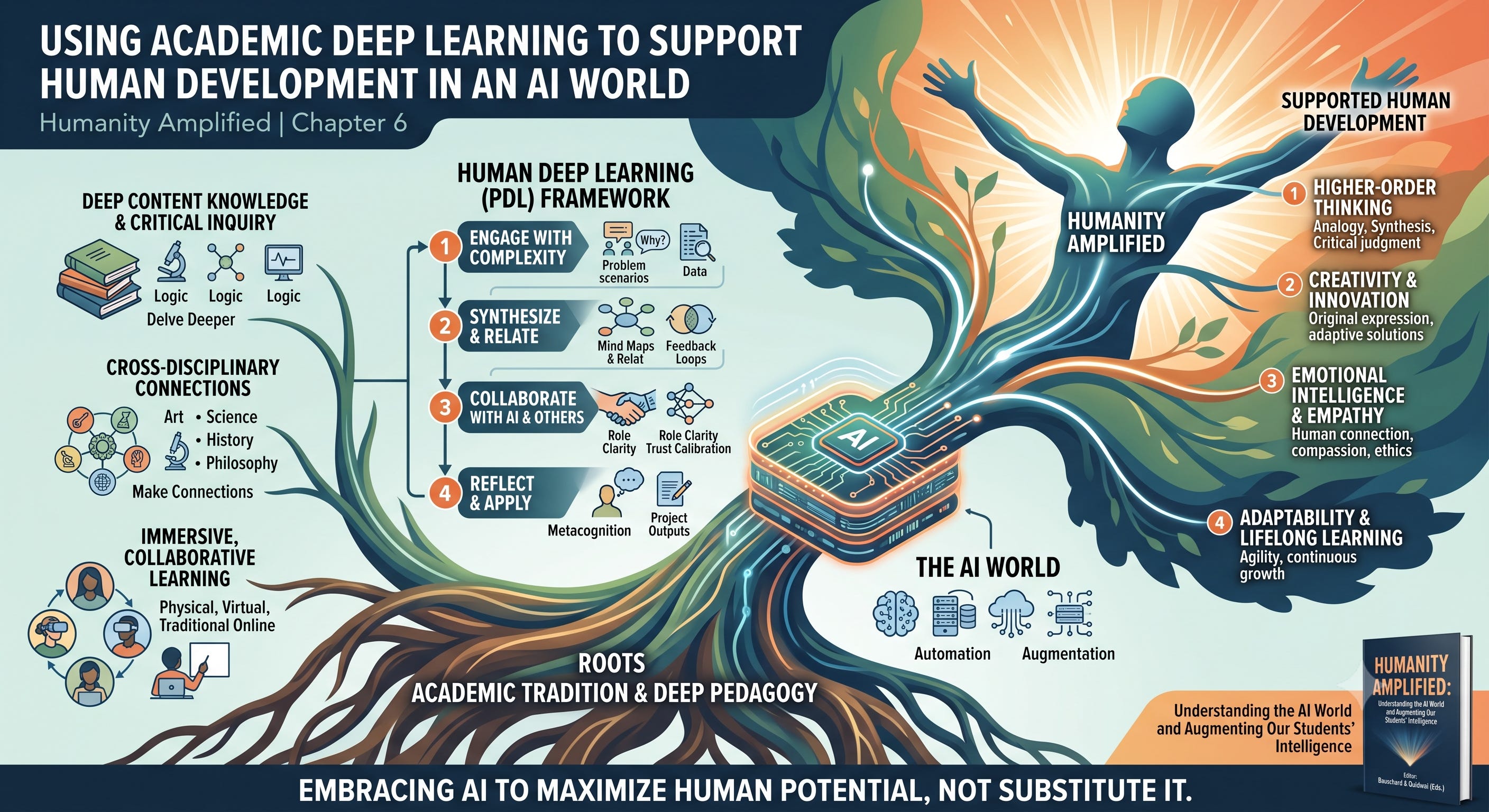
In this chapter, we outline how the education system should respond to rapid advances in AI. Our suggestions are grounded in deep learning, a pedagogical approach that pushes students deeper into content; asks them to make connections across ideas in immersive settings — physical, online[6], and virtual[7] — and has them collaborate with others, including AIs. Through this process, students develop higher-order thinking skills. By employing analysis, critical thinking, synthesis, and metacognition, they gain a lasting understanding of the content they study[8] and learn to solve real problems — first in familiar contexts[9], then in unfamiliar ones[10] — one of the hallmarks of advanced intelligence, and precisely what they will need to thrive in an AI world. As the OECD observes, deciding how to use AI for learning is hard; deciding what should be learned and taught in a world reshaped by AI is harder still.[11]
Microsoft’s New Future of Work report made the stakes concrete: as AI takes over more generative tasks, human work shifts to the “critical integration” of AI output, which demands expertise and judgment.[12] Workers must think critically enough to challenge assumptions, evaluate outputs, and offer counterarguments. The report suggested that frameworks structuring critical-thinking objectives — Bloom’s taxonomy, Toulmin’s argument model[13] — could inform the design of AI that provokes rather than placates, and that interactive technologies that spark discussion contribute to critical-thinking development.[14]
The evidence has since sharpened. In 2025, researchers from Microsoft Research and Carnegie Mellon surveyed 319 knowledge workers about 936 real instances of generative AI use and found a clean, uncomfortable pattern: the more confidence workers placed in the AI, the less critical thinking they reported doing, while workers confident in their own skills thought harder, not less. The study describes knowledge work shifting from information gathering to information verification, from problem-solving to integrating AI responses, and from doing tasks to stewarding them.[15] An MIT Media Lab team went a level deeper, using EEG to monitor 54 essay writers over four months: participants writing with an LLM showed the weakest neural connectivity of any group and the lowest sense of ownership over their own essays — an accumulating “cognitive debt,” the authors call it. The study is a preprint with a small sample, and its methods have drawn criticism, but its direction matches the survey data.[16] A 666-participant mixed-methods study found the same pattern in the general population: heavier AI use correlated with lower critical-thinking scores, mediated by cognitive offloading, with younger users the most dependent — and with educational attainment buffering the effect.[17] Nor is the effect confined to students. In the first documented case of AI-related deskilling among trained experts, Polish endoscopy centers found that experienced physicians’ unassisted polyp-detection rate fell from 28.4 percent to 22.4 percent — a 20 percent relative decline — after a few months of working with AI-assisted detection.[18] Verification, integration, stewardship: these are the higher-order capacities deep learning develops — and exactly what schooling built on retrieval and recall does not.
The causal evidence reveals the lever. In the most direct test to date, researchers ran a randomized trial with nearly a thousand students at a Turkish high school: a vanilla ChatGPT-style tutor lifted performance on practice problems by 48 percent, but when the AI was taken away, those students scored 17 percent worse than peers who had never had access — they had used the system as a crutch. A second version,