

Fresh off her presentation yesterday at the OpenAI Higher Education Conference, biomedical researcher and AI-ethics educator Professor Tina Austin joins us to share a practical, human-centered roadmap for teaching with AI.
🌱 𝗪𝗵𝘆 𝘁𝗵𝗶𝘀 𝗲𝗽𝗶𝘀𝗼𝗱𝗲 𝗺𝗮𝘁𝘁𝗲𝗿𝘀:
Faculty silos and tool-chasing are slowing real progress. Tina’s UnBlooms framework replaces “flip Bloom’s” with a non-linear, non-hierarchical approach that centers human judgment — especially students’ ability to evaluate AI outputs.
💡 𝗜𝗻 𝘁𝗵𝗶𝘀 𝗰𝗼𝗻𝘃𝗲𝗿𝘀𝗮𝘁𝗶𝗼𝗻, 𝘄𝗲 𝗰𝗼𝘃𝗲𝗿:
• Why “plug-and-play” AI fails (today it’s ChatGPT or NotebookLM — tomorrow it’s something else)
• How to design assignments where students evaluate AI using measurable rubrics
• What AI literacy really looks like — computation, cognition, evaluation, and ethics
• Campus adoption realities: pilots, “champions,” and how to move beyond silos
• The bold truth: AI is not a good evaluator of AI — humans must lead
👩🏫 𝗔𝗯𝗼𝘂𝘁 𝗼𝘂𝗿 𝗴𝘂𝗲𝘀𝘁:
Tina has taught at UCLA, USC, and Caltech; advises on AI literacy frameworks; launched a UC-wide initiative on AI in teaching and research; serves on the California & LA AI Task Forces; and is recognized as a Microsoft Innovative Educator Expert and one of ASU+GSV’s Leading Women in AI.
__
Professor Austin: I get this question almost like once a month. How do we handle this thing with faculty being in their silos?
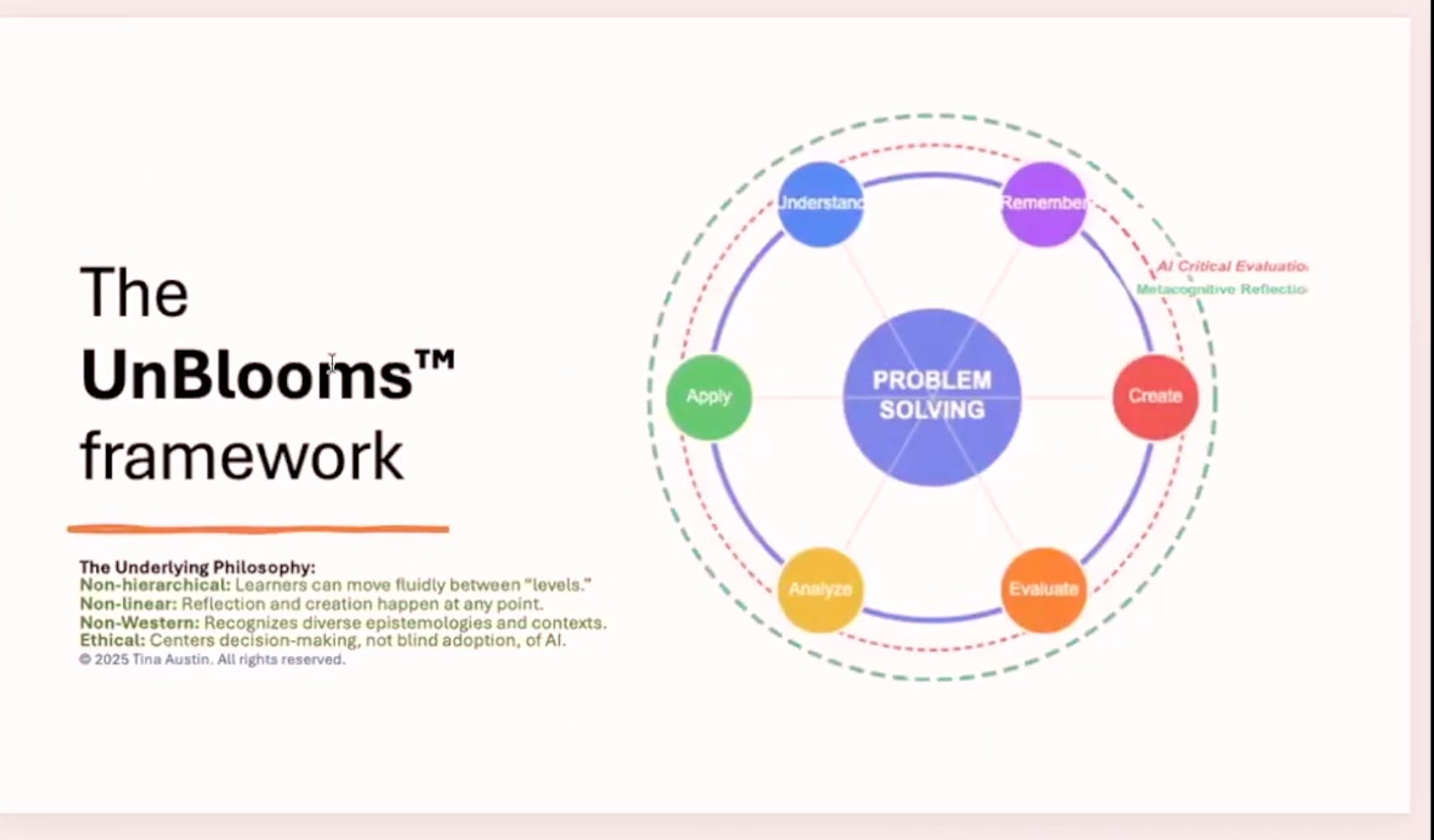
I call it UnBlooms with reference to Blooms. But the goal was to make something that... that has no hierarchy, that has... it’s nonlinear.
The problem with these tools is that right now it’s ChatGPT study mode or Google Notebook LM, but like 6 months from now, it’s going to be... um... something else. So that is not going to be helpful for instructors to just like plug and play.
AI is not really also a good evaluator of... of AI. AI doesn’t always... it doesn’t pick up on the things humans do.
Narrator: We’re excited to bring you this conversation with Professor Tina Austin.
Meet Prof. Tina Austin (bio & impact)
Dr. Anand Rao: Tina is a biomed researcher and AI ethics expert who helps universities and organizations adopt AI responsibly. She’s taught everything from regenerative medicine to AI ethics at top schools like UCLA, USC, and Caltech. And now she advises on AI literacy frameworks for higher education.
In 2023, Tina launched a UC-wide initiative to help instructors integrate AI into teaching and research, introducing her UnBlooms framework, which encourages critical thinking and AI-driven learning. Tina serves on a number of... of advisory boards, including the California and LA AI task force and is recognized globally as a Microsoft Innovative Educator expert and one of the ASU GSV’s leading women in AI. She’s dedicated to promoting evidence-based ethical approaches to AI in education and policy. We hope you enjoy this conversation with Professor Tina Austin.
Invited to the OpenAI Higher Education Summit
Stefan: Well, Professor Austin, thanks so much for joining us. We’re really looking forward to this conversation. And let me start by saying congratulations for being chosen for the speaker lineup for the inaugural OpenAI Higher Education Summit, where you’re going to be one of the few faculty worldwide invited to present on stage at OpenAI’s headquarters in San Francisco. I was really excited to see that.
Professor Austin: Thank you. I’m excited too. I was pretty shocked when they reached out to me, and uh, I think it was probably because I had shared some of the best use cases of... of their tools a couple of months ago, and uh, they saw that it applies to different disciplines. And so I’m... I’m glad to be there and excited to... to... to be there with educators there.
Rethinking pedagogy: from “what AI can do” to “what problem we’re solving”
Stefan: Yeah, that’s fantastic. Well, I saw that the title is “AI and Pedagogy: Reframing How We Learn.” Please unpack this approach for us. Tell us a little bit about what you’re planning on doing for the talk.
Professor Austin: Thank you. Yeah. So my goal is to talk about how learning is in general... is as I am sharing this...
Stefan: Yeah, sure. That’d be great.
Professor Austin: Great. Generative AI came along in 2020... well, let’s talk about ChatGPT in 2023. And so the question... um... a lot of people were asking was just “What AI can do?” and “Let’s do more of what AI can do.” And my thought was more about, “Well, what problem are we trying to solve with AI?” And so asking this question led me to...
Revamping courses & cross-disciplinary integration
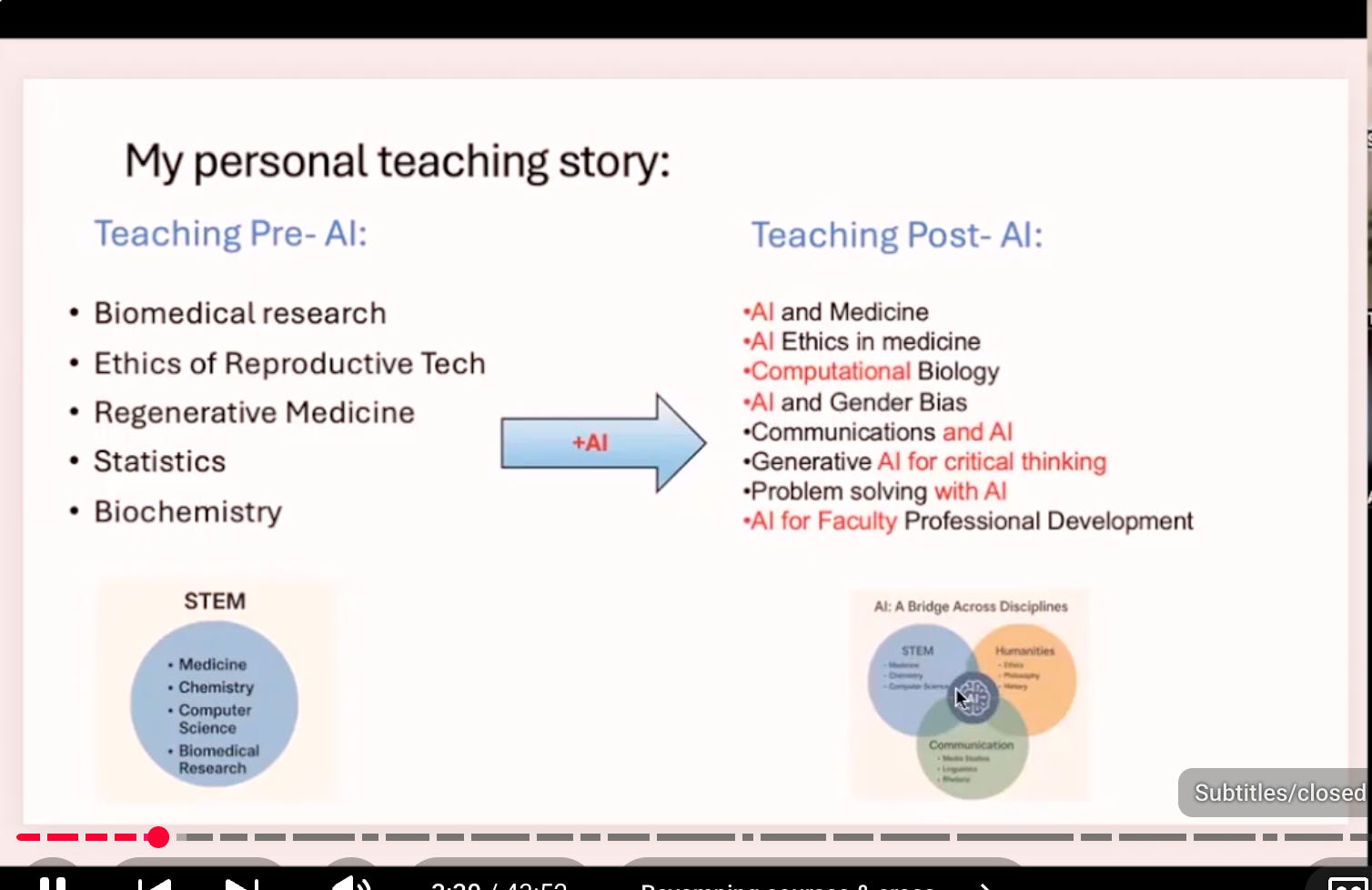
Professor Austin: ...revamp these courses. Not only revamp the courses I was already teaching, but when I shared my syllabus with faculty in this school, um, then other instructors approached me and said, “Well, I want to teach this new course,” and, “You know, we’re bringing AI into this other course.” And so eventually I ended up teaching all these other courses that had AI involved in them, and... and it bridged it to... and I... I bridged it to other disciplines. And so I was trying to find out what is the commonality between what I was doing to what I was now doing, and then what was the commonality between these different disciplines when AI came along, uh, into the picture.
Bloom’s taxonomy meets generative AI—what breaks?
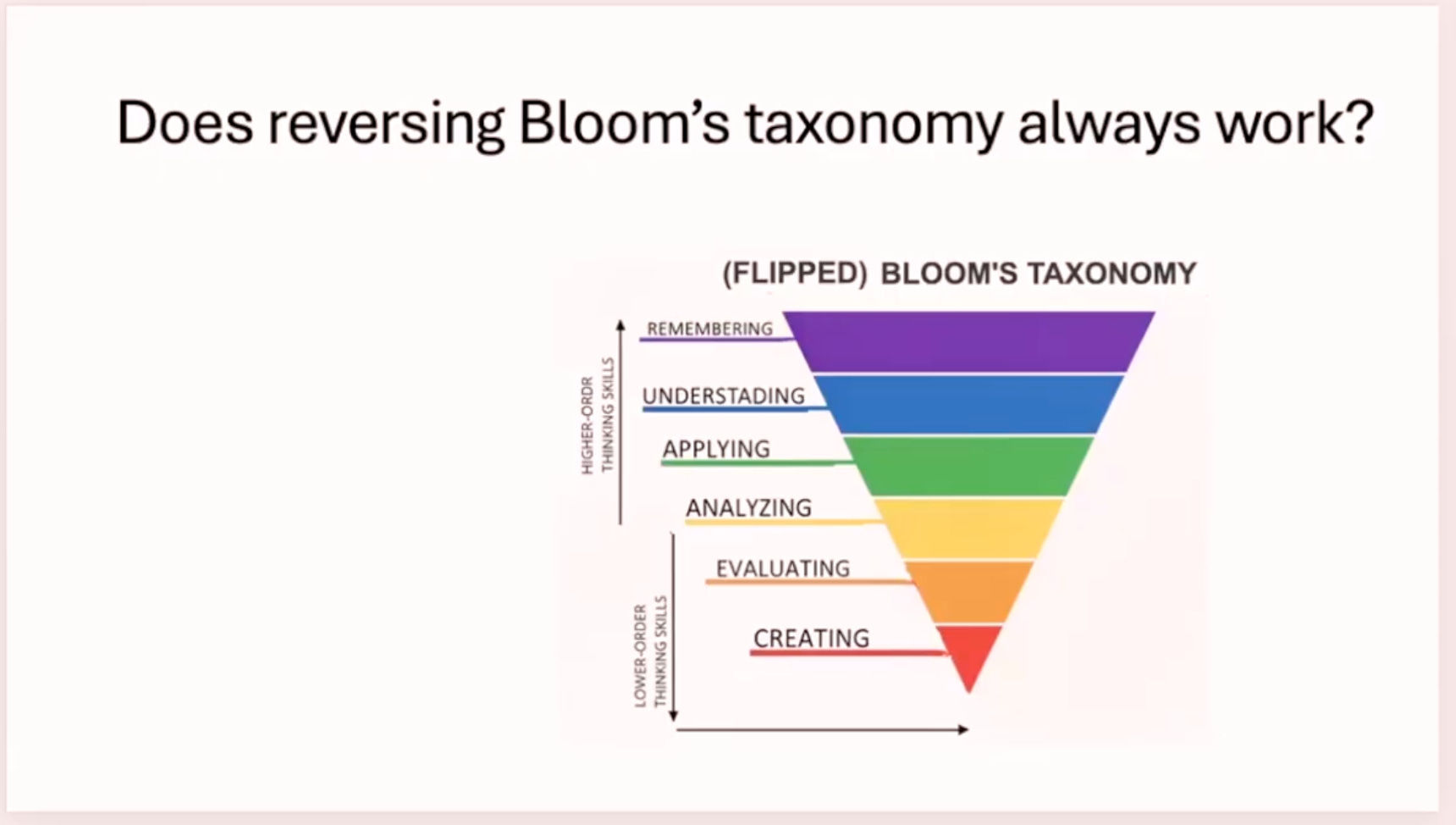
Professor Austin: And so I noticed that a lot of... um... colleagues used Bloom’s taxonomy, including myself in the past, with, you know, putting that in the syllabus. That always looks nice and pretty, and you start off with, you know, remembering, and you put a couple of lines in your syllabus about like what your goal for that course is with Bloom’s taxonomy. And then... um... generative AI came along, and all of a sudden, it doesn’t make sense to have this old framework. And so I ended up increasingly having to rethink my pedagogy as a result of AI’s emergence. And so the question was, “Well, now what does it look like?”
And so many of my colleagues I’ve seen on LinkedIn have wonderful ideas about... um... going ahead and flipping... flipping Blooms like this upside down and seeing if we can... uh, you know, just start because AI is really good at creating. Let me go back here. AI is really good at this process. And so if AI is good at creating, then... uh... what are you asking the student to really do? Right? Or if AI is good at this step, what are you asking the student to do?
Introducing UnBlooms: non-hierarchical, nonlinear scaffolding
Professor Austin: And so the question is less now about flipping Bloom’s taxonomy, but “What is the problem that you’re actually trying to solve?” And that’s why I... I called it UnBlooms, with reference to Blooms. But, you know, the goal was to make something that’s non-hierar... that has no hierarchy, that has... it’s nonlinear. And you know, when I discussed this with other colleagues on LinkedIn, we talked about Western versus non-Western models, you know, equity... um... around the world and how like many countries don’t actually adopt Blooms very well to begin with because it’s based on Western standards. And so... um... the idea was, “How can we come up...?” Well, for me, it was, “How... how can I come up with a framework that can scaffold learning... um... where human thinking is important?”
Feedback from Oxford; the UnBlooms scale & upcoming workshop
Professor Austin: And so I proposed this at... um... I presented this... uh... at Oxford last month, and I got some good feedback. And... uh... you know, I’m excited to go forward with the next steps. There’s also an UnBlooms scale that I developed, and that helps with like getting to the next stage and deciding where, you know, where to go next for... for someone who’s working with like a learning framework. And so that was something I... I was lucky to work with across different disciplines. I’m doing like a... a special workshop on it soon. I’ll announce the dates on... on LinkedIn, and I know a couple of other colleagues have reached out. So I have like all the examples and things I can... I’d love to share.
Stefan: Yeah. You know, this looks... uh... pretty exciting. I... I can’t wait. Maybe someday I’ll get “unbloomed,” and then I’ll know I’ve really... I’ll know I’ve really arrived. But you know, in terms of... I like the framework. It’s pretty cool. And have you... have you kind of... kind of walked through, you know, yourself? Like, you know, you’ve just kind of been working with this, right, and applying it in your classes. So I wonder if you had like an example of like, you know, an assignment... like, you know, either just a new assignment like in UnBlooms or maybe something that changed, or an example.
Concrete assignment design: make students evaluate AI
Professor Austin: Yeah, I have plenty of like assignments here and there. I’ve made a bot for it, just to help people out when I’ve gone to conferences, because every... what I’ve noticed with people coming in from different fields, like I have like a history professor or like... um... you know, a writing professor or, you know, physics, what... whatnot. And... and everyone’s like, “Well, how does this apply to my class?” and or, “I’m not sure how this applies to the problem I’m trying to solve.”
So the goal with a custom GPT was to first ask them, “What is the problem they’re trying to solve?” Because the... the thing about this particular framework that I’ve proposed is based on problem-solving. Like, “What are you trying to get your students... where are you trying to get your students to, or what do you want them to learn?” And so... um... it’ll ask you that question, and then it’ll say, “Maybe I want to design an enzyme experiment that... um... helps students understand how this particular enzyme works in different temperatures.” And then it will ask you, “Okay, now that you have this, the next step is going to be like...” It’ll pick from like “evaluate” or “design.” And then... um... when AI is actually involved in your assignment, that’s when the scale comes in, because now you’re having students critically reflect on the AI’s output instead of just using a tool.
Because a lot of the advice I see online is just “use... uh... NotebookLM” or “just use... um... what is it? ChatGPT study mode” or “Claude,” whatever, you... you know, the whole thing, right? The wall of... uh... buttons with Google.
Why chasing tools fails (the “next tool” problem)
Professor Austin: And the thing... the problem with these... these tools is that right now it’s ChatGPT study mode or Google Notebook LM, but like 6 months from now, it’s going to be... um... something else, like “nano banana sunflower” or something, right? And... and so that is not going to be helpful for instructors to just like plug and play. Uh, and the... the idea with this framework was... is that you put that in... put... put part of your assignment in there and have your students evaluate.
Example: using NotebookLM outputs to assess critical thinking
Professor Austin: So to give you an example, um, for NotebookLM, I put in some of my lecture notes. I added it as an assignment for students to evaluate after they had already learned about stem cells and about pluripotent cells. And then I had them watch and listen to this podcast and tell me all of the things that they noticed that was wrong with this AI-generated output. And so the students that were on surface level would say, “Oh yeah, it’s AI-generated.” Like, not beyond that, like not a ton of, you know, insight there. And then the... the level deeper was, “Oh, we noticed there was this particular thing that was rearranged that was different from lecture.” And the next level was, you know, more deep and more deep. So the... the... that was how I was able to assess them, and that’s how we got them to think critically about the work.
And this applies to Microsoft Copilot. This applies to... um... whatever tool... AI tool you want to call. And that’s why I feel that... I felt it was appropriate for... uh... OpenAI and other places, because a lot of them... they... they’re thinking in terms of what tools can we come... come up with. And the problem, as you know, Stefan, is like these... all these tools... is like they’re none of them are with 100% accuracy ever going to solve that for students.
Stefan: Well, I don’t know. You know, to me, I... I think there’s two questions, right? I mean, accuracy is an issue, right? Like right now, obviously, it’s not accurate. You know, there’s a lot of things you can do to... to improve accuracy. And, you know, maybe... maybe... maybe it’ll eventually be solved. It’s... it might not be impossible. I mean, probably not going to be stuck with the same architectures forever.
Even if accuracy improves, pedagogy still must change
Stefan: But you know, even... even if the... to me, like... even if the accuracy problem was solved, right? Like the... the challenges, you know, that you identified, right, with... with the... with the current Bloom... like still remain, right? Like the weakness of that structure isn’t like, “Well, if you put AI into it, it... it kind of... it, you know, it has errors,” right? Like the... the weakness is that kind of part of... part of that thing that we start... like different things it can already do very well, right? So what do we want our students to do, right? Like how do... what... what it kind of...
Instructional redesign - inserting tools
Stefan: ...attracts me to the... the kind of the UnBlooming and, you know, some of these kind of broader ideas is that they’re really kind of targeted at... at like instructional... kind of redesign, rather than just saying like, “Okay, take your favorite tool, right? Whether it’s Copilot or... um... you know, the... you know, I can’t even keep track of all the names. Usually I put a ‘Socrates’ in there somewhere... um... you know, right? And then... uh... you know, just... just kind of teach the kids with that,” right?
Like I... I think NotebookLM’s pretty useful, you know, for different things, right? You know, I... I wouldn’t... I wouldn’t study... uh... to become a heart surgeon and then go operate on somebody’s heart with it, right? Like because, you know, it might tell me... might make an error. But I... I think it has a lot of values. But what I... what I really like is kind of how you’re... you’re... you’re kind of getting people to think about how to kind of redesign their instruction using a framework.
Because I... I find sometimes people are... they get a little stuck, right? Like... and I think even just kind of unpacking that... like unsticks them. You know, I did... I did a... uh... a podcast at a... at a department... for a department, and... uh... college, you know, college department, master’s... uh... level, and you know, they’re just kind of like, “Okay, well, the university wants us to use this, but like we... we don’t really know how to use it. Like, would you have any ideas?” So, and you know, it was part of my background, so I was like, “Well, it’s been a while since I took these classes, but you know, I would imagine in this kind of class you could do this, and this kind of class you could do this... this kind of class you could do...” They’re like, “Oh, okay. Well, that’s great. That gives us a lot of ideas.” And it kind of... it kind of took it and enabled them... uh... kind of to run with it. So, what... what I really... I... I see a lot of value in what you’re doing is kind of opening the... it’s kind of pushing their... opening their mind in another direction.
Professor Austin: Thank you. Yes. I’m... I’m glad that you... like I’m always open to feedback, too. Like I’ve said to people, you know, “This is the link for the bot. If there’s anything that, you know, you felt that... and I could improve.”
Iterating the bot & gathering faculty feedback
Professor Austin: And so I’ve collected a lot of feedback and refined it. So the bot I... I’ve been constantly updating with... um... feedback, and most... for the most part, it’s... it’s been positive. I’m hoping to again, you know, we’re looking to get things published and... um... yeah, excited about that and see how it goes.
Dr. Anand Rao: I think what I really like about the way that you structured this... I... I mean, there are a couple of things. First, this is really appealing to a lot of faculty because it’s something they’re familiar with. They can think about Bloom’s taxonomy and they know that kind of that progression and the way it works. What I really like the way that you’ve reframed it is that it recognizes that with tools, different AI tools, um, there are some elements that are already being done really well by AI. And this then puts the emphasis on the evaluation and assessment that needs to be done by the student. Um, instead of viewing that as a step toward creativity, that is really something that is still really in the human domain... um... and hopefully will persist to be.
Keeping evaluation in the human domain
Dr Anand Rao: But that is a great way of then structuring it for faculty. I think it... it takes a... um... a touchpoint that they’re familiar with, and then it makes it easier for them to think about, “Okay, even if the AI is introduced, there’s an important role for the student and for the instructor to talk about that evaluation and that assessment.” Um, how have faculty responded to that? Do they see that as a... as a natural next step? I mean, are they more open to the idea of AI being incorporated in the process if they still see kind of that human element through evaluation and assessment?
Professor Austin: Absolutely. Thank you for that and thank you for the... the kind words. Yes, I... I’ve gotten mostly... like, actually all the feedback I’ve gotten from faculty was, “Okay, I have great ideas after this. I’m ready to jump in my assignment. I’m ready to do evaluation.”
Making the UnBlooms scale rubric-ready
Professor Austin: Um, one thing that I’m refining with the scale is actually making it a measurable tool that they can just plug into their rubric, because a lot of scales may not like have an actual thing to measure. So... um... I... I my goal has been to kind of like make it easy for them. And yeah, like faculty that I’ve spoken to... um... see the value in this because it helps with their... some of them that are already critical about AI, and they get sold AI. They don’t want AI because it sounds like to them the fraud or the stuff they see online with Instagram and this like... um... deep fakes and like, “Of course, no AI. Who wants AI?” You hear words like “work slop” or... um... what’s the other one? “Brain rot.” And of course, nobody wants AI, right? But... but to... to actually now use it as... um... a way to shine... um... you know, have students shine with their like ways to evaluate and... and their human side, this... this I feel like is... is valuable. And... and I... I honestly... like I know a lot of people say, “Well, no, one day it’ll be perfect.” I think there’s always room for critically evaluating AI.
Critical takes, bias, and healthy skepticism of big tech
Professor Austin: And yeah, and then every tool... like again, I see NotebookLM and I... I can’t help but see like, you know, you... once you see the mistakes, you can’t unsee it. And so it’s... for me... Stefan knows I... I like to do lots of critical takes on LinkedIn where it’s like, “But there’s this one thing that’s... that’s still wrong.” And I want people to see that, like so... so they’re not just like overworshipping a big tech company or...
Stefan: Um, absolutely. Yeah. Yeah. And I think, you know, you know, I... ...mean, there... there’s kind of two types of, you know, without getting too... like I don’t even know if I’ll use the right terms, right? Like there’s... there’s kind of factual knowledge, right? And maybe it’ll always make mistakes, but then there’s all these things about like kind of... that basically are like critical thinking, judgment, having a better idea... excuse me... even if it’s not the perfect idea, right? Like there’s a lot of things that we’re going to wrestle with that we can... you... even... even if, right, it... it... it suddenly gets everything right. It just... it doesn’t have like, at least kind of, you know, factual errors amongst facts that everybody agrees on. We’re still going to have all these other challenges, right, that... that AI can help us with.
And it just seems that kind of Blooms flips that, because I think the one place people struggle with a lot, it’s like, “Well, yeah, if I just put... take the AI and put it into my existing curriculum, it seems like it’s not going to work.” And a lot of times it’s not going to work, right? Your assignment is like, “Go summarize like these 10 articles.” Yeah. I mean, it’s kind of hard to like, “Okay, kids, like use it in this way, like, you know, have it... have it... have it generate like three summary sentences and then you generate the other seven in your brain,” right? Like... I mean, right? Like stuff... like it’s just kind of like forces it in there, whereas this... this kind of... this kind of reimagines it.
Um, because, right... and I... I think that’s the only way to... I mean, a... like a, you know, universities got to like, you know, kind of figure this out a little bit, right, to continue, right... um... you know, kind of continue on in... in really kind of a lot of ways, right? And they... they’ve... they’ve got to figure this out, right? So they... how that puts their role in there.
Um, but to get... you know, I know you’ve done... you know, done a lot of other work, right? Like with, you know, you know, advising boards, right, involved in California, right, at the institutional level, kind of beyond... beyond the Unbound... um... what kind of... what kind of ideas do you share with people and what, you know, what kind of reactions do you get?
PSA: AI is not a good evaluator of AI
Professor Austin: ...add one more thing to... to what Anan was saying about AI. AI is not really also a good evaluator of... of AI. And so, like you might say, “Well, I’ll just put...” The student might just put that and say, “I’m just going to offload my critical thinking to AI.” It doesn’t always... it doesn’t pick up on the things humans do. So back... and then I just want to answer that question.
What institutions ask: unions, universities, and literacy programs
Professor Austin: And then back to what you were saying, what I’m advising... universe... it depends. So I get a very broad range of questions depending on who’s invited... inviting me. Often... um... like earlier this year, I was doing a lot of... um... sessions for unions who really wanted to... to look at the... like teachers not being replaced aspect of AI, and they wanted to... to hear more about the criticism... um... for their bargaining reasons.
Um, whereas later, I’m getting more of... um... from universities about, “Okay, we admit we’re behind. What do we do? Like, where can we start?” Or like, you know, I’ve also been talking to CSU folks where they’re, you know, as you know, AI-leading university, right, in California. And so there’s... their approach is, “Okay, we really want this here.” And then you still have maybe some faculty that are trying to catch up, and they still have... um... gaps to fill. So, it really depends on where I go. I mean, sometimes I get advice from schools, from... um... from colleges, from community colleges, and “How do we build an AI literacy program?” So, it’s really across the board, to be honest with you, uh, the questions that I get. And... and... and I’m seeing more and more of that lately. Like, it wasn’t like this last year. I feel that now this year, it’s really like picked up with lots of... um... “Okay, you can’t...”
Maybe two years ago, you could just pretend not to talk about it. Remember, I came from a department when I was banned to talk about AI, and then I moved to... had to move to a different department. Um, and then by the way, yes, OpenAI shared that... uh... in a mass email, which I was not expecting, but they did. I was like, “Okay, I guess now everybody knows.” Um, and then, you know, in other departments, there were... they were very... um...
Tipping point on campus: it’s everywhere (even in Word)
Professor Austin: ...you know, much open to it. So I feel like over the years, it’s become more and more accepted. And now people are seeing, “Yeah, you right-click on Microsoft Word and it’s there.” Like, you know, so...
Dr Anand Rao: I mean, certainly there’s a raising awareness. Uh, more people are certainly aware of it, and it seems like we’ve reached a bit of a tipping point where at least in higher education, there’s an acknowledgment, “Hey, it’s not going away. We can’t ban it. We can’t just ignore it. Um, we have to do something.” But I think as most institutions... I know, finding at my institution, every... everywhere else, there are some faculty that are, you know, that they haven’t been... had the time really or the... the... the resources to really look into this or do that... that kind of work to figure out how to adapt. Um, and there’s... there are pockets of resistance, which is totally understandable and... and you know, I think is... is warranted in some cases. You don’t want to just integrate AI into everything, of course. But... um... when we’re thinking about then widespread adoption, because it’s one thing for the school to say, “Hey, we need AI. We need to embrace it. We need to move forward.” Um, it’s kind of like what we see in the corporate environment. Just because there’s that mandate doesn’t mean that it actually filters through or it does get implemented. What do you see as some of those main barriers for widespread adoption... um... in universities?
The real barriers: silos, pilots, and no central strategy
Professor Austin: Thank you. There’s actually plenty of barriers. I love this question, but I’ll be honest, there’s plenty of barriers. And I’ve been tackling... I... I get this question almost like once a month, like twice a... three times a month from different schools, from schools in the East Coast to... and everybody’s saying, “How do we handle this thing with faculty being in their silos?” or “How do we handle this thing where... um... some people see it as a pilot project?”
Like, I’m not going to name which school... there’s some faculty that treat it as a... their own pilot project to run their, you know, own thing within their classroom. And the entire university might say, “Well, they’re just doing their thing. Cool. We don’t want to... we’re... our thing is separate.” And there’s no centralized system, right? And there’s like lots of ad hoc approaches across different departments. So there’s... that’s one of the barriers. There’s... um... you know, again, these experiments... like I... every... every school, every university has their “champion AI people,” right? They’re doing their showcases. They’re out there... um... showing what they can do. But this is a barrier across all of the schools that I’ve seen where... um... that might look great to some people, but they’ll say, “Okay, great. I’m still not doing that in my class.” And that’s fine.
And I think I... to be fair to everyone, I think... um... if they don’t want to use it in their classroom or they don’t feel that they’re qualified to teach or talk about AI, that’s fine. I... I stand with them. But I also feel for them. It is, unfortunately, like in a lot of tools nowadays. I mean, you get the latest iPhone, you have AI in it. I don’t know how... um... someone can continue to say, “Well, I’m not going to use a smartphone. I’m not going to use... um... Microsoft Word. I’m... I’m just going to say no AI.” And... and so I mean, I... again, I feel for that. I... I understand where they’re coming from. I understand the problem with workload, and it’s a real one. And it... and you know, we are seeing, you know, deep fakes. We’re seeing lots of problems with big tech.
Online debate, strong feelings, and restoring civil discourse
Stefan: Well, you know, that... that... that kind of brings up, you know, another... another topic area I wanted to raise. You know, sometimes when you... um... you know, you say something, right? Like you... you can, you know, it invites controversy, right? And we... I know we [talked] a little bit about controversy a few... a few months ago, but you posted something, I think even... uh... you know, today, you said, “Oh, sometimes people DM me, ‘Hey, you may want to delete this. You don’t want that debate,’” right? So, you know, sometimes we probably do get debates we don’t want. I know when in one of our chats, I was like, “Well, I’m a debate coach. I’m used to people, you know, coming after... always kind of stick my head out.” But you know, sometimes you don’t really want it. And, you know, my other perspective is like, “Well, I mean, like, get the ideas out there, you know, uh, let... let them...” you know, debate...
Somebody... I met Pat Yongpradit at... at Code. The first time he met me, he’s like, “Well, you’re kind of a provocateur. You just... you just kind of push this stuff out there and, you know, you kind of get people to react to it.” I said, “Well, thanks. I think you’re the one of the few people [who] realize that.” Most people just get angry with me. But how do you... how do you kind of see, you know, like when you have an idea, right? Like you’re putting yourself out there, especially, you know, when it’s a more... you’re starting to really develop this UnBlooms, right? You know, you say it’s pretty much been positive on that, but you... you don’t always get... uh... positive feedback. Like how do... how do you see kind of this? You know, you mentioned posting on LinkedIn. That’s where I put my...
Professor Austin: Yeah. So, those are two separate things. On UnBlooms, I’ve got 100% positive, fully behind it. Everybody, whether they’re pro-AI, anti-AI... it’s pedagogy, right? You can’t... it’s not... it’s not controversial. Like, at least... at least nobody’s told me it’s... I’d love... I’d love for someone to tell me it’s controversial, but I think it’s... it’s pretty safe.
Stefan: Yeah, you get all the support on that, but not on everything, right? You...
Professor Austin: Yeah, but the... the... I think the debate or the... the... the line between like, “Oh, you don’t want... I don’t want my clients to see that”... um... goes back to those like posts where we saw earlier about like, you know, banning or not banning, or having this or not having this. And I think there’s a lot of excitement... everybody has very strong feelings about AI. And that’s what I’ve come to learn is like, “Oh, wow, people actually have like really strong feel...” Like this isn’t just like, you know, not using ChatGPT in the classroom. This is like, you know, a big deal, because people are looking at this as their livelihood being taken away from them. They’re looking at it as their, you know... um... you know, we’ve seen all the cases with Character.ai that had... um... issues in the news, which I’m not going to repeat here. But they see all that, and they’re right to be concerned, right?
But... but I think the problem comes... and... and I agree with you, we want to put the... the... the conversation out there so people talk about it, so we can hear different sides. The... the problem comes when you... someone [with] very strong feelings goes in there and says, “Do this, or else.” And that’s when both sides get hurt because we’re not really listening to each other. And... and again, I feel like when I made a post like that, I would have, you know, I... my thought about it [was] like, “Well, it’s not a big deal. Why? I don’t need to delete that.” And then... and then I see a couple more comments come in and like thinking, “Oh no, they’re... they’re not talking well to each other.”
Dr. Anand Rao: It’s tough to regain that civil discourse sometimes. Um, and you’re right. I mean, it’s an emotional issue for... for some people, and there’s a lot of emotional connection to different issues related to it. Um, yeah, that’s... that’s tough... tough sometimes to negotiate.
Scope & humility: empower educators, not one-size-fits-all
Professor Austin: Yeah, but it’s been good. I mean, it’s a... it’s been a learning journey for me as well to learn about, you know, where people across the world are coming from with this. And... and I like to think, “Oh, I can solve all these problems.” But then I realize, “No, I... I can just only solve the problems that are like in pedagogy and within my field and maybe within my like little state of California where I’m on this AI task force, and that’s it.” I’m not going to try and persuade someone on the other side of the world about like what they need to do in their classroom. That’s not my job. And... and like... and... and I don’t want to be the barrier for them to, you know, whether they decide to adopt or not to adopt. I’m... my goal is just, “How can I empower educators? How can I empower my students?” And then, yeah, if the framework helps other people around the world, then great. Like I feel great. But... but if it doesn’t, then... then that’s okay too, right?
Impact story: ideas that travel (Australia)
Stefan: Yeah. But you never know like how big of an impact you have. You know, sometimes I’m like, “Oh, I wish I had a bigger impact.” And then somebody posted on LinkedIn like, “Oh, all that stuff you and Saba wrote about like deep learning and all that.” Like, “We redesigned our like whole school like around this and to adapt to AI.” A guy from Australia. So I was like, “Wow.” It like kind of made... it was like, “Okay, well, I had an impact, right, on this school in Australia,” right? Um, so these ideas, like when you get UnBlooms out there, right, it is the ideas that have an impact, right? Right? It’s not going to be like maybe like some, you know, specific... uh... thing or that. But... um... you know, I think people sometime... I mean, everybody’s getting ideas out there, right? And some of these ideas are going to stick. What kind of concerns me is some people aren’t putting ideas out there. And that just means that they’re going to get led either by other people, you know, which is fine. You know, I... I don’t... if you want to be led by other people, okay. Yeah. You think you’d also want to say... but they’re also just going to kind of get led by the tech...
...cuz like you say, it’s not going to go away. They’re... they’re not going to... they’re not going to, you know, maybe they get angry and they make their kids write with pencil and paper in class now, but they’re not going to stop using Microsoft Word, right? Or I mean, Google Docs, right? Like it’s not going to... it’s not going to go away. So, I kind of like... um... you know, you know, getting up... I’ve learned to be sensitive, and you know, this one group I’m in, I almost know like if I post something like... who... there’s a limited number of people [who] react... I can tell you which people are going to react one way and which people are going to react the other way. And I hadn’t posted in a while, and I posted something the other day, and the same thing happened, right? So you know, it’s kind of, you know, people... people are kind of... um... uh... you know, they’re digging in a little more on their perspective. But I agree with you, you kind of have to be empathetic because I... I think it’s kind of hit, you know, people who teach writing and people who teach like just raw coding, right, the hardest. Like their... their livelihoods are at risk, right? Like, you know, there... there’s not going to be as much paid writing work or translators, right? So, I... I think we have to be... um... you know, I thrive a little bit in chaos, but most people don’t.
Nuanced reading vs. influencer takes
Professor Austin: Yeah. No, I... I agree. And... and the thing about, you know, I’m glad you mentioned about posts online. So, um, I think it was like a year or a year and a half ago when people... like someone... I was... I was doing a talk for Harvard Medical School, and then I had a look, and then I saw like, “Okay, this is... these are like mostly pro-AI.” And there were some that were like very strongly pro-tech. And so then I realized, “Wait, if this person is like leading this and they have very good pro-tech views... um... I wonder like what... what are like... what is the... the background? Are they looking at everything in detail?” Then I would look at the papers myself and realize, “Wait, there’s like these little details in these papers that may not be... um... told to the audience.” So then I would do my take on those. And then I realized there’s a whole another group of people that were really interested in like nuanced takes and like nuanced... like not just listening to what big followers or like, you know, what big... uh... what do you call them? Like “AI influencer”?
Stefan Bauschard: Yeah. I don’t... I don’t... I don’t know that the... you know, it obviously comes from social media, right? But I’ve been in debate in a long time, and I’ve got a lot of stuff in debate, but I... I’ve never been called like a “debate influencer,” right? Like, you know what I mean? I... taking the AI and... and applying it... um... you know, to the term. But I think in some ways it’s kind of a, you know, little pejorative of a term a little bit. It’s like, “Well, they’re kind of saying like, ‘Oh, you know, you just influence these people.’” Look, it’s... it’s comp... it’s comp... it’s complicated. But I think, you know, it’s... it’ll kind of be a civilizational change one way or another, and it’s going to create a lot of struggles and a lot of difficulties. And hopefully, um, you know, everyone will... everyone will get it... get it right.
But, you know, to Anand, like I don’t know if you... I... you know, you just met Anan, but you know, he... he started an AI and liberal arts center at his university, right? So he’s a... kind of the AI influencer at... uh... at the University of Mary Washington, right? So, you know, there’s a lot of different... um... takes and kind of opportunities, you know, that...
Defining AI literacy that fits your campus
Stefan: ...people are... develop... are developing. And I... I’ve seen... I did some research just on different university approaches. You know, I saw like Ohio State, they basically want to have some kind of AI literacy, you know, for everybody, which is cool, right? You know, centers... We... Albany, they started a whole college. But, you know, on the subject of AI literacy, how... you know, there’s different definitions, and I think we spend too long debating the definitions. Like, why don’t... why don’t we just start helping kids understand this a little bit. You know, I’ll just roll with that. But how do... how... like what do you think are kind of some important concepts... uh... in AI literacy?
Fluencies: computation, cognition, evaluation, ethics
Professor Austin: Yeah, I’m glad you asked that because as you saw in that post that you just referenced, it’s not a single thing, right? It’s not like a single skill or, you know, one thing, right? It can be several... thing... things. I feel like it’s more of like a form of fluency about blending in like... what... like in terms of computation, “How does AI work?” There’s the cognition. There’s cognitive literacy, “How does AI think?” Well, it doesn’t really think, right? Or... uh... “How do we evaluate AI?” I... you could argue that that’s a form of AI literacy, is being aware of... of what...
Like back in the day when I used to answer this question, I would start with AI 101, right? AI 101. What are the issues with AI, the biases? How do LLMs work? What’s a GPT? You know, how do this work? Does this work? And... and this was helpful for a lot of faculty and students because they... it kind of demystified it for them in terms of like, “What are we working with? It’s not a magic tool. It has all these pitfalls.” And to be able to know that, I would say that is... now you have some form of AI literacy. You can... you know how this car... uh... works, or you know... you know the safety for this car.
But then over time, the question became less about just safety of a... of... of the AI and more like, “Oh, how can I like do this, or summarize, or save time?” And I... and I have my own opinions about saving time with AI. And you know, when some of people say, “Embrace AI,” it’s not... embrace... I don’t even know how you embrace it.
Ethical literacy as core to AI literacy
Professor Austin: ...Um, so I don’t know if I’m answering your question, but it’s... it’s really a combination of all of those. There’s the ethical literacy... literacy side. So I used to teach... uh... ethics before AI came along. Um, and it was, “Well, you know, talking about accountability, about consent, about authorship, about... um... um... what do you call it? Like... um... again, the biases.” All of those are important... uh... and you could say that’s ethical literacy is a form of AI literacy. And so yeah, all of those... there’s no one clear thing. But I... I know I’ve been working with several universities that have tried to define that and build it customized for them.
And the funny question is that comes up, Stefan, is that when we talk about ethics with AI, the question is always, “Whose ethics are we talking about?” Right? “Is it this school’s ethics or that school’s ethics or this?” And so it’s... it’s varied, and that’s why the answer is so... so broad.
Stefan: Right? I mean, I think part of it, like with the ethical issues, [is] getting people to think about it, right? Like, you know, obviously in some things you wanted a defined answer, but you know, there’s a debate about like kind of intellectual property. Like, what are the issues being raised here? Like, you know, how much automated decision-making do you allow in like different contexts? Right? What biases are there? How can you counteract those? How do those compare to human biases? Like, it’s... to me, it’s not so much telling the kids like, “Well, this is ethical,” or “This is like unethical.” It’s like, “Okay, like, you know...” Or even like energy use and water use, right? It’s like, “Okay, well, I want you to think about... yeah, it’s using energy and water, but what do you... what else are you using a lot of energy?” Right.
Professor Austin: Yeah. Absolutely.
Stefan: Right. So, so I... I... I to me, I... I like to... when I work with students, I really just kind of like to get them thinking about... um... kind of the different aspects of it and, you know, their own... their own conclusions with their own kind of value structures.
Professor Austin: Abs... and that’s... that’s the thing I learned about teaching ethics for several years, was that there was never like a right... like one answer to those ethics questions. I would ask the class. I would have them have their debates, and whatever their answer was, that was correct as long as they were able to justify and use the correct arguments, kind of like what you’re doing. Um, and... and also what was beneficial about that class was we tied it to AI and medicine. So we had the... the tie-in to AlphaFold, the tie-in to like how to use AI for actual... for science. How do these Nobel Prize winners actually like use AI in their field? So it’s not a scam tool. It’s not a fraud tool. But the one you see every day is that, right? And knowing the difference, I think, is a... is big part of AI literacy.
Dr Anand Rao: That ethical question is... is one that, you... I think most schools are trying to grapple with. And a couple of things that are interesting about it is that it’s not even that ethics is part of a discussion about AI. But really, a discussion of AI is part of broader ethical questions. And the fact that schools are having trouble with that probably suggests they needed to incorporate ethical literacy broadly speaking, not just about AI. But, you know, if they’re having trouble even figuring out whose ethical perspective with regard to AI, well, it’s whose ethical perspective regarding anything that we’re talking about in the classroom, right? I mean, it... like it really kind of comes back to that as a foundational skill that we can apply to AI, and we should be talking about with AI. But yeah, I think that... that discussion of ethics is... is really important, and... and that comes back to context as well and understanding that even different people in the same class are going to have different ethical takes on what’s appropriate or not appropriate. Um, but they need to be able to understand them and interrogate them a little bit.
Professor Austin: Thank you. Yeah, absolutely.
Ground-level + 30,000-ft view: policy directions
Dr. Anand Rao. Yeah. You know, one thing about your work that... that really stands out to me is that you have the perspective of a classroom instructor, and you have great experience both in the classroom but also as a consultant working on the task force. So you have both the ground-level view and the 30,000-foot view of kind of what’s happening with AI and education. So given those perspectives that you’re able to share, if you could really set one really bold policy or regulation, or maybe it doesn’t even have to be that bold... given what you understand about AI and education, given where you see it’s going and... and kind of what dangers lie ahead, what would you want to see regulation or... or policy developed to maybe help address that?
Professor Austin: Well, that’s a really tough one. I... I love how you like... it started like it was really easy and then it like, “Okay, now I’m... I’m developing a policy for all.” That’s a really tough one, and I don’t know if it’ll age well. Maybe delete this podcast after... [Laughter]
Dr. Anand Rao: We don’t mean to stick you with anything. It’s just to see like those problem areas...
If we could set one policy: start with AI literacy for all
Professor Austin: Like... I know, I’m just kidding. Um, but... but no, I think for me, again, being both at the ground level and the 30,000-foot level, um, it start... again, I didn’t choose this path voluntarily. It... I kind of got like thrown into it as a result of the “ban AI” movement. And so it just became my... my journey that I had to now like figure out what I’m going to do next. Um, and what I think is important is for everyone to... to gain that AI literacy that we just talked about, to be able to try things out and understand where the pitfalls are and evaluate them. And then really... um... not be intimidated by AI, but kind of... you understand what it is. And I think that’s really important before you can like say “use AI” or “ban AI” or, you know, just treat it as like it’s something that’s, you know, your data is going to big tech, because you don’t have to use big tech’s version of AI either. So I don’t know if that kind of answered your question or just...
Dr Anand Rao: No, I mean, that... that kind of tells what direction we need to be going, and I... I think that’s really helpful. Thank you.
Professor Austin: Thank...
Wrap-up & thanks
Stefan: All right. Well, thanks so much... uh... for your time. This is like a great... uh... a great conversation and kind of introduce this new.. framework to get people thinking. And you know, we had a lot... we had a great opportunity to kind of cover some... cover some other issues.
Professor Austin: Thank you. I’m glad for the critical questions. Honestly, a lot of podcasts go very easy on me, and like... I knew this was going to be like one that’s very, you know, detailed. Someone’s closely looking at my post and saying, “You said this...” and...
Stefan: Oh no, well, when you... when it’s said “delete the debate” thing, you know, you...
Professor Austin: ...up on that one, right?
Dr. Anand Rao: So, I think it comes from a... a position of... of great appreciation for all that you’re adding to the conversation about AI and education, and not holding back. Because you’re right, I mean, there are lots of different perspectives... uh... represented in the educational community, and you know, we need to... to kind of honor those. Um, but like you said, that nuance is really important, and too often that’s lost.
Why nuance matters (and how to grow the middle)
Professor Austin: Thank you. And one thing I wanted to add is I feel like, you know, kind of like I showed you earlier, this Venn diagram... I have this... this group of followers that are... are some of them that are very pro-AI, some of them are that are very much like against it, and then there’s like people... And I feel like when we put debate questions like that on LinkedIn, you find that middle group that, you know, they’re talking to each other. And someone [says], “I just deleted...” They’re talking, but that’s what you want. You want that middle group to get bigger. So then... then we can all come to a consensus on... on what works for everyone. Whereas, you know, there’s people talking within their own circles. Yeah. Not a whole lot is going to get done. They’ll... they’ll send out like... um... a campaign or whatever, and they’re not talking to each other. So yeah, either... either the viral post about “brain rot” goes viral, or the viral post about the other side goes viral, and... and you just keep seeing reposts of that same post, and so they assume that’s...
Dr Anand Rao: Yeah. Yeah. And we don’t even need to come to a consensus. Sometimes it’s just a matter of having people talk with one another and not threaten to delete their post or their comment and then just leave. It’s... uh... you know, we’ve... we’ve lost that. We need to get back to it, and thanks for... for pushing us all to get involved in those discussions.
Professor Austin: Thank you. Thank you, Anand. Really appreciate that.
Closing & post-event plans from the OpenAI Summit
Stefan: All right. Well, thanks so much for this. We look forward to following more of your work, and... uh... we’d love to hear more after the OpenAI event. I wish I could be there for it.
Professor Austin: Thank you. I wish I had more invite codes to send, but I’ll definitely do like a post-event recap and... and share it with everyone. Thank you.
Stefan: Excellent. Great. Thanks.