
The Case for Universal Basic Debate: The Fourth Literacy ("R") for the Age of Superintelligence
And all my debate work consolidated.

TL;DR
Just as we said in 1900: “Industrial citizens need science, not just reading, writing, and arithmetic.” We now say in 2026: “AI-era citizens need argumentation debate, not just information and AI literacy.” Now is the time for Universal Basic Debate (UBD)
We need to move beyond "“AI cheating” on current curriculum to how we are going to prepare students to thrive in a world of intelligent machines.
Organizations such as the NYCUDL prove UBD is feasible
Organizations such as the NSDA prove the debate community is full of innovators that can make it happen and that action can be scaled nationally and internationally
A remarkably small cadre of technologists and entrepreneurs are fundamentally reconstructing the foundations of civilization while capturing unprecedented concentrations of wealth and power, even as they openly acknowledge that AI technologies pose existential risks and promise painful social disruption…This is precisely why developing robust debate education becomes an existential imperative—not as an academic exercise, but as essential infrastructure for building a new world….
Why Today’s Students Need Argumentation as Much as Reading, Writing, and Arithmetic
We stand at an inflection point in human history. According to the latest AI forecasting models, which some even argue are too conservative, we’re roughly six years away from AI systems that can automate most coding tasks (2031), and less than a decade from artificial superintelligence (2034) - systems that will exceed human cognitive capabilities across virtually all domains by at least twice the current gap between a median professional and expert in a field.
The students sitting in classrooms today - the eight-year-olds learning multiplication, the fifteen-year-olds writing essays about To Kill a Mockingbird - will graduate into a world where machines can think, write, analyze, and create better than any individual human. They’ll be the generation that builds the first truly AI-enabled civilization.
So what should we be teaching them?
The Evolution of “Basic” Education
Every technological revolution has forced us to redefine what counts as basic education - the minimum competencies every citizen needs to function in society.
The Agricultural to Early Industrial Age: The Three R’s
When we established public education in the 19th century, the “Three R’s” - Reading, wRiting, and aRithmetic - were revolutionary. These weren’t luxuries for the elite; they were fundamental infrastructure for participating in an increasingly commercial society. You needed literacy to read contracts, signs, and civic documents. You needed numeracy for commerce and wages. This was the foundation of economic participation.
The Industrial Expansion
As industrialization accelerated, we expanded the definition:
Science - understanding natural laws and industrial processes became essential for factory work and informed citizenship
Civics and History - mass democracy required citizens who understood governmental systems
Geography - global trade meant understanding the wider world
Physical Education - healthy bodies for industrial labor
Foreign Languages - global commerce created new demands
Arts and Music - cultural literacy became part of being an educated person
Each addition responded to a technological or social transformation. Science became “basic” because mechanized work required understanding cause and effect. Civics became essential because democratic participation required informed citizens.
The Information Age
In recent decades, we’ve added:
Technology and Computer Science - digital tools and coding as “new literacy”
Digital Literacy - navigating the internet, online safety, productivity software
Media Literacy - evaluating sources, identifying bias, understanding information construction
STEM Emphasis - preparing for a technology-driven economy
But notice what these skills primarily do: they help students consume, process, and produce information in digital environments. They’re about interfacing with technology and handling information flows.
That made sense for the information age. But we’re no longer in the information age.
Welcome to the Superintelligence Age
The AI Futures Model, developed by researchers tracking AI capabilities, projects two critical milestones:
Automated Coder (AC): May 2031 AI systems will be capable of fully automating most software development tasks, including those developed by AGIs. The model’s median estimate shows this happening in just over six years - when today’s sixth graders are graduating high school.
Artificial Superintelligence (ASI): July 2034 AI systems will exceed human performance across virtually all cognitive tasks, which they define as twice as smart as the current gap between a median expert and a professional expert every known field. This isn’t narrow AI that plays chess or generates text - this is systems with general intelligence surpassing the smartest humans in science, strategy, creativity, and reasoning. Today’s third graders will be entering college, if it still exists, at that time.
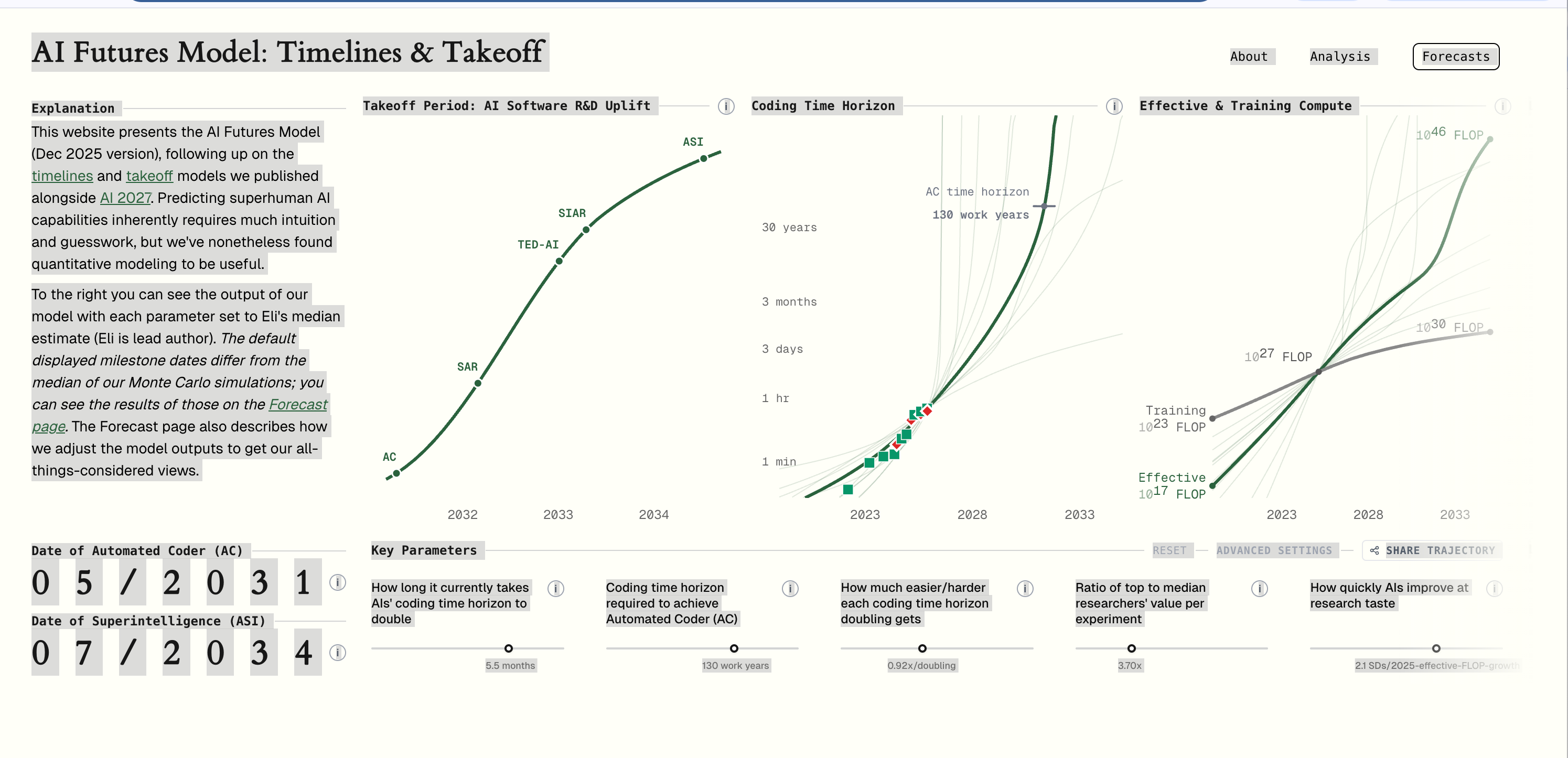
These aren’t science fiction scenarios. The model’s timeline for AI progress has tracked closely with actual developments, and the capabilities we’re seeing from systems like GPT-4, Claude, and Gemini suggest we’re on this trajectory. Many even argue these projections are too conservative. AI could “solve all math” within a couple years or less, for example, which will have transformative implications across all of the sciences. We could have a much faster “hard takeoff” where AI alone improves and develops AI. If anything, “superintelligence forecasts” are turning out to be too conservative, not to aggressive.
What Superintelligence Changes
When AI can:
Retrieve and synthesize information better than any human
Write essays, reports, and arguments more persuasively than expert writers
Analyze data at scales we can’t match
Generate code, designs, and creative content on demand
Process every document, regulation, and legal precedent instantly
...what becomes distinctively human? What capabilities will citizens need when machines can handle most cognitive work?
But recognizing what capabilities matter is only half the challenge. The other half is ensuring everyone can develop them - and can survive the transition as the economic value of traditional knowledge work collapses.
When AI can write legal briefs, analyze medical scans, generate code, and produce financial reports better than most human experts, millions of knowledge workers face the same disruption that factory workers experienced when automation hit manufacturing. But this time it’s happening faster, affecting higher-education workers, and transforming the entire information economy simultaneously.
We face a dual challenge:
Support people through the transition. When your skills become economically obsolete not because you failed to learn them but because machines learned them better, you need economic security. Rent and groceries don’t pause while you retrain (assuming there is something to retrain to).
Empower people for what comes next. But economic support alone isn’t enough. People need to develop new capabilities - skills that create value and meaning in an AI-saturated world. They need to become more human, not try to become better machines.
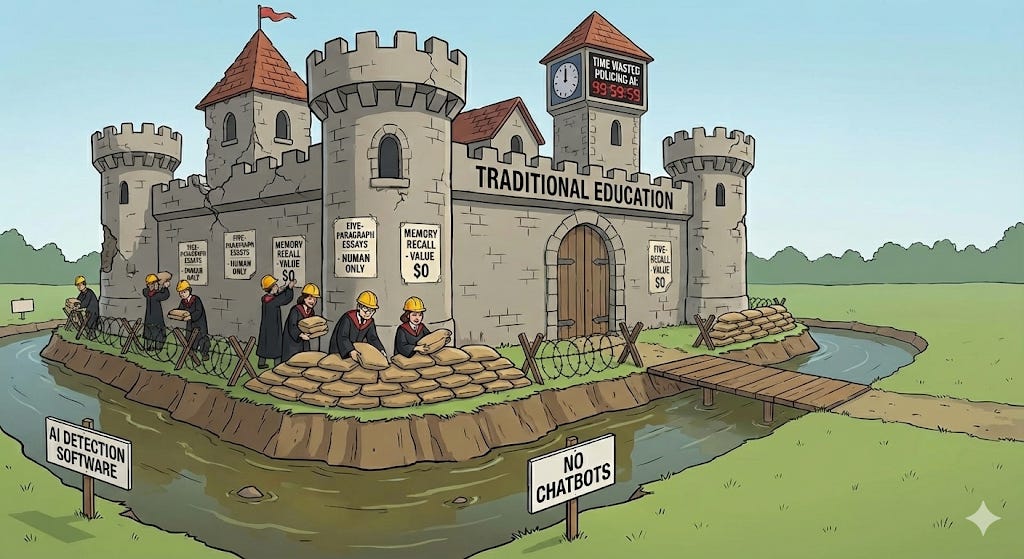
Yet much of our educational establishment remains trapped in defensive mode - obsessed with preventing “AI cheating” on essays and problem sets, implementing AI detection software, and building ever-higher walls around traditional assignments. We’re erecting moats around a castle whose tools may be completely inadequate for the era of superintelligence.
Every hour we spend policing AI use is an hour we’re not spending preparing students for a world where AI is everywhere. Every moat we dig around traditional assignments is effort diverted from building the capabilities students actually need.
We need to move beyond “how do we prevent AI cheating on current curriculum” to “how do we prepare students to thrive in a world of intelligent machines - and then superintelligent ones.”
This requires rethinking not just education, but the entire social infrastructure of the AI age. How we rebuild it will literally determine whether people live or die.
Beyond Universal Basic Income
Technologists, economists, and politicians across the political spectrum have recognized that AI-driven automation will require fundamental restructuring of our social contract. The conversation has centered primarily on Universal Basic Income (UBI) - providing all citizens with regular cash payments regardless of employment status.
UBI pilot programs have been tested in Finland, Kenya, Stockton (California), and dozens of other locations. The evidence shows promise: recipients report reduced stress, better health outcomes, and often increased entrepreneurship and education. Andrew Yang built a presidential campaign around it. Sam Altman, CEO of OpenAI, has called it essential for the AI age. Peter Diamandis, Salim Ismail, and Dr. Ben Goertzel have called for immediate action on UBI initiatives.
But UBI alone isn’t enough.
As AI researcher and former Stability AI CEO Emad Mostaque has argued in The Last Economy, we need Universal Basic Services - guaranteed access to healthcare, education, housing, compute, and other fundamental capabilities that money alone can’t ensure. Cash payments help people survive economic disruption, but they don’t automatically create the infrastructure people need to thrive and empower themselves. Alone, they are probably also not financially sustainable
Think of it this way: UBI addresses economic precarity. Universal Basic Services addresses capability precarity. And in the age of superintelligence capability development that is relevant for that era.
That’s where Universal Basic Debate comes in.
UBI ensures people can meet their material needs when employment becomes scarce.
Universal Basic Services ensures people can access healthcare, education, and infrastructure.
Universal Basic Debate ensures people develop the judgment and communication skills to participate meaningfully in an AI-mediated society and influence its development.
These aren’t competing visions - they’re complementary infrastructure for the superintelligence age. You need all three. Economic support without capability development leaves people dependent. Service access without judgment skills leaves people passive consumers rather than active citizens. And capability development without basic security means people are too stressed about survival to develop higher-order skills.
Universal Basic Debate is the educational infrastructure that completes the picture.
The Skills That Matter: Judgment and Communication
From OpenAI to Anthropic, from educational researchers to corporate leaders, we’re hearing the same refrain: the uniquely human capabilities in the AI age are judgment and communication.
Not information retrieval - AI does that better.
Not routine analysis - AI exceeds us there too.
Not even complex problem-solving in isolation - AI will match or surpass that.
What remains distinctively human:
Judgment Under Uncertainty
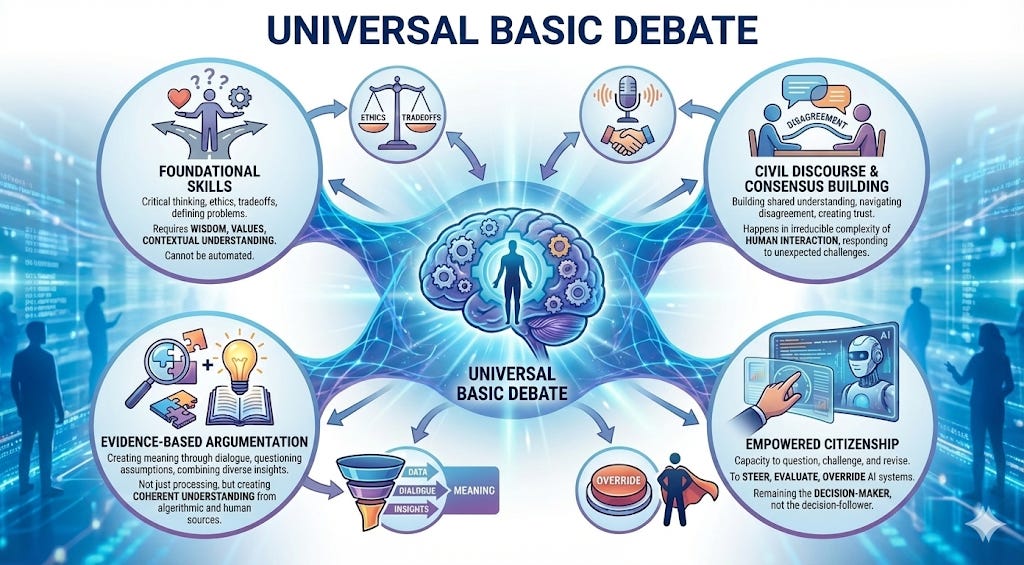
Making ethical decisions when competing values collide. Choosing between algorithmic recommendations when each has different tradeoffs. Deciding what problems are worth solving in the first place. These require wisdom, values, and contextual understanding that can’t be automated.
Real-Time Collaborative Reasoning
Building shared understanding through dialogue. Thinking on your feet in conversation. Navigating disagreement productively. Creating trust across difference. These happen in the irreducible complexity of human interaction - the back-and-forth of live dialogue where you have to respond to unexpected challenges, read social cues, adjust your approach in real-time.
Synthesis Across Perspectives
Not just processing information, but creating meaning through dialogue. Not accepting algorithmic outputs uncritically, but interrogating them, questioning assumptions, combining insights from diverse sources into coherent understanding.
Maintaining Agency
The capacity to question, challenge, and revise. To not just accept what AI systems generate, but to steer them, evaluate them, override them when appropriate. To remain the decision-maker rather than becoming the decision-follower.
These aren’t abstract philosophical ideals. They’re practical necessities. In a world where AI mediates most information work, citizens who can’t reason collaboratively, make ethical judgments, and build understanding through dialogue will be functionally illiterate - unable to participate meaningfully in democratic society.
So how do we teach these capabilities systematically?
Enter Universal Basic Debate
I’ve spent 40 years in competitive debate - as a competitor, coach, tournament director, and organizational leader. I’ve worked with students from elementary school through college, across dozens of countries, from the most under-resourced schools to the most elite programs, and supported organizations that scaled debate programs to hundreds of schools and thousands of students worldwide.
And I can tell you this with certainty: debate is the most effective educational intervention we have for developing the capacities humans need in the superintelligence age.
Not because it’s my field. Because of what it systematically teaches.
What Debate Actually Does
Debate training develops precisely the capabilities that are essential in the AI Age.
Real-Time Reasoning
Unlike essay writing where you can revise endlessly, debate requires constructing arguments, responding to objections, and rebuilding positions on the fly. You have minutes, sometimes seconds, to process new information and formulate a response. This is the cognitive flexibility required when AI generates options and you need to evaluate them in real-time.
Two-Sided Engagement
The requirement to argue both sides of complex issues - to make the best case for climate intervention and against it, for universal healthcare and against it - builds cognitive flexibility and empathy that no other pedagogy matches. You can’t retreat into ideological bubbles when you have to construct the strongest possible case for positions you initially reject.
Evidence-Based Reasoning
Debaters learn to build arguments from research, cite sources accurately, distinguish quality evidence from weak claims, and synthesize information from diverse fields. They develop healthy skepticism about all claims, including their own.
Collaborative Intelligence
In team debate, you reason together under pressure, building on each other’s ideas, covering weaknesses, combining insights. This is the distributed cognition that humans do better than any individual AI - our ability to think together.
Ethical Judgment
Engaging with pressing issues - climate policy, economic systems, technology governance, international relations - forces students to grapple with real tradeoffs, competing values, and decisions under uncertainty. Not in the abstract, but in the urgency of competition.
Maintaining Agency
Perhaps most importantly, debate teaches you to question everything. To not accept arguments at face value, to interrogate assumptions, to identify logical flaws, to demand evidence. This is the intellectual independence required to work with AI rather than being directed by it.
These aren’t soft skills or enrichment activities. They’re the core competencies of citizenship in the superintelligence age.
Why UBD Is Not Speculative
Here’s what makes Universal Basic Debate different from typical educational reform proposals: we’ve already proven it works at scale.
Debate programs have been successfully implemented in hundreds of schools across diverse contexts - rural America, under-resourced urban schools, middle-class suburbs, and schools in dozens of countries internationally. We’ve seen elementary students learn to construct arguments and middle schoolers grapple with complex policy issues. We’ve watched students transform from passive recipients of information to active, critical thinkers.
The model works. The question isn’t “can we do this?” The question is: do we have the political will to make argumentation literacy a right instead of a privilege?
The Four Pillars of Universal Basic Debate
UBD would guarantee every student, regardless of geography or family income, access to systematic debate education:
1. Argument Construction Literacy
Explicit instruction in building claims, marshaling evidence, anticipating objections, and responding in real-time. Not just “let’s have a discussion” but systematic training in the architecture of reasoning. The oral component is especially crucial - as AI handles more written tasks, spoken argumentation becomes MORE valuable, not less.
2. Two-Sided Engagement on Pressing Issues
Students debate both sides of consequential topics: climate policy, economic systems, technology governance, international relations - the issues they’ll actually need to navigate. This isn’t trivia; it’s civic infrastructure.
3. Democratized Competition
Local leagues with minimal travel requirements
Robust online tournament infrastructure (which COVID proved is viable)
Judging pools that don’t require parent volunteers (which favor affluent schools)
A tiered system: classroom debate → local → regional → national, where everyone gets the foundational experience but can opt into deeper competition.
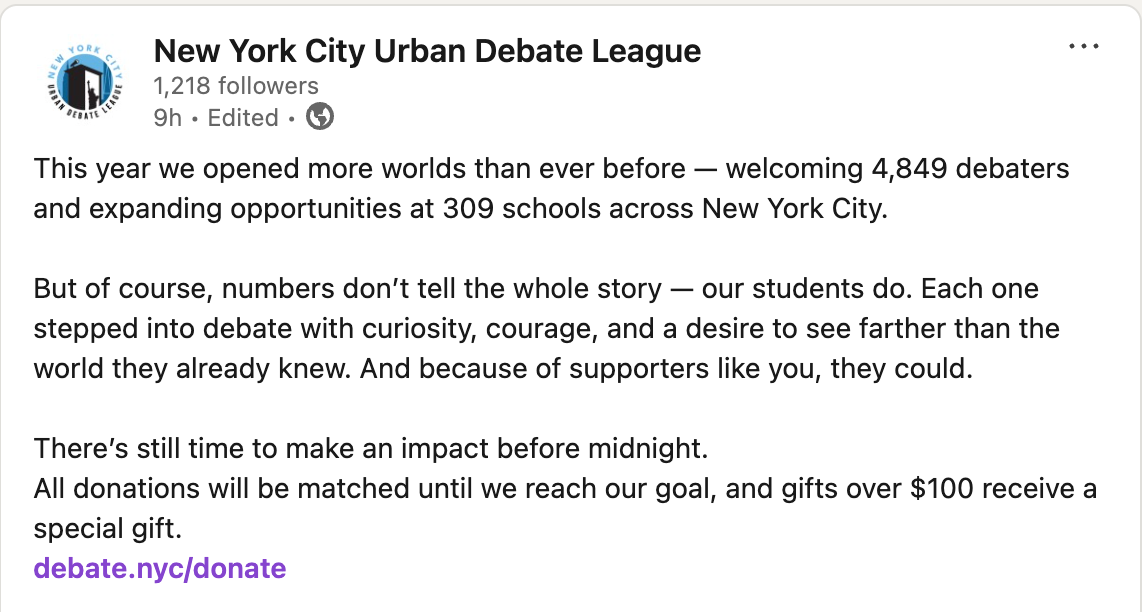
All of this as been provided by the New York City Urban Debate League, which works with some of the most economically disadvantage schools in NewYork City. As they say, if you can make it happen there, you can make it happen anywhere.
5,000 debates | 32,000 speeches | 168,000 minutes of speaking
The model works. The question isn’t “can we do this?” The question is: do we have the political will to make argumentation literacy a right instead of a privilege?
And let’s be blunt about schools that resist this.
We hear the excuses: “We don’t have time in the curriculum.” “Our teachers aren’t trained in debate.” “It’s too expensive.” “It’s not on the standardized tests.” “We tried it once and it didn’t work.”
Stop.
If judgment and communication skills are the essential human capabilities for the superintelligence age - and every serious AI researcher, economist, and educator agrees they are - then schools that “don’t have time” for systematic argumentation training need to ask themselves a fundamental question: What exactly are you making time for that’s more important than preparing students for the defining challenge of their lives?
You have time for test prep that measures skills AI performs better than humans. You have time for homework assignments that students complete with ChatGPT. You have time for lectures that students could get more effectively from AI tutors. But you don’t have time for the one pedagogy proven to develop real-time reasoning, collaborative intelligence, and ethical judgment under pressure?
And the budget objections? Please. You found $2 million for a new football stadium. You found hundreds of millions for iPads that sit in drawers. You found funding for standardized test prep materials that teach to assessments measuring obsolete skills. You found budget for textbooks that are outdated before they’re printed. You found money for the third assistant principal position and the consultant who told you to focus on “21st century information age skills” (it’s 2025, by the way).
But you can’t find funding for debate? For the educational intervention with the strongest evidence base for developing exactly the capabilities everyone agrees students need? With AI coaches that can scale instruction at minimal cost? With online tournaments that eliminate travel expenses?
You have the money. You’re choosing to spend it on everything except what matters.
Automated Coder arrives in 2031. Superintelligence in 2034. Or sooner. Today’s sixth graders will face these realities before they finish college. What are you teaching them that will help them navigate that world? What capabilities are you systematically developing in your students that will augment AI and enable them to thrive in this world?
If the answer isn’t “judgment and communication through rigorous argumentation training,” you’re not preparing students. You’re warehousing them.
The infrastructure exists. The methods are proven. The timeline is clear. Schools either adapt to develop the capabilities students actually need, or they become increasingly irrelevant to the families counting on them.
4. AI-Augmented Coaching
Here’s where it gets interesting. AI coaches can provide:
24/7 access to argument feedback and case construction help
Personalized drills on logical reasoning, evidence evaluation, speaking clarity
Practice opponents (with AI arguing both sides to expose weaknesses)
Evidence compilation and organization
But AI doesn’t replace human coaches - it augments them. Human coaches focus on strategic thinking, ethical guidance, mentorship, and the judgment calls that machines can’t make. AI handles the scalable technical instruction.
The Infrastructure Argument
When we call something “infrastructure,” we’re saying:
Everyone needs it to function in this society
Private access alone creates unjust inequality
It’s a public good that enables everything else
Underinvestment is a societal failure, not an individual choice
We recognized this with roads, water, electricity, and internet access. Now we’re recognizing it with Universal Basic Income and Universal Basic Services - ensuring everyone has economic security and access to healthcare, education, and housing.
Universal Basic Debate belongs in this same category. Just as UBI addresses economic precarity and UBS addresses service access, UBD addresses capability development - the systematic cultivation of judgment and communication skills that citizens need to participate meaningfully in AI-mediated democracy.
You can’t participate fully in AI-age civic life without the ability to:
Construct and evaluate claims
Engage opposing viewpoints in good faith
Reason collaboratively under time pressure
Make ethical judgments when algorithms offer competing options
Build shared understanding with people you disagree with
Maintain intellectual agency when surrounded by intelligent systems
That’s not enrichment. That’s not college prep for some students. That’s basic citizenship infrastructure.
Building a New Civilization
Today’s students won’t just inhabit the world of superintelligence - they’ll build it.
They’ll be the ones deciding:
How to govern AI systems that can outthink any human
How to (re)distribute the enormous wealth AI generates
How to maintain human agency and dignity when machines can do most cognitive work
How to preserve democracy when algorithms mediate most information
How to build collaborative institutions that leverage both human and artificial intelligence
How to navigate conflicts between nations with different AI governance approaches
These aren’t hypothetical questions for some future generation. The AI Futures Model shows Automated Coder in 2031 and Superintelligence in 2034. Today’s middle schoolers will face these questions before they turn 30.
We cannot send them into that future with only the literacies of the information age.
They need the capacity to reason together under pressure. To question algorithmic outputs. To build shared understanding across profound disagreement. To make ethical judgments when technical expertise can’t provide answers. To maintain their agency as decision-makers rather than becoming passive consumers of machine-generated options.
They need debate.
At this pivotal moment in human history, a remarkably small cadre of technologists and entrepreneurs are fundamentally reconstructing the foundations of civilization—rewriting the terms of economic production, social organization, and human capability itself—while capturing unprecedented concentrations of wealth and power, even as they openly acknowledge that these technologies pose existential risks and promise painful social disruption. Yet this transformation is proceeding with virtually no meaningful participation from civil society: no democratic deliberation about the future we're building, no collective examination of the social contract being rewritten by machine intelligence, no public forum for the billions whose lives will be irrevocably altered.
This is precisely why developing robust debate education becomes an existential imperative—not as an academic exercise, but as essential infrastructure for human survival itself. We need citizens equipped with the communication skills to articulate complex ideas under pressure, the judgment to weigh competing values and navigate genuinely unprecedented conditions, and above all, the intellectual courage and capacity to question everything—every assumption about human purpose, every inherited structure of work and education, every premise underlying our economic and social systems—because we are not merely reforming existing institutions but will be forced to recreate the social contract entirely in an age when machines can perform most cognitive labor. Without these capabilities distributed throughout society rather than concentrated among those building the algorithms, we face not just institutional failure but a fundamental threat to human agency and collective survival, ceding the most consequential decisions in human history to an unaccountable few who happen to control the most powerful technologies ever created.
The Infrastructure Already Exists: NSDA and the Path to Scale
Here’s what most people don’t realize: the national infrastructure for Universal Basic Debate already exists. We don’t have to build this from scratch.
The National Speech and Debate Association (NSDA) serves over 100,000 students annually across all 50 states. They’ve pioneered innovations that make scaling possible: online debate platforms that eliminate geographic barriers, judge training that doesn’t require parent volunteers, accessible formats like Public Forum and Big Questions Debate, and rapid adaptation to online competition during COVID.
The debate community has been solving equity and access problems for decades. The infrastructure, expertise, innovation, and track record exist.
Now it’s time for NSDA and the broader debate community to embrace a bigger mission: making Universal Basic Debate part of the Universal Basic Services framework.
This means explicitly positioning debate education alongside UBI and UBS in policy conversations. It means formally endorsing Universal Basic Debate and committing to develop scalable curriculum frameworks, AI-augmented coaching tools, and platforms that eliminate barriers. It means partnering with education reformers, AI researchers, and policymakers to establish argumentation literacy as essential infrastructure.
The competitive debate community has always punched above its weight - a small subset of students developing capabilities that transform their lives. The question is: what if those capabilities weren’t limited to students whose schools offer debate teams?
Debate alumni hold some of the highest positions in business, law, and politics. Supreme Court justices. Fortune 500 CEOs. U.S. Senators and Representatives. Presidential candidates. Tech industry leaders. Award-winning journalists. Leading academics. The list is extraordinary.
They didn’t succeed despite doing debate - they succeeded in large part because of it. The skills debate taught them - constructing arguments under pressure, synthesizing complex information, reasoning collaboratively, maintaining intellectual integrity, communicating persuasively - turned out to be exactly what leadership required.
Many of these leaders credit debate as foundational to their success. They talk about how it taught them to think, to speak, to lead. How it gave them confidence and analytical skills that opened doors throughout their careers.
Now those leaders face a moral reckoning.
You benefited from debate education. It shaped who you became. It gave you advantages that propelled your career. You know firsthand that debate develops the exact capabilities - judgment, communication, collaborative reasoning - that everyone agrees are essential for the AI age.
So what are you doing to ensure the next generation has access to what you had?
If you’re a CEO, are you advocating for UBD as part of corporate social responsibility and workforce preparation? If you’re in government, are you pushing for debate education as essential infrastructure alongside UBI and UBS? If you’re a tech leader, are you developing the AI coaching tools that make UBD scalable? If you’re a judge or lawyer, are you championing civic education that develops the reasoning skills democracy requires?
The debate community - both current practitioners and successful alumni - should be leading the charge for UBD, not waiting for permission from educational bureaucracies that don’t understand what’s coming. We know what students need. We know how to develop it. We’ve proven the model works.
Will we think big enough to match the moment?
The debate community should be leading the charge for UBD, not waiting for permission from educational bureaucracies that don’t understand what’s coming. We know what students need. We know how to develop it. We’ve proven the model works.
Will we think big enough to match the moment?
From Three R’s to Four Literacies
Just as we said in 1900: “Industrial citizens need science, not just reading, writing, and arithmetic.”
We now say in 2025: “AI-era citizens need debate, not just media literacy”
Reading, writing, arithmetic - and argumentation.
The fourth literacy for the fourth revolution.
We’re already building the economic and service infrastructure for the superintelligence age through Universal Basic Income and Universal Basic Services. These recognize that AI disruption requires guaranteed economic security and service access.
But we also need capability infrastructure. Universal Basic Debate is how we ensure that every student - not just those whose parents can afford tournament travel and private coaches - develops the judgment and communication capacities required for citizenship in the age of superintelligence.
Together, these three pillars create the foundation for human flourishing when machines can do most cognitive work:
UBI: Economic security when employment becomes scarce
UBS: Access to healthcare, education, housing, and essential services
UBD: Development of distinctively human capabilities - judgment, communication, collaborative reasoning
It’s how we prepare students not just to survive the AI revolution, but to lead it.
The infrastructure is proven. The need is urgent. The timeline is clear.
The only question is whether we have the wisdom to act before the superintelligence arrives and today’s students become tomorrow’s leaders without the tools they need.
Because they won’t just inherit civilization. They’ll have to rebuild it.
And we owe them the skills to do that well.
PS It occurred to me while writing this that if 75% of active debaters are NSDA members and NYCUDL has close to 5% students, the NYCUDL alone has approximately 3.5% of the nation’s debaters. The NYCUDL overwhelmingly operates in the most socioeconomically challenged schools in NYC. If they can do it, why can’t you?”
An inspiring post. This is something I would like to pursue further for 2026-2027, a post-retirement' project. How do I pick your brain or begin to think of next steps?