
The Case for Building Data Centers in Your Community

Stefan-Bauschard | GlobalAI Debates
I have something of a reputation as a provocateur. I’ll write a take partly because I think the conventional wisdom deserves a stress test, that too many humans have become stochastic parrots, or just because I think a new industrial era requires a new way of thinking. Simply adding AI to our current socioeconomic system is not what is unfolding.
This is not one of those takes.
I am writing this one straight, even though I realize it will not get a lot of support, as most Americans oppose data centers.
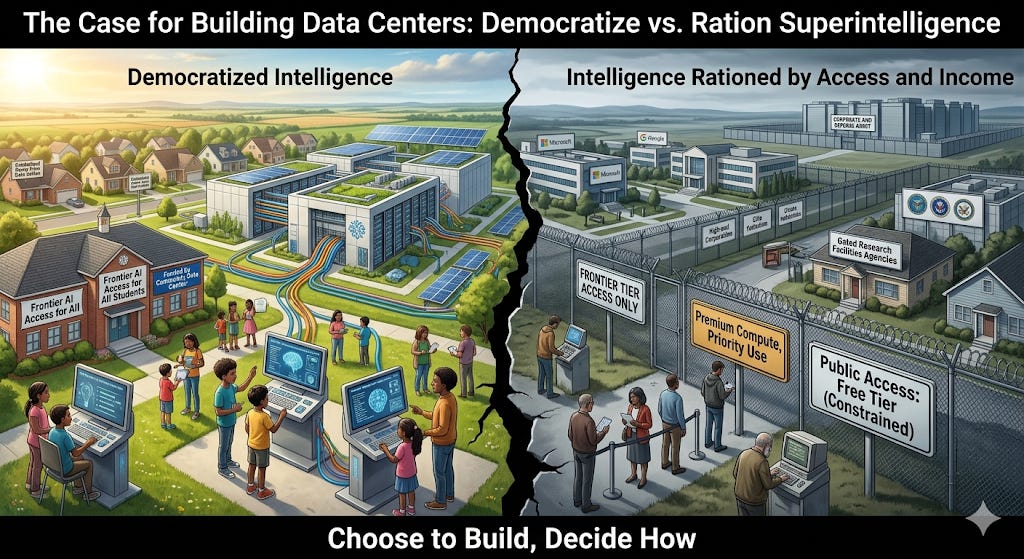
That said, the growing movement to slow, block, or impose a moratorium on data center construction, while with good intentions and reflective of important concerns, is one of the most quietly damaging policy positions in American life right now — and the people advancing it are about to support the rationing of superintelligence itself to the Pentagon and the largest companies on Earth. Block the buildout and you don’t stop superintelligence from arriving. You just guarantee it arrives wearing a uniform or a corporate logo, with no third tier of academic, civic, or public infrastructure for everyone else.
Let me explain.
The fantasy of stopping AI
Before we go further: nobody is going to stop AI.
A lot of the policy conversation right now is conducted as if there is some version of the next ten years where the data centers don’t get built, and the models don’t get trained. There isn’t. The geopolitical incentives, the capital flows, and the national security logic all point forward.
If your county turns down a project, it goes to the next county. If your state turns it down, it goes to the next state. If county and state deployment slows down, the centers get built on federal lands, in the Gulf, in Asia, and — within a decade — in orbit. Microsoft has already prototyped subsea data centers. SpaceX is openly designing for compute in space. The Pentagon is not going to wait on a county zoning board.
The question on the table is not whether the largest AI systems in human history get built. They are getting built. The only live questions are where, for whom, and whether we build enough to benefit everyone.
A moratorium does not stop AI. It decides which communities get the tax base, which get the jobs, which get the leverage — and if all citizens get cheap, abundant access to the resulting superintelligence.
What happens when you restrict compute
Compute is the new electricity. That isn’t a metaphor anymore; it is an operating fact of the economy.
Restrict data center construction and two things happen, both predictable. First, compute becomes scarce — and scarce compute does not flow to the people who need it most. It flows to the people who can pay the most: the Department of Defense, the major cloud hyperscalers, the largest financial institutions on the planet. The middle of the economy — the small business, the independent researcher, the regional hospital, the school district, the solo developer trying to build something — gets crowded out. Not because they don’t have good ideas. Because they can’t outbid Lockheed.
Second, the compute that remains gets more expensive. Restrictions raise the price. They always do. The hyperscalers absorb it. Everyone else doesn’t.
If you imagine the most concentrated, most corporate, least democratic possible future for AI — that is what restricting data centers produces. Not the opposite.
The coal analogy
Imagine that in 1925 — worried about coal pollution, and rightly so — we had decided to limit power plant construction until cleaner alternatives matured. No new coal plants. Strict caps on the ones we had. Wait for nuclear. Wait for renewables.
Would electricity have stopped? No. It would have been rationed. The wealthy and the well-connected would have gotten it. Firms big enough to build their own generation on-site would have gotten it. Rural electrification — the single most economically equalizing infrastructure project of the 20th century — would not have happened. The middle class would not have been built.
The pollution argument was real. The answer was not to restrict the infrastructure. The answer was to clean it up while building it.
I am asking us to remember that lesson.
Intelligence rationing
Here is where the stakes get higher than electricity, which is saying something.
The education system is already a scarcity machine. There are only so many seats at Stanford and only so many at Exeter, and we have built an entire social hierarchy around the competition for them — because getting one confers a lifetime advantage. We have made our peace with rationing prestige.
Now compound that with AI.
The richest universities and the most expensive private schools can pair entrepreneurship programs with access to the most capable frontier models. Their students will graduate having spent four years working alongside something close to a personal genius. Everyone else will graduate having spent four years working alongside whatever the free tier happened to allow that week when it wasn’t compute-constrained.
The alternative to building data centers is building intelligence rationing. It will look exactly like medical rationing looks today. The people with means get the good version. The people without means get the version that’s “good enough.” Outcomes diverge. Mobility collapses. The story we tell ourselves about merit gets even thinner than it already is.
Dario Amodei talks about putting “a country of geniuses in a data center.” Fine. I’ll take him at his word. The question is: who gets to talk to the geniuses?
If we build enough compute, the answer is everyone. A nurse in rural Ohio. A teacher in West Texas. A high school senior who has never met anyone who went to college. A small business owner in Detroit. Compute empowers.
AI will be able to do 80% of all jobs by 2030. The good news is that AI will also be available to the everyday person who has an idea to start something of their own. Coding, customer service, marketing, and design are no longer blockers. This means millions of new entrepreneurs will be born. What I see is massive wealth creation opportunities. — Vinod Khosla
If we don’t build enough compute, the answer is the people who can afford it. And we will have engineered, with our own good intentions, the most stratified society in modern American history.
AI tokens will be strategically and economically central to all future societies, so we should do our best to enable their free flow. If we fail, we’ll bear costs, economic and geopolitical…In the past, when the fruits of industrial revolutions were unevenly distributed, the resulting shifts in relative wealth, security and power have prompted mass migration, reopened dormant conflicts, and destabilised democracies…(W)e should simply build a lot of datacenters to alleviate the coming compute crunch – Aaron Leicht
Stop fighting the centers. Start negotiating the terms.
If you accept the premise of this essay — that the data centers are getting built somewhere regardless of what your county does — then the leverage local communities have is not the leverage to prevent construction. It is the leverage to shape it. To decide, while there is still time to decide, what a host community gets in return.
That leverage is enormous. We should use it.
A tax base you cannot move. A data center is one of the few pieces of physical capital in the modern economy that cannot be relocated when the tax rate changes. You can move a factory. You cannot meaningfully move a 200-megawatt facility with billions of dollars of fiber, substations, and cooling infrastructure sunk into the ground. That makes data centers an unusually durable tax base — and we are going to need one. Nobody, including the people building these systems, actually knows what AI will do to employment. If the disruption is severe, communities will need a way to fund the response. Whether that response looks like a partial UBI, expanded community services, retraining, or something we haven’t named yet, you cannot fund it without a tax base. Lock it in now.
Commitments to schools and community. Make the deal include a real commitment to fund the local schools — not just generally, but specifically, including frontier AI access for every student in the district that hosts the facility. If the company is going to draw on your power grid, your water table, and your zoning code, your kids should be the first in the country to use what it makes.
Power they generate, prices the community pays. Data centers are among the largest power purchasers in America, which means they have an interest in building generation and the capital to do it at scale. Make them. And then make a piece of that generation flow back to the host community at subsidized rates — or, in the most ambitious version, free residential electricity within a defined radius. That isn’t radical. It is the same logic the railroads operated on a century ago and the rural electrification co-ops a generation after that. If we are going to live next to the largest energy consumers in the country, we should also live next to the lowest electricity bills.
Environmental terms that actually bind. Water, cooling, emissions, noise, heat island effects. Negotiate them. Inspect them. Penalize violations. None of this is the same as banning construction. It is the price of doing business, and a serious community can demand a serious price.
The point is to turn the data center buildout from a zero-sum fight — they win, the community loses — into a positive-sum deal. Compute gets built. The community gets a tax base, a power deal, a school commitment, and environmental guardrails. The country gets to remain the place where the future is built.
The world we could choose
For the first time in human history, we are within reach of ending the scarcities that have defined modern life. Not luxury scarcity. Human scarcity. The scarcity of a good doctor. A patient tutor. A competent lawyer. A mentor for a kid who has never had one.
These have been scarce forever — not because the knowledge didn’t exist, but because the humans who held it could only be in one place at a time. Expertise has always been bottlenecked by the carrying capacity of a single human life.
AI breaks that bottleneck. A country of geniuses in a data center is also a country of the best doctors. A country of 1:1 tutors. A country of advocates for everyone who has never had one.
And here is what we have to be honest about: we already ration all of this. Health care and legal help are rationed by income and zip code. Education is rationed by property tax base. Mental health care is rationed so severely it functions, for most Americans, as something that doesn’t exist.
We made our peace with it because there was no alternative. You cannot manufacture more cardiologists overnight. The scarcity felt like physics.
It isn’t physics anymore. It’s a choice.
Build the compute, and the scarcity breaks — directionally, durably, the way electricity broke the scarcity of light. Don’t build it, and the scarcity holds. Worse, it compounds. Because now there will be a cardiologist, a tutor, an advocate in the machine. The best versions just won’t be available to everyone. They will be available to whoever can pay for the frontier tier while everyone else gets whatever the free tier happened to allow that week.
The rationing we have lived with for centuries gets replaced by a rationing that is faster, sharper, and more consequential — because the gap between the frontier model and the free tier will be larger than the gap between Harvard and another college, and it will compound every year.
That is the choice on the table. Not whether to ration intelligence. We already ration intelligence. The choice is whether to use this strange, narrow, once-in-a-civilization moment to end the rationing — or to lock it in for another century with better technology and worse equity.
Moratoriums on data centers are a vote to lock it in. For a world where superintelligence exists but most people can’t afford to talk to it. For a world that looks a lot like the one we have now — stratified by access, sorted by zip code, defended by people who already got theirs — except more consequential, because the thing being rationed is no longer prestige or comfort but cognition itself.
Robert Brooks, May 16, 2026 Lambda (Datacenter) Chief Commercial Officer, The myth of interchangeable AI compute, https://archive.thedeepview.com/p/the-myth-of-interchangeable-ai-compute
Brooks: Take the word “computer.” Today, it means a box. It used to mean a human job. “Intelligence” is similarly abstract. Most of us just picture really smart people. Put “super” in front of it, and the goal is to create a tool that goes beyond what any human has done in every domain, all at once. Edison was not necessarily smart in domains he never touched, [for example]. Combine human intelligence with that tool, and you get drug discovery, safer transportation, [and] faster movement through the economy. The mission for Lambda is to democratize that: superintelligence for all, not something locked inside one lab.
We have done better than moratoriums before. Rural electrification did better. The interstate system did better. The public library did better. Each was a fight. Each was won by people who understood that infrastructure is destiny and that you cannot democratize what you refuse to build.
Build the data centers. Tax them hard. Make them fund the schools and lower the electric bills. But build them. Everywhere. Fast.
Because the alternative isn’t a world without superintelligence.
The alternative is a world where superintelligence exists, and your neighbor’s kid can’t reach it.
We have spent a century rationing the things that matter most. We finally have a chance to stop.
Let’s not waste it building a wall around the cure.