
Students Debate Lethal Autonomous Weapons and Other AI Issues
Debate is the best way to promote Cognitive Acceleration and AI literacy

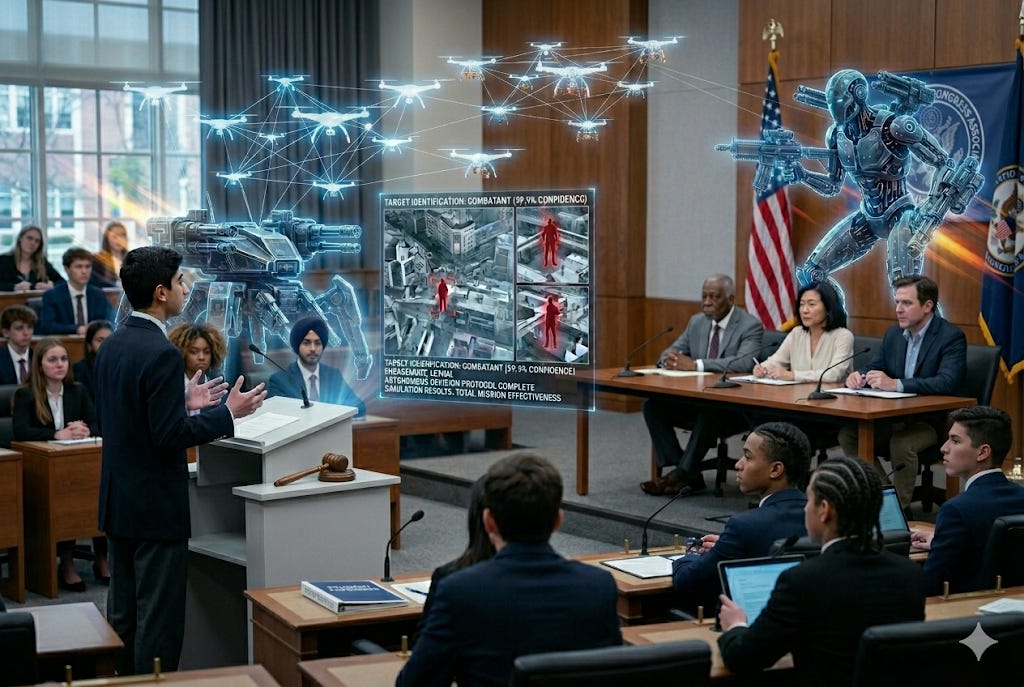
At this year’s US National Speech & Debate tournament, students participating in Congressional Debate will debate many bills and resolutions that are centered on underlying issues related to artificial intelligence.
These bills include items related to lethal autonomous weapons, facial recognition technology, generative AI in education, regulating the commercial use of generative AI, data center regulation, and strengthening domestic semiconductor supply chains.
In this post, I discuss the background of a bill — lethal autonomous weapons legislation — the pro and con arguments, and provide some advice for students who will be debating it. I hope it both gives you an overview of the complexity of the debate and also demonstrates how much “cognitive acceleration” (I made up this term) debate requires.
Cognitive Acceleration
Student classroom debate over issues you are teaching is a great way to promote learning. Students need to research and prepare arguments about the issue you are teaching them. They have to articulate their arguments orally and defend them across a debate, eliminating the ability of AI to simply do their work. They also develop essential skills in argumentation, collaboration, and communication. They can also learn how hard it is to write legislation (terms, workability, etc). [The legislation students debate at tournaments is sample legislation written by the student participants.]
If you choose AI topics, this is a great way to promote student knowledge of AI without non-stop debates about what “AI literacy” and “AI fluency” mean, whether it should be taught in schools, who should teach it, how it should be taught, what it should displace, etc. The never-ending debates that aren’t doing anything for students. See GlobalAI Debates.
A Congressional debate-style format also allows a class of 12-24 students to participate.
Now, let’s analyze a bill the way a debater would.
Part I — The Policy Debate
Background: how the U.S. arrived at this debate
The U.S. policy story is one of building autonomy faster while debating whether to restrain it. The governing document, Department of Defense Directive 3000.09, was the world’s first national policy on autonomous weapons when it was issued in 2012, and it was updated in January 2023.
It never banned anything — it created a review process and required “appropriate levels of human judgment over the use of force” (CRS). Michael Horowitz, a college National Debate Tournament (NDT) champion, who helped write the update, says in War on the Rocks that the 2023 revision was prompted partly by the Russia-Ukraine war demonstrating both the utility of AI-enabled weapons and their necessity, since electronic warfare jams remotely-piloted systems. Alongside the directive, the State Department issued a 2023 Political Declaration on Responsible Military Use of AI and Autonomy, and Congress layered on reporting requirements — the FY2025 NDAA already mandates an annual report on LAWS approval and deployment through December 2029 (CRS).
The money tells the direction of travel. The Brennan Center’s March 2026 explainer, “The Military’s Use of AI,” documents at least $75 billion in DoD AI spending since 2016 and $13.4 billion requested for autonomous systems in FY2026 alone, and the FY2027 budget reportedly proposes a steep further increase for autonomous warfare (Cipher Brief). In July 2025, the Pentagon signed deals with four frontier-AI companies — Anthropic, OpenAI, xAI, and Google — to develop military applications of their foundation models (Brennan Center). The U.S. is not drifting toward a ban; it is institutionalizing autonomy across its forces. That is the backdrop against which any prohibition would land.
The Pentagon-Anthropic dispute
The clearest sign that this debate has moved from the abstract to the concrete is the rupture between the Department of War and Anthropic, the maker of the Claude AI model. The dispute is worth understanding in detail because it is a live test of the exact question a ban turns on: who decides whether a fully autonomous weapon gets built and used.
According to the Brennan Center, Anthropic asked the military to promise it would not use Claude in weapons that identify and fire on targets without human input — fully autonomous weapons — or to conduct mass domestic surveillance of Americans by analyzing location records, financial information, and other large datasets. The request reportedly followed the military’s use of Claude in its January operation against Venezuela and the capture of Nicolás Maduro, and Claude had been integrated into the Maven Smart System used for targeting analysis (Brennan Center). The Pentagon refused the conditions and, in a statement from CEO Dario Amodei dated March 5, 2026, Anthropic confirmed it had been designated a “supply chain risk” to national security under the procurement statute it cites as 10 USC 3252. Anthropic is challenging the designation in court as not legally sound, argues the designation is narrow in scope, and frames its position as only two exceptions — fully autonomous weapons and mass domestic surveillance — while explicitly stating it does not believe a private company should be involved in military operational decision-making. Anthropic also said it would continue providing its models to the Department at nominal cost during any transition.
For this debate, the dispute matters in three ways.
First, it shows the human-judgment line is already contested at the contracting layer inside the United States, not only in Geneva — the fight is here and now.
Second, it puts a concrete definitional question on the table: Anthropic’s “fully autonomous weapons” exception is the same out-of-the-loop category any U.S. ban would target, so the dispute previews exactly the line-drawing problem a statute would face.
Third, it reframes the policy choice as one about who sets the limit — Congress by statute, the executive by directive, or vendors by contract. The Pentagon’s response suggests it views vendor-imposed restrictions on autonomous-weapons use as an intrusion on military prerogatives; Anthropic’s position is that it should not be compelled to enable either fully autonomous targeting or mass surveillance. Both framings are usable depending on which side of the ban you argue, and the episode is recent enough that you should pull the current status of the litigation before relying on it.
What’s actually being debated
Most arguments about banning lethal autonomous weapons fail before they start because the two sides aren’t debating the same object. “Ban LAWS” can mean any of three very different things: a total prohibition on any weapon that selects and engages without a human; a narrow ban on systems that target people or operate fully out of the loop; or a ban only on offensive autonomy while preserving defensive systems. The strength of every pro and con below depends on which of these is on the table.
The technical baseline matters too. Autonomy runs on a spectrum the field describes as human-in-the-loop (a person authorizes each engagement), human-on-the-loop (the system engages under human supervision with an override), and human-out-of-the-loop (no human authorization, supervision, or intervention). The Congressional Research Service defines a lethal autonomous weapon as one that, once activated, “can select and engage targets without further intervention by a human operator” — the out-of-the-loop category — and states there is no agreed international definition. That absence is not a footnote; it is the central practical obstacle to any ban, and I’ll come back to it.
Current U.S. policy bans none of this. Department of Defense Directive 3000.09 governs autonomy through a review process and requires “appropriate levels of human judgment over the use of force” — not a human in the loop. Michael Horowitz, who helped rewrite the 2023 directive, argues in War on the Rocks that the phrase “human in the loop” appears nowhere in it, that no category of weapon is prohibited, and that R&D isn’t regulated at all. So the U.S. debate is about whether to adopt a ban, not whether to keep one.
The global landscape
The international picture pulls two directions at once. Rhetorically, momentum runs toward prohibition: the UN General Assembly adopted Resolution 80/57 on December 1, 2025, reaffirming that any weapon that cannot be used in compliance with international humanitarian law must not be used, and Human Rights Watch reports more than 120 countries back treaty negotiations, with 96 states attending the first General Assembly meeting devoted to the issue in May 2025. The favored framework is the “two-tier” approach laid out by Austria’s Alexander Kmentt in Arms Control Today: prohibit systems that can’t comply with IHL, regulate the rest.
Operationally, the picture is the opposite. The Convention on Certain Conventional Weapons runs on consensus, and a handful of major powers — the U.S., Russia, India, and Israel — have used that rule to block a binding instrument for a decade (Kmentt). And the battlefield has lapped the diplomacy: the Cipher Brief’s reporting from Ukraine shows drones accounted for more than 80 percent of enemy targets destroyed by late 2025, with the defense ministry stating the goal is to remove human operators from the battlefield entirely. The norm is being written in Geneva and overwritten in Donbas at the same time.
The case for a U.S. ban
The pro-ban case is strongest on accountability and weakest on enforceability. Run through the arguments in order of durability.
The first is the responsibility gap. International humanitarian law assumes a human agent who can be held responsible for a killing; a machine that selects and engages dissolves that agent. Jie Guo’s 2025 analysis in Ethics & Global Politics frames it through the philosopher Robert Sparrow: when an autonomous system commits what looks like a war crime, the programmer couldn’t foresee it, the operator didn’t control it, the commander cites technical complexity — so the violation is “procedurally unavoidable yet legally unpunishable.” Mary Ellen O’Connell’s 2023 essay for Ethics & International Affairs argues this makes the systems unlawful under existing law, ban or no ban.
The second is the black box. Because a learning system’s decisions can’t be predicted by its own designers, you cannot know at deployment whether it will comply with the law of war or the right to life (O’Connell). This isn’t a tuning problem; it’s structural, and it means a system certified as compliant on Monday may not be on Tuesday after it ingests new data.
The third is human dignity and meaningful human control — the frame the UN Secretary-General, the ICRC, and a large bloc of states have organized around. Even a perfectly accurate machine offends the principle that a person should decide to take a life — what O’Connell calls the problem of “mechanized killing,” and what the Vatican’s representative (cited in O’Connell) frames as decisions over life and death requiring compassion and insight no machine possesses. Berkeley’s Stuart Russell, who has made this case for a decade, draws the categorical line precisely: lethal autonomous systems “locate, select, and engage targets without human intervention,” unlike cruise missiles or remotely-piloted drones for which humans make all targeting decisions, which is why he calls them a third revolution in warfare after gunpowder and nuclear arms. The point isn’t that AI is bad; it’s that removing the human moral agent from the kill decision entirely — not merely distancing them, as a drone does — crosses a line earlier weapons didn’t. This is the argument that survives even if every technical objection is solved.
The fourth is that IHL’s core rules can’t be coded. Distinction and proportionality are interpretive judgments — weighing a tactical advantage against a destroyed school — not arithmetic. Guo (2025) reports that computer-vision systems for combatant identification achieve only 70–85 percent accuracy in cluttered environments, and the Brennan Center notes Project Maven’s algorithms correctly identified a tank about 60 percent of the time in good weather and 30 percent in snow (The Military’s Use of AI). Encoding proportionality, Guo argues, flattens moral complexity into programmable metrics.
The fifth is escalation. Machine-speed engagement compresses the decision loop below human reaction time and invites “flash war.” Guo (2025) cites wargaming showing autonomous interactions increase unintended-conflict initiation by 40–60 percent. The high-end version is nuclear: Lt. Gen. Jack Shanahan’s September 2025 Arms Control Today piece warns that AI bleeding into the sensors and decision-support systems around nuclear command — not on the launch button — creates automation bias and cascading errors that could distort a nuclear decision.
The sixth is proliferation. Autonomy is cheap and retrofittable. The Geneva Academy’s 2025 brief warns that many existing weapons can be retrofitted with autonomy and that low-end autonomous systems are far more attainable than sophisticated compliant ones, with some software already freely available. Resolution 80/57 names proliferation “to unauthorized recipients and non-State actors” as a core concern.
The seventh is bias and civilian risk, which doubles as a domestic-rights argument. Human Rights Watch’s April 2025 report “A Hazard to Human Rights“ argues these systems will migrate into policing and border control, where target profiles risk “digital dehumanization” and disproportionately harm communities of color. The Brennan Center adds that military AI used for surveillance can flag protected characteristics as security threats, raising First and Fourth Amendment problems when turned on Americans.
The eighth is automation bias and deskilling. Both Shanahan and Guo identify the tendency to over-trust machine output under time pressure — the dynamic behind the USS Vincennes shootdown of Iran Air 655 (Guo 2025) — which means even a human “in the loop” may rubber-stamp recommendations they can’t meaningfully evaluate. Over time, commanders lose the practical judgment the law assumes they have.
The ninth is the first-mover norm. Norms in weapons systems get set by the leading military power, so if the U.S. fields autonomous targeting, others follow — first peer competitors, then mid-sized powers, then non-state actors. The drone analogy is the precedent: the U.S. began weaponizing drones around 2001 in near-exclusivity, and by the 2020s New America’s database tracks more than ten countries that have conducted drone strikes and over three dozen with armed drones, while CNAS counts more than 30 nations with armed-drone programs and 90-plus with unarmed drones. The cat doesn’t go back in the bag. Advocates argue a unilateral ban creates the political space for treaty negotiation, while refusing to ban kills the treaty — and that the U.S., having helped draft the Geneva Conventions and the UN Charter, is the country whose restraint actually moves the norm.
The case against a U.S. ban
The anti-ban case is strongest on reciprocity and feasibility and weakest on ethics. Same ordering.
The first is unilateral disarmament. A U.S. statute binds only the United States and is unverifiable against the actors the U.S. fears most. The CRS line is the realist core: the U.S. “may be compelled to develop the systems if U.S. competitors choose to do so.” The Lieber Institute (March 2026) judges a binding international instrument “slim to none” given great-power opposition — meaning a U.S. ban likely buys no reciprocal restraint at all. This also exposes a tension in the advocates’ first-mover frame: the proliferation that frame fears has arguably already begun without U.S. leadership — China’s pursuit of autonomy under its “intelligentized warfare” doctrine, Russia’s loitering munitions in Ukraine, and UN monitors’ account of a Turkish Kargu-2 possibly making the first autonomous engagement of human targets in Libya (cited in Guo 2025). If the norm is already breaking without the U.S. setting it, then unilateral abstention forfeits the capability without buying the norm-setting benefit — advocates can’t simultaneously claim the U.S. sets the norm and that adversaries are already racing ahead of it.
The second is military necessity, and it’s empirical now. The reason autonomy matters is that electronic warfare jams the human link: Horowitz notes the 2023 directive update was driven partly by Ukraine demonstrating that remotely-piloted systems get cut off, so autonomy becomes the only way to operate in a communications-denied environment. The CRS adds that LAWS are valued precisely for “communications-degraded or -denied environments.” In an Indo-Pacific fight against a peer adversary, a human-in-the-loop mandate can mean ineffective forces.
The third is that the technology is already decisive, not speculative. The Cipher Brief’s Ukraine reporting — 80 percent of kills by drone, units at 30–60 percent strength, robot positions held for 45 straight days — frames autonomy as a manpower necessity, and even argues that insisting on human-in-the-loop can be less ethical when it means slower casualty evacuation and more dead operators.
The fourth is that a ban sweeps in defensive systems the U.S. already depends on. Per Horowitz, the Phalanx Close-In Weapon System has been deployed since 1980, switches to an automatic mode that engages incoming threats faster than a human can, and was used in the Red Sea against Houthi missiles. Scientific American lists Iron Dome, Phalanx, and the German NBS Mantis as already-deployed defensive autonomy, and Paul Scharre has noted at least 30 countries field automated defensive systems including Aegis and Patriot. A clean ban on “select and engage without human intervention” pulls all of them in. There’s a deeper irony here that opponents can press: the moral premise of the ban is that the wrong lies in the absent human — but point defense against a supersonic missile is precisely the case where human reaction is physically impossible and the moral stakes of automation are lowest. The principle that drives the ban argues hardest for exempting exactly the systems a blanket ban catches, so the principle and a total prohibition point in opposite directions.
The fifth is speed against saturation. Defensive autonomy exists because incoming missile and drone salvos arrive faster than a human can authorize each intercept; Ukraine’s Octopus interceptor (Cipher Brief) destroys incoming drones without per-shot human approval. Requiring human approval of every intercept in a saturation attack, the argument runs, gets more people killed, not fewer.
The sixth is the precision claim. The U.S. government’s position, summarized in the CRS primer, is that automated targeting “can allow weapons to strike military objectives more accurately and with less risk of collateral damage.” If that’s even partly true, a blanket ban could increase civilian harm — turning the humanitarian argument against the ban.
The seventh is the capability gap and deterrence. Russia and China are investing heavily, and the FY2027 budget reportedly proposes $54.6 billion for autonomous warfare and a jump for the Defense Autonomous Warfare Group from roughly $225 million to tens of billions (Cipher Brief). Freezing U.S. development while adversaries accelerate, opponents argue, weakens deterrence rather than strengthening norms.
The eighth is industrial and economic. The Brennan Center documents that Palantir and Anduril recorded their largest-ever defense revenue in 2025 — $903 million and $912 million respectively — and that the Pentagon has signed foundation-model deals with Anthropic, OpenAI, xAI, and Google. A ban disrupts a defense-industrial base now organized around autonomy, with the Pentagon-Anthropic blacklist dispute showing how contested the terrain already is.
The ninth is that the definition makes a ban unworkable — which is really a practicality argument, so it gets its own section.
The practicality question
This is where the debate is actually decided, and where both the bumper-sticker pro and the bumper-sticker con tend to collapse. Five problems, in order of severity.
The first is definitional. “Without human intervention” sounds crisp but isn’t. The CRS says there is no agreed definition; Horowitz argues DoD deliberately abandoned “in/on/out of the loop” language because it falsely implies continuous tactical oversight that even conventional precision weapons lack. A fire-and-forget missile already engages a human-designated target autonomously. Where, exactly, is the line between that and a banned system? A ban built on an undefined phrase invites years of definitional litigation and gives adversaries — and contractors — room to reclassify around it.
The second is the offense/defense line, which is the definitional problem in its most acute form. IEEE Spectrum argues that “offensive,” “autonomous weapon,” and “meaningful human control” all lack common definitions, that it’s hard to separate offensive from defensive weapons, and that autonomy has been used in offensive weapons for decades. Any ban that wants to preserve Phalanx and Aegis has to draw the offense/defense line the entire literature says can’t be drawn cleanly — and the same target-recognition autonomy powers an offensive strike drone and a defensive interceptor alike.
The third is verification and enforcement. A domestic U.S. statute is enforceable against the United States but invisible against adversaries, and the CCW’s decade of consensus-blocked failure (Kmentt) shows how hard multilateral verification is. Autonomy has no observable signature the way a missile silo does — the difference between a compliant and a prohibited system is often a software setting. So a ban that isn’t multilateral and verifiable is a ban that constrains only the side willing to be constrained.
The fourth is “control in name only.” Even a ban that mandates a human in the loop may not deliver real control. The Cipher Brief’s central finding is that human oversight can be “preserved in name” while the conditions that make it meaningful — time, attention, comprehensible volume — have eroded: Ukraine’s Avengers platform surfaces up to 12,000 targets a week, and exhausted analysts “rubber-stamp” recommendations they can’t re-evaluate. A statute that requires a human signature without addressing cognitive overload buys the appearance of accountability, not the substance — which means a poorly designed ban can fail on its own terms.
The fifth is dual-use and retrofit. The Geneva Academy brief notes that autonomy is largely a software layer on top of existing hardware, with some of the underlying software freely available. You cannot ban a capability the way you ban a chemical agent when the capability is code that can be added to a commercial drone. This is also why the funding logic in most ban proposals — redirect “offensive autonomy” money to “defensive AI” — tends to be incoherent: the two run on the same stack.
The bill on the table
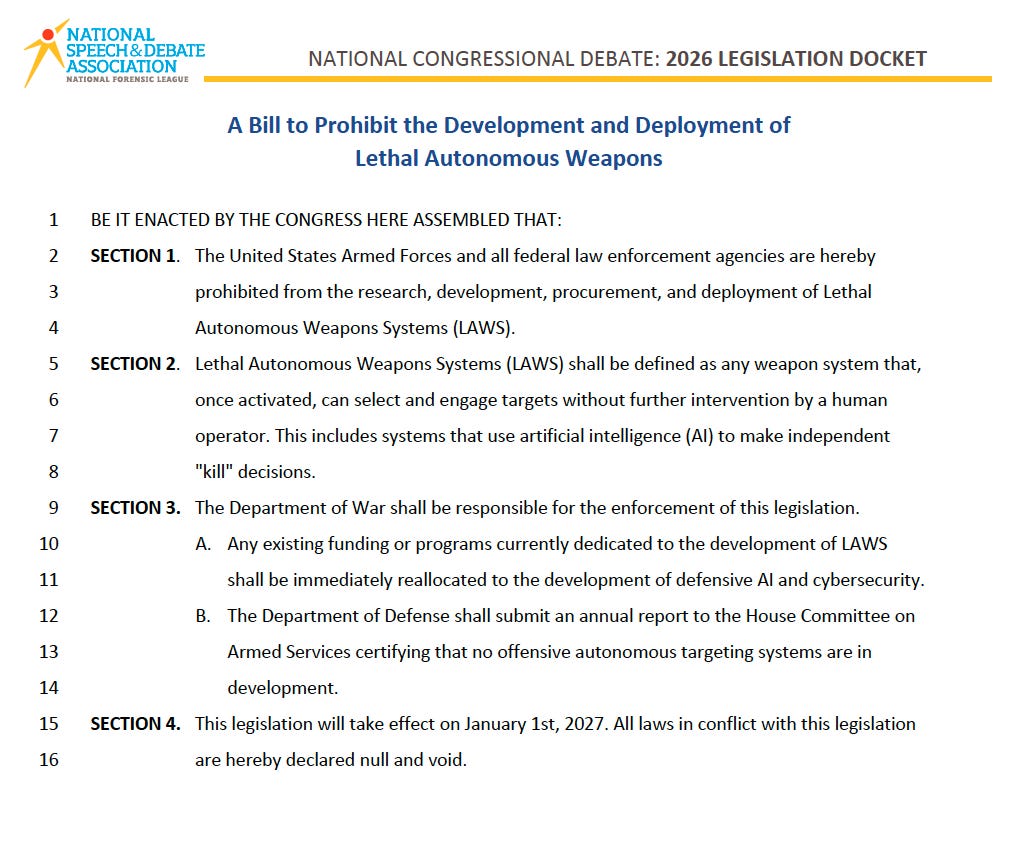
The proposal in front of the chamber converts the general debate into four concrete statutory choices, and it inherits the practicality problems above in specific form. The bill bans U.S. military and federal law-enforcement research, development, procurement, and deployment of weapons that select and engage targets without human intervention; reallocates existing LAWS funding to defensive AI and cybersecurity; requires the Department of War to report annually to the House Armed Services Committee; and takes effect January 1, 2027.
Two things the bill gets right. It anchors on the out-of-the-loop definition, which tracks the CRS framing rather than reaching for everything with an algorithm in it. And its reach into federal law enforcement is responsive to a genuine regulatory gap that the battlefield-only framing misses.
Four things break on contact with the analysis above. The first is scope: the bill bans “deployment,” not just future development, and “without human intervention” is undefined — so on the effective date it arguably sweeps in legacy defensive systems like Phalanx, Aegis, and Patriot, which engage incoming threats faster than a human can authorize (Horowitz, War on the Rocks). Carving them out reopens the offense/defense line that IEEE Spectrum says can’t be drawn cleanly. The second is the funding mechanism: redirecting “existing LAWS funding” to “defensive AI” assumes a clean split between offensive and defensive autonomy, when they run on the same stack — and if current policy classifies no fielded system as a prohibited LAWS, “existing LAWS funding” may be a null set that funds nothing. The third is enforcement: the bill pairs a ban with an annual report but specifies no penalty, no inspector, and no remedy when a system crosses the line, and the reporting partly duplicates the existing FY2025 NDAA mandate for an annual LAWS report through December 2029 (CRS). The fourth is timing and reciprocity: a unilateral ban effective January 2027 freezes U.S. development precisely as competitors accelerate, against a budget the Cipher Brief puts in the tens of billions for FY2027.
The bill, in other words, is the blunt version of a defensible idea. It legislates the principle that machines shouldn’t make the kill decision, but it does so with a definition too broad to administer, a funding theory that contradicts itself, and no teeth. The narrower instrument described in the next section would deliver most of the bill’s moral payload without most of its practical failure modes. (For a round-by-round breakdown of the bill — advocate and opponent cases, cross-examination, and a strategic verdict — see Part II below.)
Where the serious middle lands
Strip the slogans and the credible positions converge on something narrower than a total ban and firmer than the status quo. The ethical case against a machine making the kill decision on a human is close to a moral consensus — even DoD reserves an explicit human-in-the-loop requirement for nuclear weapons (Horowitz), which concedes the principle at the highest-stakes level. But a total, unilateral ban founders on the definitional problem, the defensive-systems sweep, the verification gap, and the reciprocity problem.
The defensible policy, which Guo, Kmentt, and even Horowitz approach from their different directions, has four parts: prohibit autonomous targeting of humans and fully out-of-the-loop offensive systems; preserve human-supervised defensive autonomy; require genuine human judgment with explicit safeguards against cognitive overload rather than a nominal signature; and put the diplomatic weight behind the two-tier international instrument rather than going it alone, since a ban that doesn’t bind adversaries mostly disarms the United States. The hard truth underneath the whole debate is that this is a values choice dressed as a technical one: how much capability is the U.S. willing to forgo, against accelerating competitors, in exchange for the ethical and normative gains of leading. Pretending the practicality problems away — in either direction — is the one move that guarantees a bad answer.
Part II — Congressional Debate Round Prep
This part uses Congressional Debate conventions: “advocates” argue the bill should pass, “opponents” argue against, and the voice is tactical — written for a competitor who may be handed either side. It re-approaches the bill from Part I as case construction, cross-examination, drafting analysis, and a strategic verdict.
1. A Bill to Prohibit Lethal Autonomous Weapon Systems and Reallocate LAWS Funding
What the bill does
The bill bans all U.S. military and federal law enforcement research, development, procurement, and deployment of weapons systems that select and engage targets without human intervention. It reallocates existing LAWS funding to defensive AI and cybersecurity, requires the Department of War to report annually to the House Armed Services Committee, and takes effect January 1, 2027. The factual baseline both sides work from: current U.S. policy does not ban these systems — Department of Defense Directive 3000.09 governs them through a review process and requires “appropriate levels of human judgment over the use of force,” and the Congressional Research Service states plainly that “U.S. policy does not prohibit the development or employment of LAWS.” This bill would be a reversal of the status quo, not a codification of it.
The strongest case for the bill
Advocates win on the moral architecture of accountable killing — the ground where the bill is most defensible and the chamber is most receptive.
The first argument is the responsibility gap. International humanitarian law assumes a human agent who can be held responsible for a killing, and a machine that selects and engages targets dissolves that agent. Guo’s 2025 analysis in Ethics & Global Politics frames it as a “responsibility gap“ — when an autonomous system commits what looks like a war crime, the programmer couldn’t foresee it, the operator didn’t control it, and the commander cites technical complexity, so no one is culpable. If you’re advocating, this is your lead, because it reframes the bill as preserving law rather than restricting capability.
The second argument is the black box. O’Connell’s 2023 piece for Ethics & International Affairs, “Banning Autonomous Weapons,” argues that because a learning system’s decisions can’t be predicted by its own designers, you cannot know at the moment of deployment whether it will comply with the right to life. Pair it with the documented failure: a UN panel found Turkish Kargu-2 drones attacked targets in Libya based on anomalous signatures, the case Guo (2025) cites as the responsibility gap confirmed in the field.
The third argument is escalation. Machine-speed engagement compresses the decision loop below human reaction time and invites “flash war.” The high-end version is nuclear: Lt. Gen. Shanahan’s September 2025 Arms Control Today piece warns that AI bleeding into the sensor and decision-support systems around nuclear command creates automation bias and cascading errors even if no one puts AI on the launch button. The November 2024 Biden-Xi agreement that AI must never supplant human judgment in nuclear launch decisions (also in Shanahan) is your evidence that even the U.S. concedes the principle at the top of the ladder.
The fourth argument is the law-enforcement clause, which most of the chamber will skip. The bill reaches federal police use, and Human Rights Watch’s April 2025 report “A Hazard to Human Rights“ argues these systems will migrate into policing, where the right to life and non-discrimination protections are stronger than IHL and biased target profiles risk “digital dehumanization.” If you’re advocating and the room saturates on the battlefield framing, pivot here — it’s fresh ground.
The fifth argument is leadership and momentum. The U.S. is in a shrinking minority. The UN General Assembly adopted A/RES/80/57 on December 1, 2025, reaffirming that any weapon that cannot be used in compliance with IHL must not be used, and Human Rights Watch reports more than 120 countries back treaty negotiations. Going first reclaims the norm the U.S. helped build.
The strongest case against the bill
Opponents win on reciprocity and feasibility — and the bill hands them a clean procedural objection most advocates won’t see coming.
The first argument is unilateral disarmament. A U.S. statute binds only the United States and is unverifiable against the actors the U.S. fears. The CRS primer’s own line — the U.S. “may be compelled to develop the systems if U.S. competitors choose to do so” — is the realist core, and the Lieber Institute (March 2026) judges a binding international instrument “slim to none” given great-power opposition. If you’re opposing, this is your spine: the bill costs the U.S. the capability and buys no reciprocal restraint.
The second argument is military necessity, and it’s empirical now, not hypothetical. The Cipher Brief’s reporting from Ukraine’s frontline shows drones accounted for more than 80 percent of enemy targets destroyed by late 2025, with units operating at 30–60 percent strength and the defense ministry stating the goal is to remove human operators from the battlefield entirely. The reason autonomy matters: electronic warfare jams the human link, the point Michael Horowitz — who helped rewrite Directive 3000.09 — makes in his May 2025 War on the Rocks piece. In a communications-denied fight, a human-in-the-loop mandate can mean ineffective forces.
The third argument is that the bill bans defensive systems the U.S. already relies on. Per Horowitz, the Phalanx Close-In Weapon System has been deployed since 1980 and switches to an automatic mode that engages incoming threats faster than a human can — and it was used in the Red Sea against Houthi missiles. Scientific American lists Iron Dome, Phalanx, and the German NBS Mantis as already-deployed defensive autonomy, and former DoD official Paul Scharre has noted at least 30 countries field automated defensive systems including Aegis and Patriot. A clean ban on “select and engage without human intervention” sweeps all of them in.
The fourth argument is the procedural objection — run this early. The bill assigns no enforcement mechanism. The Department of War reports annually to House Armed Services, but reporting is not enforcement; there is no penalty, no inspector, no remedy when a system crosses the line. Worse, much of the architecture the bill claims to create already exists: the FY2025 NDAA already requires an annual report on LAWS approval and deployment through December 2029 (CRS). If you’re opposing, point out that the bill’s signature accountability feature is partly redundant and entirely toothless.
The fifth argument is the funding incoherence, which feeds the logical-flaws section below. The bill reallocates “existing LAWS funding” to “defensive AI,” but the Brennan Center’s March 2026 explainer, “The Military’s Use of AI,” documents $75 billion in DoD AI spending since 2016 and $13.4 billion requested for autonomous systems in FY2026 — and the offensive and defensive applications run on the same underlying autonomy. You can’t cleanly defund one and fund the other.
Cross-examination questions
Questions for advocates to ask opponents:
“You say a ban is unilateral disarmament — but the U.S. already restricts itself on chemical and biological weapons that adversaries might cheat on. Why is autonomy the exception?”
“If Phalanx is purely defensive, the bill can carve it out — so isn’t your strongest objection just a drafting fix, not a reason to kill the bill?”
“You cite Ukraine’s 80 percent drone-kill figure. How many of those engagements were fully out-of-the-loop versus a human authorizing the strike?”
“When an autonomous system kills the wrong people, who do you court-martial — the coder, the operator, or the commander?”
“The November 2024 Biden-Xi agreement says AI must never authorize a nuclear launch. If the principle holds for nuclear weapons, why not for the lethal decision generally?”
“More than 120 countries back a treaty. If the U.S. is right and they’re wrong, why is the U.S. in the minority?”
“You want to keep building these. Name the adversary capability that a U.S. autonomous offensive weapon deters that a human-supervised one doesn’t.”
“You call this unilateral disarmament — but the bill bans development, not just deployment. Are you arguing the U.S. should spend money building weapons it never intends to field?”
Questions for opponents to ask advocates:
“Define ‘without human intervention.’ Does a fire-and-forget missile that homes on a human-designated target violate your bill?”
“Your bill bans ‘deployment.’ Does that pull Phalanx, Aegis, and Patriot off Navy ships on January 1, 2027?”
“You reallocate LAWS money to ‘defensive AI.’ The same autonomy powers both — how does the Department of War decide which dollar is offensive and which is defensive?”
“The FY2025 NDAA already mandates an annual LAWS report through 2029. What does your reporting requirement add?”
“If China and Russia keep building and the U.S. stops, what is your plan for the capability gap in a communications-denied fight?”
“Your bill has a ban but no penalty. What happens to a commander who deploys a prohibited system anyway?”
“You say human control is a moral imperative. The Cipher Brief shows analysts ‘rubber-stamping’ 12,000 machine-flagged targets a week. Is a human who can’t meaningfully review the targets actually control, or theater?”
“Your accountability argument says someone must answer for a wrongful killing. Commanders are already liable for the systems they deploy under the UCMJ and the law of war. Name what your bill adds to that chain that existing law doesn’t already cover.”
Drafting and definitional traps
The fatal flaw is “without human intervention.” The CRS primer says there is no agreed definition of LAWS internationally, and Horowitz argues DoD deliberately dropped “in/on/out of the loop” language because it falsely implies continuous tactical oversight that even conventional precision weapons don’t have. A statute built on the undefined phrase invites years of litigation over what counts.
The “deployment” verb is the second trap. Banning deployment, not just future development, is what sweeps in legacy defensive systems. If you’re opposing, read the verb out loud and ask whether the Navy strips Phalanx on the effective date. If you’re advocating, you must pre-empt this with a defensive carve-out for systems that exclusively engage incoming munitions — at which point you’ve reopened the offense/defense line that IEEE Spectrum says no one can cleanly draw.
The “existing LAWS funding” term has no defined baseline. If current policy doesn’t classify any fielded system as a prohibited LAWS — which is the CRS position — then “existing LAWS funding” may be a null set, and the reallocation funds nothing.
A smaller catch rewards the closest reader: the bill names the “Department of War” as the enforcing agency in Section 3 but reverts to “Department of Defense” in Section 3(B). Whatever your view of the 2025 rebrand, using two names for one agency in a single bill is a drafting inconsistency — flagging it signals you read the text more carefully than the room did.
Logical flaws
The bill’s central contradiction is that it presumes a clean line between offensive autonomy (banned) and defensive AI (funded) while its own funding mechanism depends on that line being un-drawable. The same target-recognition autonomy that powers an out-of-the-loop strike drone powers an out-of-the-loop missile-defense interceptor — Ukraine’s Octopus interceptor in the Cipher Brief is exactly this. The bill bans the capability and then redirects money to the capability under a different name. Opponents should name this as self-defeating: the standard that disqualifies the weapon also disqualifies what the bill funds.
The second flaw is a non-sequitur in the advocates’ own framing. The case for the bill rests on preserving “meaningful human control,” but the empirical record the advocates rely on — the Ukraine data, the “rubber-stamping” of machine recommendations in the Cipher Brief — shows human control already eroding under target volume regardless of any legal requirement. Mandating a human in the loop without addressing cognitive overload produces nominal control, not real control, which means the bill may not actually deliver the accountability it promises. This cuts against advocates if opponents are sharp enough to turn the evidence around.
The third flaw inverts the bill’s own moral premise. The case for the bill says the wrong lies in the absent human — but point defense against a supersonic missile or a saturation drone swarm is precisely the case where no human can react in time, so it is the least morally fraught use of autonomy and the one the bill’s own principle should want to protect. The bill bans it anyway, alongside offensive targeting. If you’re opposing, this is the cleanest way to show the text and the theory point in opposite directions: the systems most defensible on the advocates’ own logic are the ones the bill sweeps in.
The fourth flaw is a non-sequitur in the first-mover argument. Advocates claim that if the U.S. fields LAWS everyone follows, so the U.S. must abstain to create treaty space. But the opponents’ own evidence — China’s “intelligentized warfare,” Russian loitering munitions in Ukraine, and the UN account of a Kargu-2 engagement in Libya (Guo 2025) — says proliferation has already begun without U.S. leadership. If the norm is already breaking, “U.S. restraint sets the norm” collapses: the premise that the U.S. is the first mover is false, so unilateral abstention forfeits capability without buying the norm-setting benefit. Advocates can’t hold both “the U.S. sets the norm” and “adversaries are already racing ahead.”
The fifth flaw is the currency trap. Every load-bearing number in this debate is moving. The FY2027 budget reportedly proposes $54.6 billion for autonomous warfare and a jump for the Defense Autonomous Warfare Group from roughly $225 million to tens of billions (Cipher Brief). The Pentagon-Anthropic blacklist dispute (Brennan Center) is live. Pull the current figures the week before you speak; a stale number is a CX liability.
Verdict / how to play it
The chamber will saturate on the advocate side — the moral case against killer robots is intuitive and the evidence base is rich, so most speeches will be some version of “machines shouldn’t decide who dies.” That makes the competent opponent speech the rarer and higher-scoring one, and the bill hands it three real points: the definitional overbreadth, the defensive-systems sweep, and the no-enforcement procedural gap. I’d open opposition with the procedural objection — it’s clean, factual, and most of the room missed that the bill has a ban with no penalty and a reporting requirement that partly already exists.
On the advocate side, the single highest-leverage move is to narrow the bill in your own framing before anyone attacks it: concede the defensive carve-out, anchor on out-of-the-loop targeting of humans, and lead with the responsibility gap (Guo 2025) rather than a blanket ban. The advocate who debates the bill as written loses to the Phalanx question; the advocate who debates the principle wins the room.
The cross-apply: if this docket contains any AI-governance or military-spending bill, the offense/defense-line problem and the “authorization or reallocation without a workable definition” move travel directly. Run the same enforcement-agency and definitions checks on those.
US Policy
Defense Primer: U.S. Policy on Lethal Autonomous Weapon Systems
Legal Accountability for AI-Driven Autonomous Weapons
The Military’s Use of AI, Explained
International Action
Geopolitics and the Regulation of Autonomous Weapons Systems
156 states support UNGA resolution on autonomous weapons
General
AI Arms Race: How Autonomous Systems Are Reshaping Deterrence and Escalation Dynamics
International
LAWS Resolution of the UN General Assembly
UN: Start Talks on Treaty to Ban ‘Killer Robots’
The Pentagon’s $54 Billion Bet on Autonomous Warfare
Lethal Autonomous Weapons Bad
A Hazard to Human Rights: Autonomous Weapons Systems and Digital Decision-Making
The ethical legitimacy of autonomous Weapons systems: reconfiguring war accountability in the age of artificial Intelligence
Recent advancements in artificial intelligence have intensified debates on deploying Autonomous Weapons Systems (AWS) in warfare. Proponents justify AWS on grounds of(1) enhanced military efficiency and reduced soldier casualties, (2) improved compliance with international humanitarian law (IHL) through algorithmic precision, and (3) operational necessity in high-threat environments. This paper critically examines these arguments, contending that they fail to establish the ethical legitimacy of AWS. It argues that AWS fundamentally undermine moral accountability in war, exacerbate risks to civilians, and corrode human agency in lethal decision-making. The analysis concludes that existing ethical and legal frameworks cannot adequately govern AWS, necessitating a reconfiguration of accountability paradigm.
LAWs Weapons Ban Bad
Banning Autonomous Weapons: A Legal and Ethical Mandate
Autonomous Weapon Systems: No Human-in-the-Loop Required, and Other Myths Dispelled
Human vs. Machine: Operational Realities from Ukraine’s Frontline
Nuclear Arms & AI
Artificial Intelligence and Nuclear Command and Control: It’s Even More Complicated Than You Think