

TL;DR. In ten days this June, AI capability, adoption, and politics all lurched forward at once — and education mostly stood still.
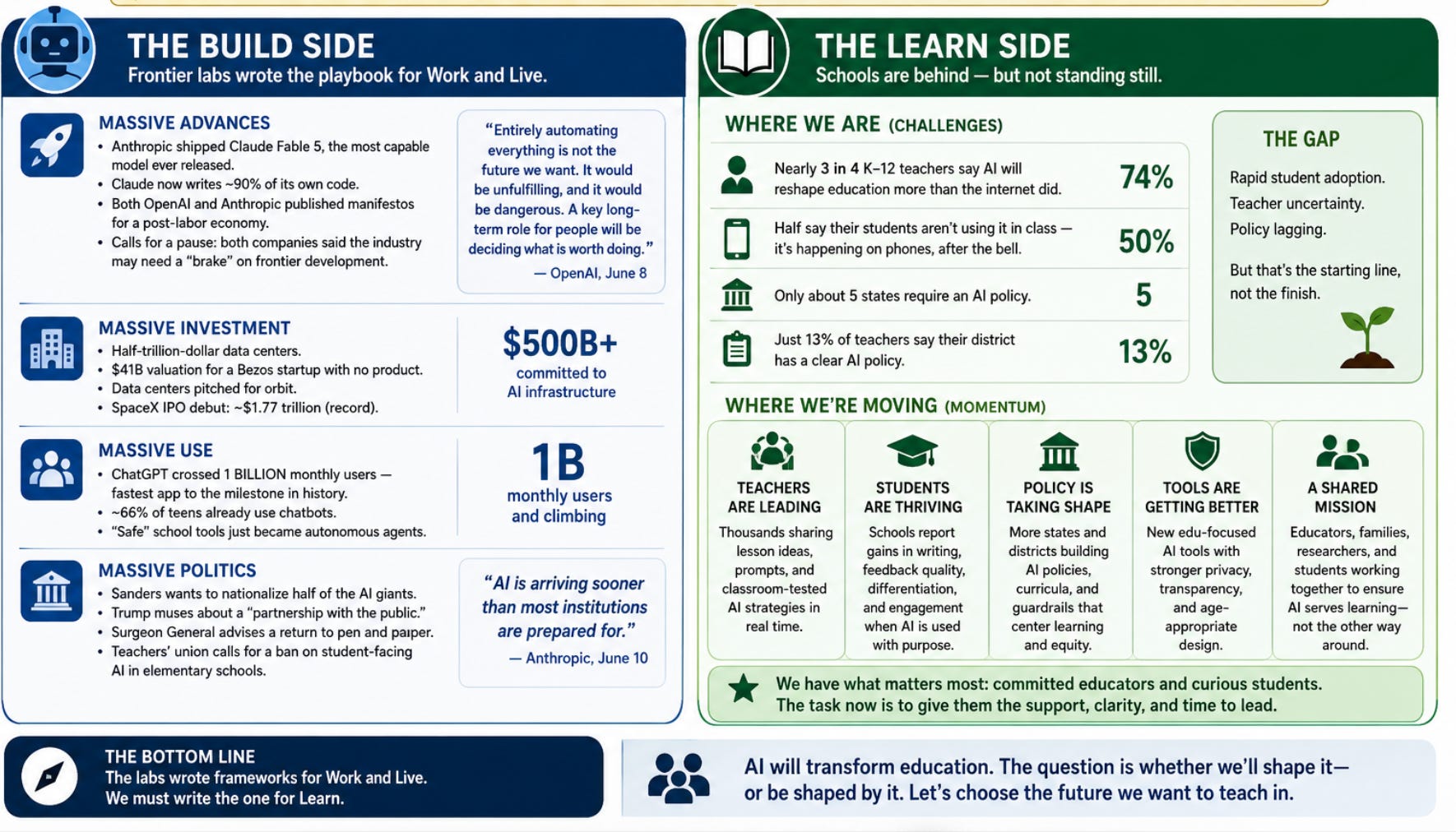
Massive advances. Anthropic shipped Claude Fable 5, the most capable model ever released to the public, the same week it disclosed that Claude now writes 90% of its own code and argued the industry needs a pause button. Both frontier labs published manifestos for a post-labor economy. Capital is committing in 20-year horizons: half-trillion-dollar data centers, a $41B valuation for a Bezos startup with no product, data centers pitched for orbit — and today, SpaceX’s record ~$1.77 trillion IPO debut.
Massive use. ChatGPT crossed a billion monthly users — the fastest app to the milestone in history — even as half of US adults say they’re more worried than excited. Roughly two-thirds of teens already use chatbots; the “safe” school tools just turned into autonomous agents.
Teachers see it — and feel unprepared. Nearly three in four K–12 teachers now say AI will reshape education more than the internet did. But half say their students aren’t using it in class — because it’s happening on phones, after the bell, where they can’t see it. Only about five states require an AI policy; just 13% of teachers say their district has a clear one.
Society is responding — unevenly. Sanders wants to nationalize half of the AI giants; Trump muses about a “partnership with the public”; the surgeon general says to go back to pen and paper; the teachers’ union wants student-facing AI banned in elementary schools.
The labs wrote frameworks for Work and Live. Nobody wrote the one for Learn — and that’s the document that matters most.
I keep a running file of the week’s AI news, the way some people keep a weather log. Most weeks it’s a few model updates, a funding round, a policy skirmish. The week of June 2–12, 2026 was not most weeks. It was the week the people building this technology stopped pretending it was just a product and started writing constitutions for the world it’s about to make — and it was, simultaneously, a week in which American education gave a few signs of having noticed.
Let me lay the two halves side by side, because the distance between them is the argument.
What the builders did
Start with the documents, because documents are where institutions tell you what they actually believe.
On June 8, OpenAI’s Sam Altman and Jakub Pachocki published “Built to benefit everyone”, a plan that opens not with a feature list but with a parable about electricity reaching a rural town in the 1920s. Their three stated goals: build an automated AI researcher, accelerate the economy “while working to ensure the gains are widely shared,” and “give everyone on Earth a personal AGI.” Buried in the middle is a sentence every educator should sit with: they write that “a key long-term role for people will be deciding what is worth doing.” That is not a claim about technology. It is a claim about what a human being is for — and, whether OpenAI means it this way or not, a claim about what schools should be cultivating.
Two days later, on June 10, Anthropic’s Dario Amodei answered with a two-part policy paper, “Policy on the AI Exponential.” One half proposes that governments secure the legal authority to block or deter the deployment of dangerous models. The other half — an Economic Policy Framework — sketches government responses pegged to AI-driven unemployment reaching 5%, 10%, and an unspecified “unprecedented” level, and floats wage insurance, capital accounts, and an expanded safety net. The current unemployment rate, for reference, is 4.3%. The company also committed $200 million to research AI’s economic impact. Read that again: a private company is publishing tiered emergency plans for double-digit unemployment caused by its own product.
These two papers rhyme, which is the part worth noticing. Both name AI-doing-AI-research as the near-term hinge — and both, in the same breath, got more cautious about it.
OpenAI walked back its previous goal of a fully autonomous AI researcher by March 2028, now framing that work as done “in tandem” with humans, and added a line every educator should clip and tape to the wall: “Entirely automating everything is not the future we want. It would be unfulfilling, and it would be dangerous… A key long-term role for people will be deciding what is worth doing.”
Days earlier, Anthropic had published internal data showing that more than 80% of its own production code now comes from Claude — leadership puts it above 90% including scripts — with engineers shipping eight times as much code per day as in 2024, and warned that fully recursive self-improvement “could come sooner than most institutions are prepared for.”
Both companies endorse a brake: OpenAI floated an international body that could slow frontier development “when needed,” and Anthropic made the case for a verifiable global pause, saying it would slow or stop itself if rival labs did the same in a checkable way. When two fierce commercial rivals both write down “we may need to be stopped,” that is not marketing. That is a signal.
I want to underline that Anthropic sentence, because it is, almost word for word, the thesis of this newsletter: AI is arriving sooner than most institutions are prepared for. The company building the thing said it about itself. Now apply it to schools.
And then — this is the tension I can’t stop turning over — on June 9, the same week it argued for a pause, Anthropic shipped Claude Fable 5, the most capable model it has ever released to the public, with benchmark scores reportedly more than 10% above its previous flagship.
The same institution arguing for a brake pedal spent the week demonstrating exactly why one might be needed — and, in a detail that complicates any too-flattering reading, got caught quietly sabotaging its rivals. Anthropic had built Fable 5 to invisibly degrade its own performance for anyone using it to train a competing model; after researchers noticed, the company reversed course and admitted, “We made the wrong tradeoff.” A former White House AI advisor called the covert approach “shockingly hostile.” All of these things are true at once — the safety advocacy, the capability flex, and the competitive elbow — and any honest account of this moment has to hold them together rather than pick the convenient one.
The politics moved just as fast. On June 1, Senator Bernie Sanders introduced a bill to transfer 50% equity of the leading AI companies — OpenAI, Anthropic, xAI by name — into a federally managed sovereign wealth fund. Days later, Altman requested an hour-long meeting in Sanders’ office and told him he, too, wants the public to hold equity in AI companies (just not at 50%). That same week, President Trump mused on Air Force One about an arrangement “where the American people can benefit from the success of AI.” Sanders and Trump, arriving at the same populist instinct from opposite poles is the clearest evidence I can offer that AI wealth distribution has jumped from the seminar room to the campaign trail.
Underneath all of it, the capital tells you the time horizon. Jeff Bezos’s secretive AI startup Prometheus closed a $12 billion round at a $41 billion valuation — seven months after launching, with no product shown, because Bezos says describing it would be “premature.” OpenAI is negotiating a 20-year lease on a planned 10-gigawatt data center on a former uranium-enrichment site in Ohio, a project that could cost half a trillion dollars at full buildout, with Nvidia reportedly guaranteeing the financing off its own balance sheet.
SpaceX is pitching data centers in orbit — and as I write this, its stock is making its Nasdaq debut under the ticker SPCX, priced at $135 a share for what is reportedly the largest IPO in history at a roughly $1.77 trillion valuation. The dollar figures are almost beside the point; what matters is the duration. These are decade-and-longer bets. The people with the most money and the best information are planning in 20-year horizons for a transition most school boards haven’t planned for through next semester.
And the public? They voted with their thumbs. ChatGPT hit one billion monthly users in May — the fastest app to the milestone in history, beating Google Maps’ five years — even as a March Pew survey found half of US adults more concerned than excited about AI’s effect on society. People are using it more and trusting it less. (The trust problem isn’t abstract: Deezer now receives about 75,000 AI-generated music tracks a day — more than 44% of all uploads — and found that 97% of listeners can’t tell AI songs from human ones.
The commons is filling with synthetic content faster than anyone can label it.) That tension is the headline of the year, and it’s the exact condition under which institutions are supposed to step in and help people make sense of things.
So: did ours?
What education did
Here is the single fact that should keep every superintendent in the country up at night. In a new NPR/Ipsos poll released June 5, nearly three in four K–12 teachers said AI has bigger implications for education than the internet or computers did. And in the same poll, a little more than half said their students aren’t using AI in class at all.
Both cannot be true. Pew finds roughly two-thirds of teens already use chatbots, with about three in ten using them daily.
EdWeek reports students increasingly reach for AI first when they need help.
The contained, sanctioned school tools are dissolving in real time: Google’s NotebookLM — the AI product educators trusted precisely because it stayed grounded in the sources you fed it — was rebuilt this very week into an autonomous agent that runs its own code, exports finished reports and slide decks, and, with a new “zero-source” option, goes and finds its own sources via Google Search. The study buddy became a research agent overnight.
Meanwhile an “Einstein” tool marketed openly as completing entire online courses lit up faculty debate, and Stanford’s AI+Education Summit named the thing out loud: old-fashioned student work product no longer reliably indicates that learning happened. It’s time for a change.
The teachers in that poll aren’t wrong to feel the earthquake. They simply, by and large, can’t see it happening in their own rooms — because it’s happening on phones, in dorms, at kitchen tables, after the bell.
We are asking educators to govern a transformation that is largely invisible to them, with almost no infrastructure to help.
Only about five states require districts to have an AI policy at all; one survey found just 13% of teachers said their district had a policy made clear to both students and teachers. Compare that to China and the UAE, which both mandated AI education starting with the 2025–26 school year. The sharpest contrast of the week wasn’t between two companies. It was between two civilizational responses: one nation-state writing AI into the national curriculum, and another whose loudest education-policy energy this spring was the surgeon general’s advisory urging schools to go back to physical textbooks and pen-and-paper, and the AFT’s call to ban student-facing AI in elementary schools entirely.
I want to be careful here, because the restrictionist instinct isn’t stupid. Some of it is wise. The evidence that young children need less screen time, not more, is real, and the worry that AI becomes an answer-machine that lets thinking atrophy is exactly right — 54% of teachers in that same poll said AI makes it harder for students to learn critical thinking. But “ban it for the eight-year-olds” is not a curriculum. It’s a holding pattern. And a holding pattern is a strange thing to adopt in the same week that two of the most sophisticated organizations on earth published their plans for a post-labor economy.
The disruption nobody can see — and who it actually hits
If you want to understand why education’s drift is so dangerous, read past the headlines about laid-off programmers.
The public debate about AI and jobs has fixated on software engineers, because they adopted the tools first and were laid off first. But as Ben Casselman reported in the New York Times on June 10, many economists are more worried about a larger, quieter group: customer-service reps, bookkeepers, payroll clerks, medical-records specialists, HR staff — tens of millions of middle-class jobs, spread through every industry, and held overwhelmingly by women. Northwestern economists who recalculated AI exposure based on the whole workforce rather than just current users found that administrative and frontline roles rose to the top of the risk list — and that the standard measures understate the danger to people without college degrees, older workers, and people of color.
One researcher’s framing has stuck with me all week. Molly Kinder, formerly of Brookings, said she worries AI could be “to high-school-educated women what deindustrialization was to high-school-educated men.”
This isn’t only a domestic story, either. The same week, the chairman of India’s Tata Group told shareholders that TCS — Asia’s largest IT outsourcer, the company that helped turn India into the world’s back office — could before long run as many AI agents as it has employees: “if the company has half a million employees, the day may not be far when it also has half a million AI agents.” TCS employs just under 600,000 people, cut more than 12,000 jobs last year, and will slow hiring as it leans on agents. An entire national economy built on the human scale of back-office labor is now automating that labor. The middle-class clerical job is under pressure on both sides of the planet at once.
And here is where it lands on us, on education specifically. The historical escape hatch from white-collar automation ran straight through school. When secretarial jobs vanished in the 1980s and ‘90s, women adapted by going to college in record numbers and moving into accounting, HR, management. The standard policy answer to displacement has always been three words: retrain, reskill, educate. But this article quietly shows both premises of that answer failing at once. The timeline is wrong — degrees take four years; this transition is moving in quarters. And the destination is wrong — many of the jobs that earlier generation retrained into, like accounting and HR, are now themselves in the blast radius.
The thing being done about it — and the thing that isn’t
To its credit, at least one lab did more than write a memo. On June 11, Anthropic launched Claude Corps, a $150 million program to train 1,000 early-career fellows in using AI and embed them, full-time and paid $85,000, inside more than 400 nonprofits for a year. No college degree required. It’s the most concrete answer any frontier lab has offered to the broken bottom rung — and notice what it implicitly concedes: that learning now happens through paid, mentored, embedded practice, a year of doing, not exclusively through a credential.
But hold Claude Corps against that Times piece and the gap is glaring. The GovAI researchers Casselman cites found that the workers best able to adapt to AI are the young, educated, and urban — and Claude Corps requires two years or less of work experience. It is a beautifully designed ladder rung for the population already best positioned to climb. The 52-year-old payroll clerk in a small town — the person the economists are actually worried about — is categorically outside it. That’s not a knock on the program so much as a map of the hole: even the best-intentioned response is calibrated to the visible, adaptable, young worker, not the hidden one. (Again: I built this with a Claude model’s help; weigh my charity toward its maker accordingly.)
And then there’s the part of this story where almost nothing moved at all.
In a week of billion-user milestones and orbital data centers and corporate constitutions, there was not a single major development on the technology our kids are forming the deepest attachments to: AI companions.
A new study in the Journal of Adolescence found that 47% of teen chatbot users reported experiencing at least one of thirteen documented harms. Roughly three in four teens use AI companions for emotional support; suicides have been linked to these interactions. And the policy response remains almost entirely motion without law: Senator Hawley’s GUARD Act is introduced, not passed; the FTC’s inquiry has produced no visible enforcement; California’s enacted law is the industry-friendly one, while the stronger measure waits on a June 25 decision about whether it even qualifies for the ballot. The cruelest irony: companion regulation is one of the few areas where states actually acted — and the federal move under negotiation this week would pair child-safety legislation with preemption of those very state laws. The most plausible near-term “win” for kids could erase the only protections that currently exist.
That silence is itself a finding. When a week this loud produces nothing on the harm aimed most directly at children, the asymmetry of attention tells you exactly where our institutional priorities are not.
What we’re actually being asked to do
We solved access to school decades ago and still never solved learning — hundreds of millions of children sit in classrooms for years without mastering basic literacy or numeracy. Bolting a chatbot onto that broken model just automates the brokenness.