
DOE Warning: Students Risk Future Without AI Skills and Literacy (And they are Right)
Those who good listeners and demonstrate empathy will be least exposed to job loss.


As many readers of my blog likely know, I’m strongly opposed to many of the actions taken by the Trump administration.
I’m also pessimistic, at least in the short-term, about the impact of AI. I think that it will lead to the economic devaluation of many people and that when people lose their economic value they become disposable. Without the need for human labor, there will be fewer incentives to give people a stake in the political system and maintain democracy.
These problems will be magnified in a world of declining support for social spending and increased support for military/security spending and tax cuts.
There are a lot of ingredients for a very rough decade ahead, and cruelty isn’t going to make this any better.
That said, I think this administration does really understand the significance of evolving AI, and in a way that the last one did not.
AI Literacy/Fluency
I think it’s fair to say there is an emerging consensus around what is included in a basic definition of AI literacy/fluency and it embraced by the USDOE.

Basic knowledge of the technology (“technical knowledge”). This doesn't mean becoming an ML engineer, but rather developing a foundational understanding of how AI systems work. An AI-literate person should understand that these systems are grounded in data, make predictions based on that data, often use tools to achieve their objectives, and employ various methods to optimize for accuracy.
An ability to use AIs (“engage, create with, manage and design AI”). This includes crafting effective prompts for agentic systems that clearly communicate goals and constraints, understanding how to iteratively refine requests based on AI responses, and knowing when AI tools are appropriate for a task versus when human judgment is essential. AI-literate users can evaluate the quality and reliability of AI outputs, understand the limitations of different AI systems, and integrate AI assistance into their workflows while maintaining critical oversight of the results.
An ability to understand the impact on the world “evaluate its benefits, risks, and implications.” The ability for AI to understand its impact on the world represents systems thinking that recognizes how artificial intelligence development and deployment ripple through interconnected global networks. In employment, this means AI systems anticipating how their own capabilities—from automation to knowledge work assistance—create cascading effects across labor markets, potentially displacing certain jobs while creating new categories of work and reshaping entire industries worldwide. Politically, it involves AI understanding how its outputs influence democratic processes, how algorithmic decisions affect governance and policy-making, and how AI-driven information systems contribute to broader trends in political polarization, misinformation, and institutional trust across different societies. Socially, this understanding encompasses how AI technologies reshape human relationships through communication platforms, how AI-generated content influences cultural movements and global conversations, and how algorithmic systems alter social structures and community dynamics. Geopolitically, it requires AI recognizing that its development and deployment create far-reaching consequences—AI capabilities drive international competition for technological supremacy, algorithmic systems influence migration and resource allocation decisions, and AI governance choices set precedents for future international cooperation on technology regulation.
Durable skills (“durable skills”). Durable skills encompass abilities like critical thinking, creativity, emotional intelligence, communication, leadership, collaboration, adaptability, and complex problem-solving. Creative thinking, metacognitive skills, leadership, and growth mindset are the skills employers report will increase in importance the most The Future of Work is Human: Why Durable Skills Are the Key to Workforce Success - America Succeeds alongside technological competencies. These skills involve uniquely human capabilities such as building relationships, navigating ambiguity, exercising judgment in complex situations, and understanding cultural and emotional nuances.
As AI becomes increasingly capable of handling routine tasks, data analysis, and even sophisticated technical work, the value of distinctly human skills grows exponentially. While technical proficiency in AI tools is increasingly valued, employers are also prioritizing durable human skills such as communication, leadership, and empathy
This basic understanding of “AI” literacy has become widespread.
In the Supplement Grant making, The USDOE emphasizes many types of integration (see below), but also strongly advocates something I’ve been promoting since 2023: provide professional development for educators on the *integration of the fundamentals of AI into their respective subject areas. (“Proposed Priority and Definitions).
From my “Innovation Academy” proposal —
Examples include lessons on deflation and job transitions (economics), human-AI interaction (psychology), societal transformations during the Industrial Revolution and how those compare to AI (history), AI surveillance and totalitarianism while reading 1984 (English), and deep fakes (politics). All of these lessons integrate knowledge from the standard curriculum students have to learn, but tie learning about AI into that. AI will transform every part of society, so this should be easy to do. If teachers wanted to, they could teach said lesson to their whole class, but everyone wouldn’t be supportive of that, so the idea would be to allow students in the AI innovation academy to substitute one lesson in their core courses with one of these lessons.
Why is this essential? Because AI will change all of these areas of society; it will radically restructure our economy, our politics, and our social relations. And is already starting to do so.
Why is it timely? It is essential that students develop this knowledge and skills immediately and that schools not wait to push it into “next year’s” planning cycle.
Why?
Students of all ages are already being impacted by AI. As I wrote a couple days ago, a large percentage of students are already developing significant relationships with such AI bots. These include friendships, emotional companionship, and counselling support. Students need to understand the significance of this.
Many students will start to make college choices for 2026-7 and 2027-8. While many have always lived by the principle of, “I’ll attend the best college that I can get into that seems good for me,” colleges and universities that are not investing heavily in preparing students for an AI world are probably not the best choices for students. It is already becoming more difficult for graduates to get jobs in a world of expanding AI, and those who do not understand how to use AI in their “fields” (the continued viability of the idea of a “major” is already being challenged) well will face even more daunting challenges.
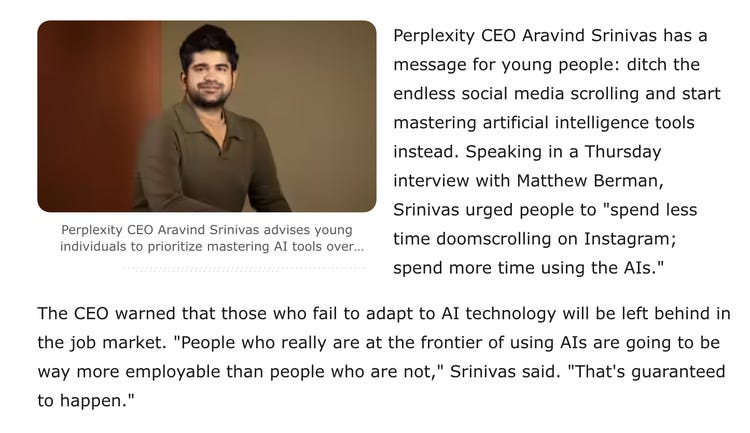
3. Students who understand how to use AI well in high school (and even early grades) will have a significant advantage over those who don’t. Even within the realm of traditional instruction, students who know how to use AI responsibility will have a massive advantage over those who don’t. For example, yesterday I spent time working with students to develop their own no-code applications that both directly teach them new things and help them practice (flash cards, quizzes, problems) and give them immediate feedback. You can now create any unique app for anything you want, and students who know how to create teaching and tutoring apps will have a huge academic advantage.
4. Economic opportunities. More and more students are using creating significant businesses using AI while they are in high school. There are, for example, high school students and college freshman are building start-ups as part of Linked Ventures in Cambridge, MA.
5. Alternative educational pathways. Many alternative pathways to lucrative careers and business opportunities are emerging (Thiel Fellows, Y Combinator acceptance, direct workforce training). While I think college will remain the best choice for many, more and more will choose opportunities to develop lucrative businesses in high school and choose programs that can support those efforts when they graduate.
This is not to say that students will stop learning after high school. They, and all of us will have to, but the idea of graduate high school, go to college for 4 years, and get a job is rapidly eroding. As has been noted by many, what you learn your freshman year of college may not even by relevant by the time you graduate.6. Changes within traditional educational pathways. Even within traditional pathways, students will have to make important decisions. Do they still want to chose majors when leading research indicates that jobs within those areas are likely to be automated? How can we help students make informed choices?
[Source: World Economic Forum, January 2025; note: This is based on ChatGPT-4o capabilities, which is an older model in terms of capabilities at this point].
7. Changes within skill demand. Over at least the last few decades, we’ve been focused on developing students who can succeed at the highest levels of “knowledge work,” but as those above reveals, jobs with those skills are most likely to be replaced with Ais. Those who are good listeners, demonstrate empathy, can think creatively, can coach others, will be least exposed. Those with strong reading, writing, and mathematics abilities will be least likely to find work.8. Politics and political arrangements. Politics and political arrangements are undergoing a fundamental transformation driven by artificial intelligence, digital surveillance, and new forms of data integration. Research confirms that AI-generated political messaging has become remarkably effective at influencing public opinion, with studies showing that personalized and targeted political messages produced by advanced generative AI tools can be highly persuasive, sometimes more so than human-generated messages.
Governments worldwide are rapidly expanding their surveillance capabilities by integrating AI with existing data collection systems, allowing agencies to cross-reference information from social media activity, financial transactions, location data, communication patterns, and public records to create comprehensive profiles of citizens' political activities. In the United States, this manifests through increased coordination between federal agencies, local law enforcement, and private technology companies, enabling real-time monitoring of political expression, protest organization, and dissent in ways that were technically impossible just years ago. These technological shifts give incumbent powers significant advantages over challengers and grassroots movements, as traditional forms of political organization become more vulnerable to interference and suppression, fundamentally altering how political power operates by moving from mass persuasion toward individualized influence and preemptive surveillance.
9. This is all coming very fast. The scale of AI infrastructure being built right now is staggering and represents the largest technological buildout since the internet. OpenAI CEO Sam Altman says the company will bring over 1 million GPUs online by 2025. Meta is also committed to 1 million+ GPUS.
Elon Musk's xAI is perhaps most aggressive, with plans for a million-GPU data center by the end of 2025, requiring so much power that Musk is literally buying overseas power plants and shipping them to the U.S. Some projections suggest xAI's plans could reach 50 million GPUs by 2030. This isn't just incremental growth—it's exponential scaling that creates computational resources larger than anything that has ever existed.
And it’s not just scale. We're witnessing the emergence of AI systems that can modify and improve themselves, which represents a fundamental shift from human-directed to autonomous AI development; the beginning of recursive self-improvement where a self-improving AI becomes smarter and faster with each iteration, potentially resulting in an AI that eventually outperforms its human developers, contributing novel algorithms, neural architectures. The concept isn't theoretical anymore; practical implementations are emerging where agents create goals, simulate tasks, evaluate themselves and others, learn from failure and evolve into more capable versions.
10. The idea that we will see more in the next 10 years than the last 100 is becoming widely accepted among technologists and futurists. Some say that #. is even underestimated (it could be 1,000X what we’ve seen in the last 100).
This compression of technological change creates a cascading effect where each breakthrough enables faster subsequent breakthroughs. When AI systems can design better AI systems, when massive computational resources can be deployed instantly, and when these systems can iterate thousands of times faster than human researchers, we enter an era where technological development becomes discontinuous rather than gradual.This has profound political and economic implications because, as you noted, technological change always drives social change. The difference now is the speed and scope. Previous technological revolutions—the printing press, steam engine, electricity, computers—unfolded over decades, giving societies time to adapt institutions, laws, and social structures. And event those created disruption and conflict, including widespread warfare and violence.
But when change happens even more rapidly, existing institutions can't keep pace. Political systems designed for slower change become obsolete before they can reform themselves. Economic structures built on human labour and gradual productivity gains face disruption faster than new systems can emerge to replace them. Educational systems built on years-long decision-making processes may not even survive.The opportunities are immense—potential solutions to climate change, disease, poverty, and scarcity could emerge rapidly. But the disruption is equally massive. Entire industries, professions, and ways of life could vanish within years rather than generations. This creates winners and losers at unprecedented speed, generating social tensions and conflicts that political systems aren't equipped to handle. The concentration of computational power in the hands of a few companies also concentrates unprecedented influence over the future direction of human civilization, raising questions about democratic governance and shared prosperity that we're nowhere near answering.
___So, yes, I think this administration gets AI in ways that the previous one did not.
Helping students understand the significance of this technology, how it works, how they might be able to take advantage of it, and what complementary skills they will need to thrive (or at least survive) in this world is essential.
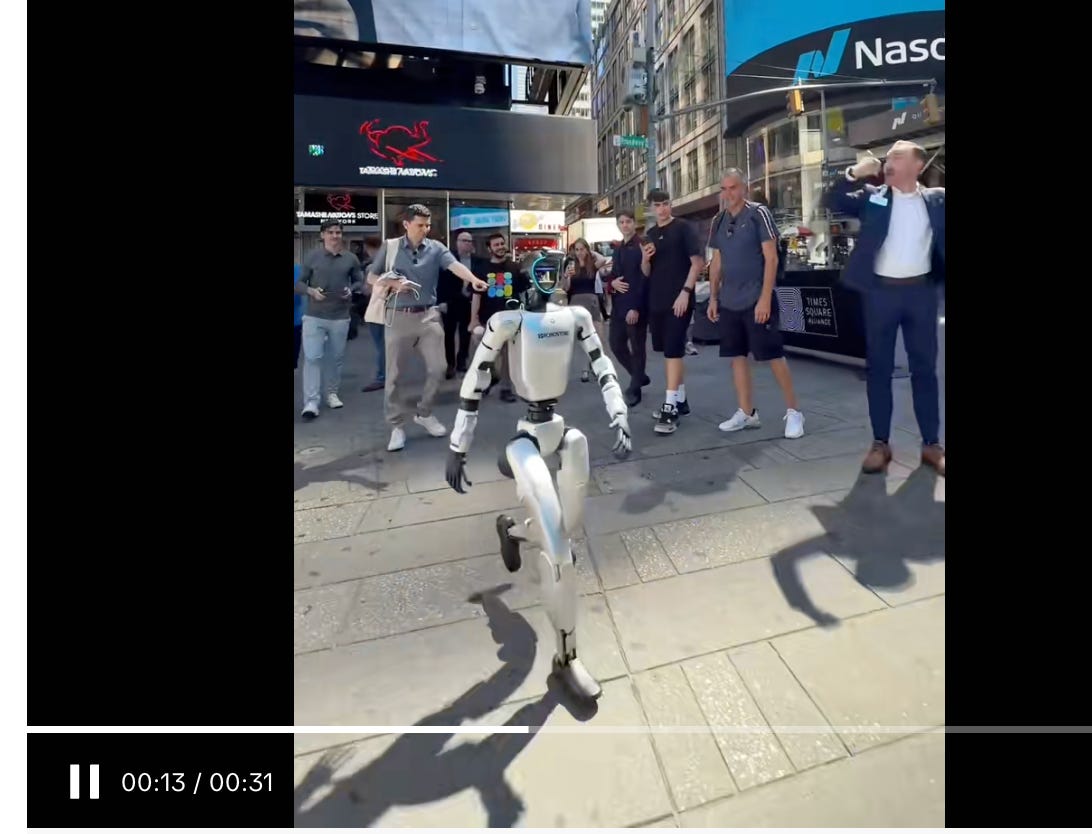
And even awareness can go a long way. Over the last two days, I’ve been giving my students a taste of the growing expansion of humanoid robotics. One of the students told me if she saw one, she’d run.Well, if she was in midtown Manhattan lately, she would have seen one.
__
Proposed Priority: Advancing Artificial Intelligence in Education


Background:
Artificial Intelligence (AI) is rapidly reshaping the future of education, work, learning, and daily life. As AI becomes more integrated into the tools and systems that shape elementary, secondary, and postsecondary education, it is increasingly important for students to develop AI literacy. A strong foundation in AI literacy will help ensure students are prepared to navigate and contribute to a society where these technologies play a growing role in decision-making, communication, innovation, and career readiness.
Beyond serving as a subject of study, AI also offers powerful opportunities to enhance teaching and learning. When used effectively, AI tools have the potential to support personalized instruction, increase classroom engagement, and improve student outcomes. Educators are beginning to use AI-powered platforms to analyze student progress, identify learning gaps, and tailor support to individual needs. This work is only the beginning.
To move from passive users of AI to active creators and innovators, students must also understand foundational computer science. Exposure to core concepts such as algorithms, data analysis, and computational thinking can deepen their understanding of how AI systems function. Incorporating computer science where appropriate can reinforce efforts to build meaningful AI literacy in educational settings.
This priority is designed to support efforts that expand student understanding of AI and its real-world applications. The priority will also promote the appropriate integration of AI into education, providing AI training for educators, and fostering early exposure to AI concepts and technology to develop an AI-ready workforce and the next generation of American AI innovators.
Proposed Priority:
Projects or proposals to do one or more of the following:
(a) Expand the understanding of artificial intelligence through one or more of the following:
(i) Support the integration of AI literacy skills and concepts into teaching and learning practices to improve educational outcomes for students, including how to detect AI generated disinformation or misinformation online;
(ii) Expand offerings of AI and computer science education in K-12 education;
(iii) Expand offerings of AI and computer science courses as part of an institution of higher education's general education and/or core curriculum;
(iv) Embed AI and computer science into an institution of higher education's general preservice or in-service teacher professional development or teacher preparation programs;
(v) Provide professional development for educators on the integration of the fundamentals of AI into their respective subject areas;
(vi) Provide professional development in foundational computer science and AI, preparing educators to effectively teach AI in stand-alone computer science and other relevant courses, including instruction about how to use AI responsibly;
(vii) Partner with State educational agencies or local educational agencies to encourage the offering of dual-enrollment course opportunities to earn postsecondary credentials and industry-recognized credentials in AI coursework concurrent with high school education;
(viii) Create opportunities for high school students through the development or expansion of AI courses and career-relevant, in-demand certification programs; or
(ix) Support dissemination of appropriate methods of integrating AI into education.
(x) Build evidence of appropriate methods of integrating AI into education.
(b) Expand the appropriate use of artificial intelligence technology in education through one or more of the following:
(i) Use AI to support K-12 or postsecondary instruction, supplemental learning, or other assistance or resources to students who are gifted and talented (as defined in 20 U.S.C. 7801(27)), or those who are otherwise in need of accelerated or other advanced learning opportunities;
(ii) Use AI to support K-12 or postsecondary instruction, supplemental learning, or other assistance or resources to students who are below grade level, in need of remedial or developmental education, struggling to graduate with a regular credential from their education program, or otherwise in need of additional assistance to complete their program of study;
(iii) Use AI to support early intervention, K-12, or postsecondary instruction or services for children and students with disabilities and their families;
(iv) Integrate AI-driven tools into classrooms to personalize learning, improve student outcomes, and support differentiated instruction. This integration may include, but is not limited to, adaptive learning technologies, virtual teaching assistants, tutoring, and data analytics tools to support student progress;
(v) Provide resources and support for the use of AI in teaching and/or tutoring in an education program or teacher training program;
(vi) Provide resources and support for the use of AI in teacher preparation programs;
(vii) Use AI technology to improve teacher training and evaluation;
(viii) Promote efficiency in classroom and school operations through the application of AI technologies that reduce time-intensive administrative tasks; or
(ix) Use AI technology to provide high-quality instructional resources, high-impact tutoring, and college and career pathway exploration, advising, and navigation to improve educational outcomes.
In her “Dear Collegue,” letter, Lind McMahon stresses the following on AI.
Dear Colleague Letter on AI:
This guidance addresses the use of formula and discretionary grant funds to support improved outcomes for learners through the responsible integration of AI, including:
AI-based high-quality instructional materials;
AI-enhanced high-impact tutoring; and
AI for college and career pathway exploration, advising, and navigation.
The letter also overviews principles for the responsible adoption of AI, including attention to user privacy issues and the importance of teaching students about the appropriate use of AI in the context of social media.
The guidance document emphasizes the importance of engaging affected stakeholders, especially parents, in decisions about the adoption and deployment of new technologies.
Secretary McMahon’s Supplemental Priority on AI:
In May, Secretary McMahon announced her first three proposed priorities for the Department’s discretionary grants: evidence-based literacy, expanding education choice, and returning education to the states.
Secretary McMahon’s proposed priority outlines key areas for expanding responsible AI education, including:
Integrating AI literacy into *teaching practices* to improve student outcomes;
Expanding *AI and computer science education* in K-12 schools and higher education institutions;
Supporting professional development for educators on teaching AI and computer science fundamentals; and
Using AI to personalize learning and support differentiated instruction, improving outcomes for students at all levels.
Additionally, the proposed priority encourages the use of AI technologies to enhance classroom efficiency, reduce administrative burdens, and improve teacher training and evaluation.
The Department seeks public comment on the proposed priority and definitions. Interested parties are invited to submit feedback via the Federal eRulemaking Portal at Regulations.gov by August 20, 2025.
In addition to its grant competitions, the Department is exploring ways to streamline and modernize its own operations by leveraging AI in support of students and families. In particular, Federal Student Aid (FSA) recently asked its current and anticipated vendors how they could utilize AI to detect and prevent fraud and abuse and improve service delivery related to student aid and postsecondary pathway exploration.