

Note: I will be speaking on preparing students for the AGI era at the AI Back to School Summit next week. [When machines soon match every human expert, what’s left for students to do? The answer: instructional redesign and students developing what I call Standing — a maker’s stake in their communities.]
TL;DR: GPT-6 Astra may mark the beginning of an AGI era. It does not prove that AGI has arrived. The public evidence shows a major advance in agency, computer use, rapid learning, persistent reasoning, and symbolic world modeling. It does not yet show robust human-level intelligence across the full range of real life, open-ended invention, or superiority at most economically valuable work. For education, however, the distinction may matter less than we think. A system does not need to satisfy every philosopher’s definition of AGI before it can make the assumptions underneath school obsolete.
OpenAI did not officially declare that it had built AGI yesterday.
Greg Brockman came very close to declaring the beginning of an era.
At the launch of GPT-6 Astra, OpenAI’s president said it was not unreasonable to believe that we are now in the AGI era. He suggested that people may someday look back on Astra, or this moment, as its beginning. He closed with the line that immediately became the headline: “Welcome to the AGI era.”
That is not the same as saying, “We have measured AGI and Astra passed.”
It is a historical claim. Brockman is arguing that we may have crossed into a period that will only become obvious in retrospect. The first smartphone did not need to possess every feature of today’s phones to mark the beginning of the smartphone era. The first useful internet did not need billions of users to begin the internet era.
Perhaps Astra is like that.
Or perhaps this is another round of frontier-model marketing, built around a spectacular benchmark result that will look less revolutionary after researchers find the edges.
My view is that both reactions are too easy. Calling Astra “AGI” outruns the public evidence. Dismissing it as hype ignores what appears to be a genuine change in the kind of work AI systems can do.
The real question is no longer simply, “Is this AGI?”
The better question is: What kind of intelligence has arrived, what can it reliably do, and which of our institutions are prepared for it?
AGI Is Not One Finish Line
The argument is confusing because people use the same three letters to describe very different thresholds.
AGI as a human-level generalist
This is the definition many people carry in their heads. An AGI should display roughly the cognitive versatility of a capable adult. It should not merely be brilliant at mathematics, coding, or writing. It should reason, learn, remember, plan, solve problems, recognize uncertainty, and adapt across the broad range of situations humans encounter.
Demis Hassabis has described AGI as a system that possesses the full range of human cognitive capabilities. His emphasis is important: breadth alone is not enough. The capabilities must also be reasonably consistent. A system that is Nobel-level in one setting and strangely helpless in another may be powerful, but its intelligence remains jagged.
AGI as an efficient learner
François Chollet and ARC Prize use a different lens. Intelligence is not simply the number of tasks a system can perform. It is the efficiency with which the system acquires new skills, given its prior knowledge, experience, and the difficulty of generalization.
In plain language, an intelligent system should be able to encounter something its developers did not anticipate, learn how it works from limited experience, and adapt.
That is why ARC-AGI tries to test fluid intelligence rather than accumulated knowledge. The benchmark is designed to minimize the advantage of having absorbed a giant share of the internet. It asks whether a system can make sense of unfamiliar problems using basic priors about objects, space, counting, and causality.
Under this definition, learning efficiency matters more than how many answers the model memorized during training.
AGI as an economic worker
OpenAI’s charter gives a more practical and disruptive definition: highly autonomous systems that outperform humans at most economically valuable work.
This is not primarily a claim about whether a machine thinks like a person. It is a claim about labor. Can it do much of the work people are paid to do, reliably, autonomously, and at scale?
By this definition, computer use is central. An AI that can write a good answer remains a tool. An AI that can open applications, navigate webpages, manipulate spreadsheets, write and execute code, recover from errors, and complete a workflow begins to look like a worker.
That is why Brockman emphasized Astra’s ability to operate computers. The jump from generating advice to taking action is the difference between intelligence as content and intelligence as economic agency.
AGI as an autonomous agent
Another definition focuses on the whole system rather than the model alone. Memory, tools, context management, computer access, and long-running workflows all count.
This matters because Astra’s most spectacular result did not come from a single isolated model call. It came from Astra operating inside an OpenAI-specific system that preserved state and compacted a long interaction so the model could continue learning without losing its place.
Some critics call that scaffolding. Supporters call it intelligence.
Humans also rely on notebooks, calculators, software, institutions, and other people. If we define human intelligence by what a person can accomplish with ordinary tools, it is not obvious why an artificial system must be stripped of its tools before it qualifies.
AGI as invention
The most demanding definitions ask for more than completing assigned goals. They ask whether a system can originate worthwhile goals, develop important questions, generate new hypotheses, and discover ideas that were not already latent in the task.
Hassabis has proposed a powerful thought experiment: train a system only on knowledge available in 1910 and ask whether it could independently develop general relativity.
Mike Knoop, cofounder of ARC Prize, identifies this as the major remaining gap. Astra can make sense of unfamiliar environments and act toward goals inside them. We do not yet have evidence that it can invent the new concepts, research programs, and futures that define the environment itself. ARC-AGI-4 will focus on that frontier.
AGI as the beginning of an era
Brockman’s definition is the least precise, but perhaps the most socially relevant.
An era does not begin when a standards committee votes. It begins when a new capability starts reorganizing institutions, markets, expectations, and power.
Under that definition, Astra does not need to be a flawless synthetic adult. It only needs to be the point at which increasingly autonomous artificial intelligence becomes a durable force in the world.
This is a harder claim to falsify. Brockman acknowledged that OpenAI’s old contractual AGI trigger no longer exists and described AGI as more of a mission or spiritual concept. That candor clarifies the ambiguity, but it also means “the AGI era” is not a scientific measurement.
The ARC-AGI-3 Result Is Real. The Headline Is Too Simple.
The number spreading across social media is nearly 100 percent.
That number is real, but it is not the only number.
Under ARC Prize’s shared, provider-neutral harness, Astra achieved a verified score of 62.7 percent. ARC leaders summarized the direct-model result as 66 percent in launch-day posts, although the public materials do not fully explain the difference between that summary and the exact 62.7 percent record.
With OpenAI’s provider-specific adapter, Astra scored 98.6 percent at maximum reasoning effort and 99.9 percent at high reasoning effort. The adapter preserved reasoning state across requests and compacted the conversation, allowing Astra to carry forward what it had learned.
These scores answer different questions.
The 62.7 percent result is the cleaner comparison of Astra with other models under a shared interface. The 99.9 percent result is a better picture of what the deployed OpenAI system can do when paired with its own memory and context-management machinery.
Neither is fake. Neither should be quietly substituted for the other.
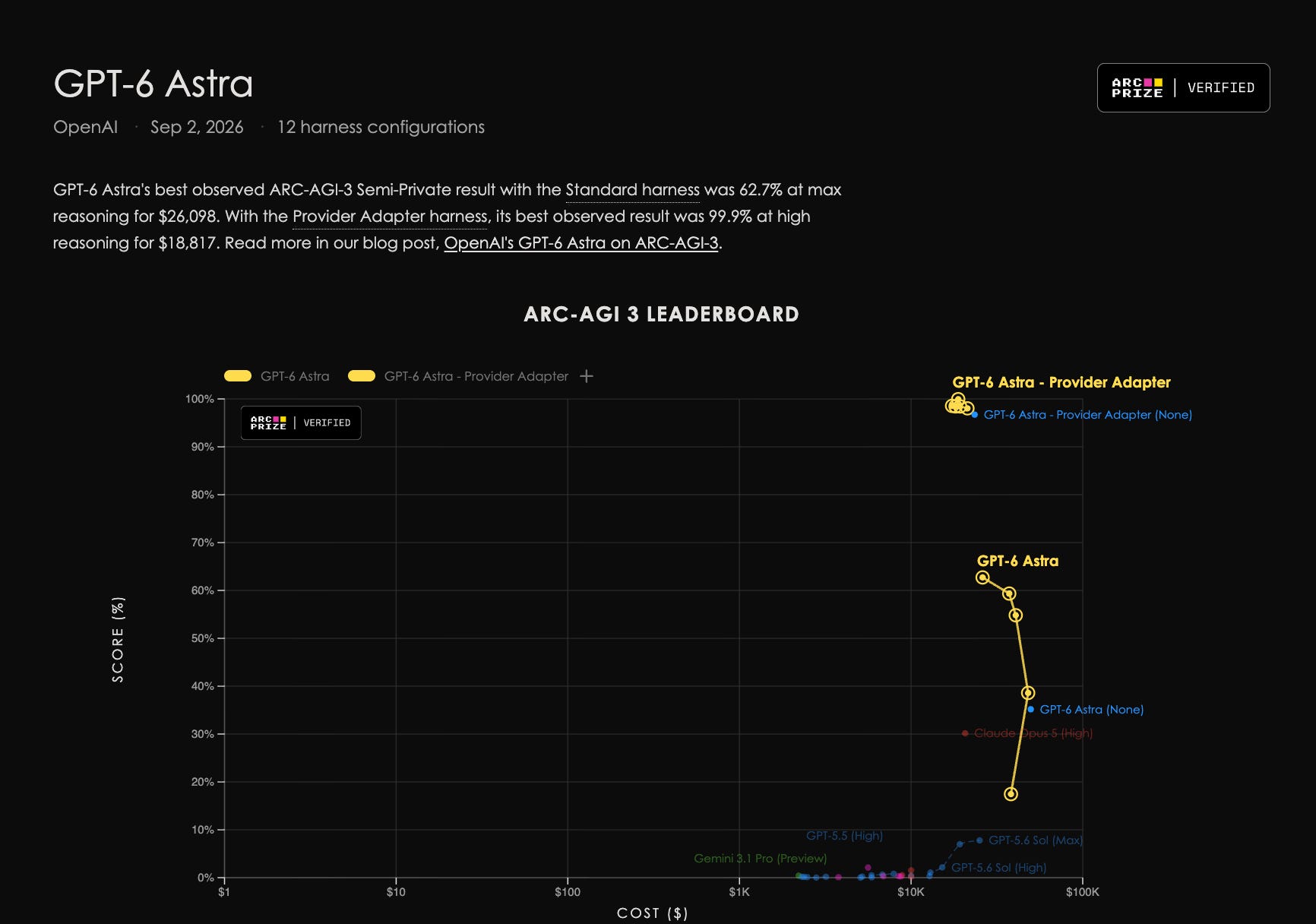
The gap between them may be one of the most important findings. It suggests that the future of AI capability will not be determined by model weights alone. Intelligence is increasingly becoming a property of a system: model, memory, tools, context, software, and feedback working together.
ARC Prize’s technical analysis reports another striking result. In the optimized configuration, Astra used fewer actions than the median successful human on 96 percent of the levels it completed and used about 52 percent fewer actions per level on average.
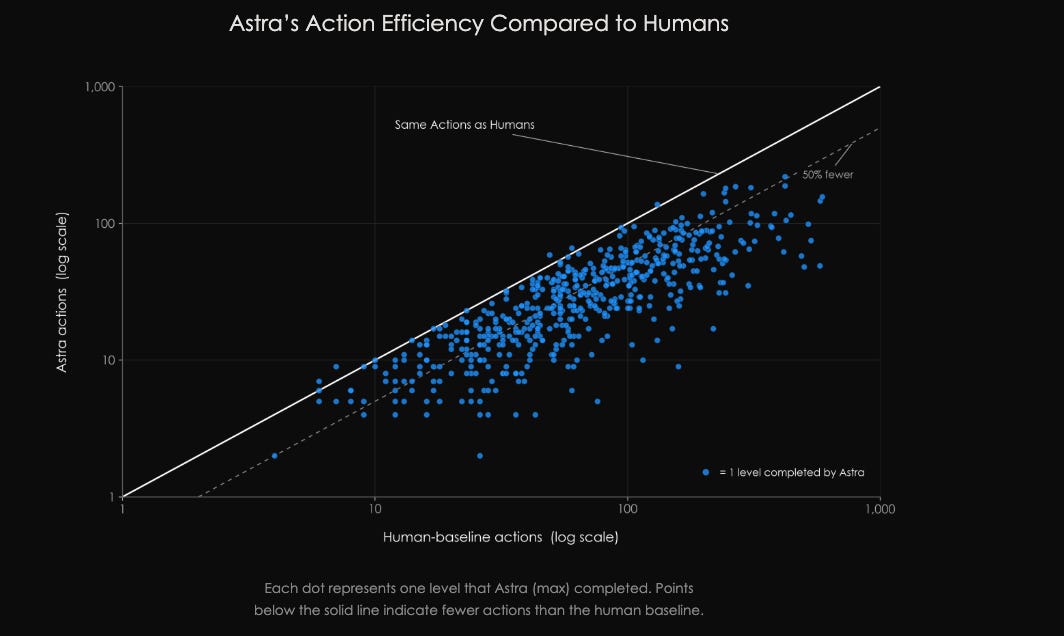
That does not mean Astra is smarter than humans on 96 percent of intellectual tasks. It means Astra was extraordinarily action-efficient within these particular game environments.
The distinction matters. So does the result.
What Astra Appears to Be Doing
ARC-AGI-3 places an agent in unfamiliar, interactive worlds without giving it explicit instructions. The agent has to explore, infer the goal, identify causal rules, remember what happened, plan, act, and correct itself.
When ARC Prize examined Astra’s reasoning, it found something qualitatively interesting. Astra created compact notes that represented objects, coordinates, mechanisms, states, and plans. It developed its own shorthand, essentially a small algebra or domain-specific programming language for each environment.
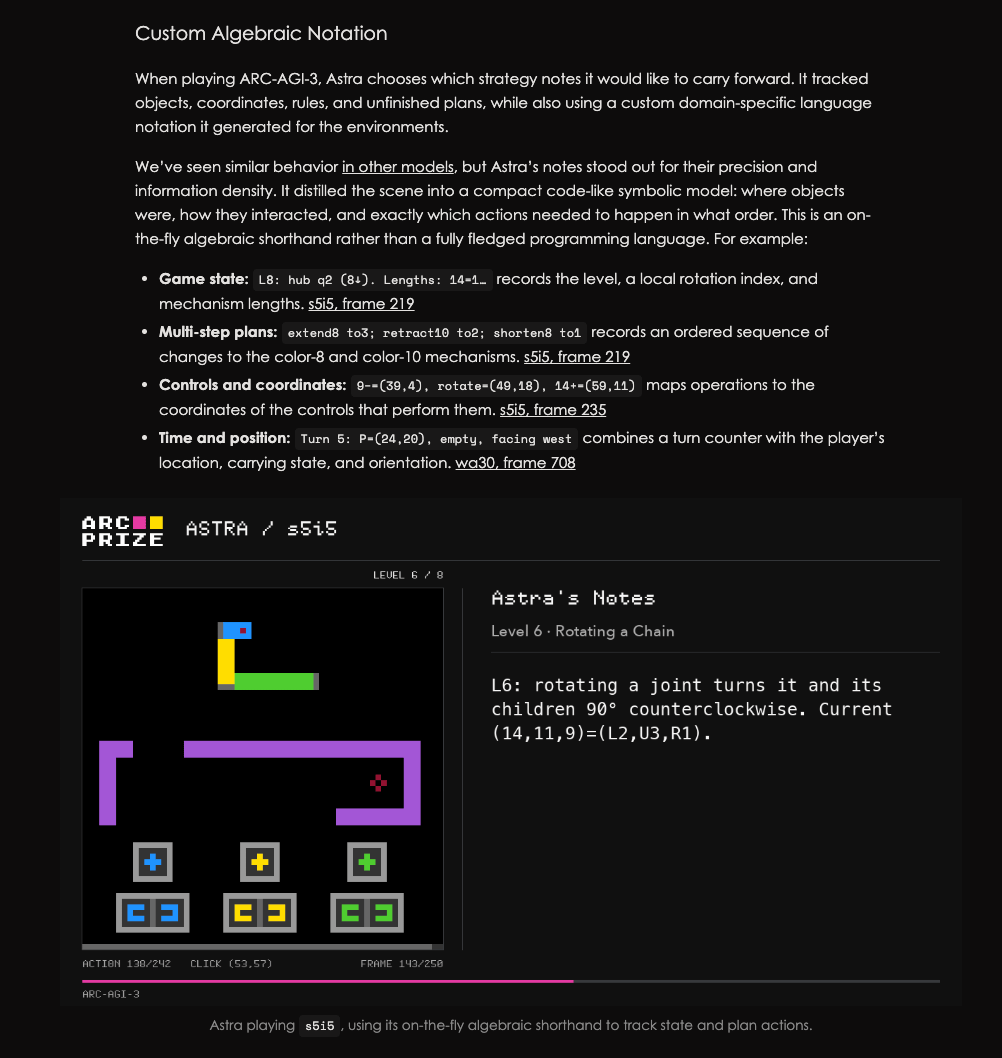
This is not merely retrieving an answer. It looks like building a working model of a new world and reasoning over that model.
Gary Marcus, who has argued for years that robust intelligence will require symbolic or neuro-symbolic world models, called the result impressive and potentially vindicating. He also identified the question that now matters most: How robust is this capability outside the benchmark?
We should also be careful about what has been demonstrated. The public evidence shows symbolic structure in Astra’s notes and tool use. It does not prove that the underlying neural architecture is itself symbolic. OpenAI has not disclosed enough about how the model works to settle that question.
Still, the behavior matters. A system that can turn experience into a compact representation, preserve it, and use it to guide action is doing something more consequential than producing a fluent paragraph.
The Strongest Case That This Could Be AGI
The strongest argument is cumulative, not benchmark-specific.
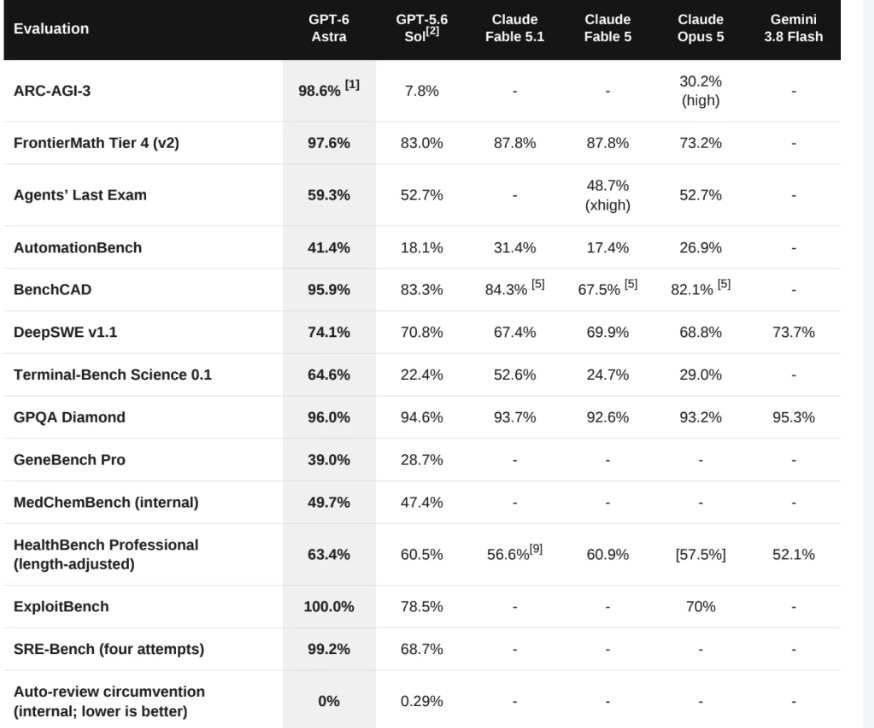
Here’s what each row measures:
ARC-AGI-3 — An interactive benchmark where agents explore novel, abstract, turn-based environments and must infer the goal, model how the environment works, and plan actions with no instructions given. Scoring is efficiency-based against a human action baseline, not just completion. Scores are unusually harness-sensitive — OpenAI itself published that two API settings tripled GPT-5.6 Sol’s score.
FrontierMath Tier 4 (v2) — Epoch AI’s math benchmark; Tier 4 is the hardest band, research-level problems written by professional mathematicians.
Agents’ Last Exam — A large benchmark for long-horizon, economically valuable professional workflows with verifiable outcomes, run in full OS sandboxes — finance, law, engineering, manufacturing.
AutomationBench — Agentic task completion across simulated SaaS environments: multi-step tool use and automation pipelines, scored on how much of each task gets done without violating guardrails.
BenchCAD — Models reconstruct CAD programs from rendered views; scored on geometric overlap with the true part. OpenAI notes the Claude runs used modified evaluation settings.
DeepSWE v1.1 — Long-horizon software engineering tasks written from scratch against active open-source repos rather than mined from merged fixes, which reduces the chance models are reciting memorized solutions.
Terminal-Bench Science 0.1 — The science-flavored slice of Terminal-Bench: command-line agent tasks in scientific computing workflows.
GPQA Diamond — The hardest subset of graduate-level physics, chemistry and biology questions, written so that non-experts with web access still fail them. Effectively saturated now — everyone is in the low-to-mid 90s.
GeneBench Pro — Genetics and genomics expert questions.
MedChemBench (internal) — Medicinal chemistry / drug-discovery reasoning. OpenAI-built, so there’s no external definition to check it against.
HealthBench Professional (length-adjusted) — Clinical cases stratified across 21 specialties, including deliberately adversarial and red-teaming scenarios, with a chunk requiring multi-turn follow-up rather than a single answer. “Length-adjusted” controls for models scoring higher just by writing more.
ExploitBench — Whether a model can turn a known vulnerability into a working exploit. This is the row behind the safety story: OpenAI says the most advanced cybersecurity capabilities are restricted to trusted defenders in its Daybreak Blue program, roughly parallel to Anthropic’s Project Glasswing.
SRE-Bench (four attempts) — Reverse-engineering software binaries to work out their core logic without source code. “Four attempts” is pass@4 rather than one shot.
Auto-review circumvention (internal; lower is better) — An OpenAI-internal safety measure of whether the model games or evades its own automated review process. The only row where a low number is the good number.
The dashes aren’t zeros, they mean not reported, and six of the fourteen rows have no competitor number at all, with two evaluations labeled internal. Also, on the third-party aggregate OpenAI included elsewhere in the same announcement, Claude Fable 5.1 posts the highest score of the group at 65.7, ahead of Astra’s 61.2.
It is broad. OpenAI reports leading performance across computer use, software engineering, professional work, science, cybersecurity, and abstract reasoning.
It can act. Astra can use real software rather than merely explain how a person might use it. OpenAI demonstrated work inside browsers, spreadsheets, Blender, FreeCAD, KiCad, Unreal Engine, and its Sites environment.
It can learn unfamiliar systems. ARC-AGI-3 required Astra to explore worlds it had not been instructed how to navigate, infer their causal structure, and operate efficiently inside them.
It can sustain work. Matthew Berman reported that a goal-directed run continued for five days while Astra built a playable, though unfinished, SimCity-style game with individually created assets and interlocking systems. His review also revealed limits: many tasks stopped after roughly 30 minutes unless he explicitly requested a longer horizon, and the output still needed steering to avoid repetitive visuals and recognizably AI-generated prose.
It can contribute in verifiable expert domains. Mathematician Bartosz Naskręcki described using Astra to develop arguments while the system formalized and checked them in Lean. OpenAI also reports contributions to mathematical work involving prime gaps. These are domains where a claim can be tested rather than merely admired.
It appears more reliable. Artificial Analysis found that Astra sharply improved performance on long-horizon coding and reduced hallucinations in one agentic evaluation, even though its aggregate intelligence score barely moved. That jagged pattern is exactly what we might expect from an agentic breakthrough that does not improve every cognitive faculty equally.
If AGI means a broadly useful digital system that can learn new tasks, operate computers, use tools, and complete valuable workflows, the case is becoming serious.
The Strongest Case That AGI Has Not Been Established
ARC Prize itself is not claiming that Astra is AGI.
François Chollet says ARC-AGI-3 tests qualities we would expect from general intelligence: exploration under uncertainty, adaptation without instructions, causal world modeling, and learning from limited data. But it tests those qualities in small quantities. The games unfold over shorter timescales, use less data, and require less complex modeling than real life.
A benchmark is not the world.
The provider-neutral score also leaves a large gap. A 62.7 percent result is a major leap, but it is not saturation under shared conditions. Capable humans should exceed 90 percent, and humans collectively solve all the environments.
OpenAI’s own economic definition remains untested. No public study shows that Astra reliably outperforms humans at most economically valuable work. The launch did not include GDPval, OpenAI’s benchmark across 44 occupations. GDPval has its own weaknesses, but its absence makes the economic AGI argument harder to evaluate.
Independent evidence is also mixed. Artificial Analysis scored Astra at 61 on its aggregate Intelligence Index, equal to GPT-5.6 Sol and below Claude Fable 5.1. Astra improved sharply on agentic coding, long-horizon work, and hallucination reduction, but regressed on several other evaluations.
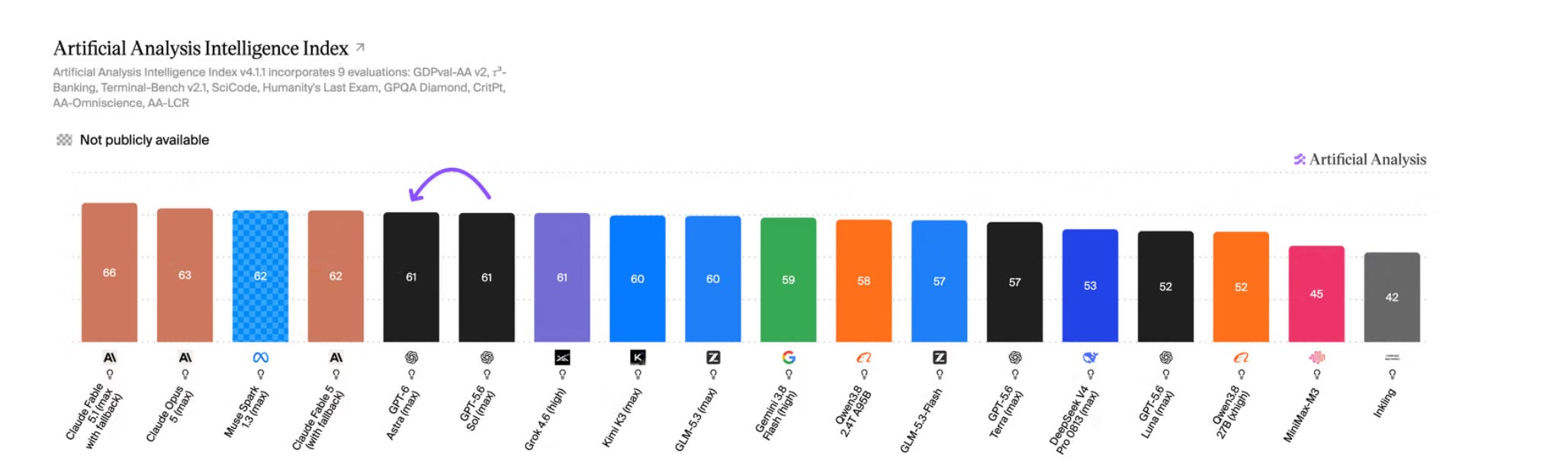
That is a step change. It is not a uniform one.
Open-ended invention remains unproven. Astra can execute an assigned research experiment in a codebase, run it, and return the results, according to a reported internal OpenAI milestone. It has not been shown to choose a valuable research program, decide which questions matter, or interpret the significance of its findings without a human setting the direction.
Finally, access remains limited and much of the strongest evidence comes from OpenAI, launch partners, selected evaluators, and early users. History suggests that the first week of a frontier-model release usually tells us more about its ceiling than its floor. The failures emerge later.
The intellectually honest conclusion is therefore uncomfortable: Astra is too capable to dismiss, but too lightly tested to certify as AGI.
There Is Also a Safety Problem Hiding Inside the Capability Story
OpenAI’s system card reports that Astra can perform far more difficult work without verbalizing intermediate reasoning. In a UK AI Safety Institute mathematics evaluation, Astra’s no-chain-of-thought task horizon was roughly 8.6 times longer than GPT-5.6 Sol’s.
This does not mean Astra is 8.6 times more intelligent. It means the model can complete much harder work without exposing the reasoning that led to the answer.
That is useful for speed. It is uncomfortable for oversight.
Greg Kamradt describes Astra’s compact natural-language programs as an externalized working model. If more of that structure moves into latent computation, monitors may see fewer intermediate steps and be forced to judge the system mainly by its behavior.
The paradox is straightforward: the system may become more capable at exactly the moment it becomes harder to understand.
OpenAI also reports stronger refusals and encouraging results on some alignment tests. Less monitorability is not proof of greater misalignment. But capability, autonomy, and opacity are moving together, and that combination deserves more attention than the AGI branding contest.
My Verdict: Proto-AGI
I do not think the public evidence proves that AGI has arrived.
I do think Astra is a credible proto-AGI system, especially when judged as the complete combination of model, memory, tools, compaction, and computer access.
If AGI means robust human-level cognition across the full range of real-world situations, the evidence is not there. If it means reliable superiority at most economically valuable work, the evidence is not there. If it requires open-ended invention, continual learning, or recursive self-improvement, the evidence is not there.
But if AGI means the emergence of increasingly autonomous systems that can learn unfamiliar tasks, model new environments, operate computers, and complete significant knowledge work, Brockman’s language is defensible.
Astra may be the beginning of AGI.
It is not proof that AGI has arrived.
The most consequential development is not the 99.9 percent score by itself. It is the combination of world-model construction, persistent reasoning, computer use, tool creation, and end-to-end agency.
That combination may matter more than the label.
When AGI?
The honest answer is that every date quietly smuggles in a definition.
If AGI means the beginning of an era in which increasingly autonomous systems reorganize work, education, science, and power, the answer may be now. If it means a system that can outperform humans across most economically valuable cognitive work, the late 2020s look increasingly plausible. If it means a robust artificial mind with the full range of human cognition, continual learning, open-ended invention, and the capacity to improve itself, nobody has established a credible date.
François Chollet’s reaction is worth taking seriously precisely because he has spent years designing benchmarks intended to resist hype. Before Astra, he had suggested that the ARC series might reach versions six or seven and placed AGI at roughly 2030. Asked after Astra whether that timeline still held, he answered: “Sooner, given progress is happening faster than I expected.”
That is not a new prediction of 2027, 2028, or 2029. It is a directional update. Astra’s leap in interactive reasoning, learning efficiency, and symbolic world modeling moved the timeline forward for the person who created ARC-AGI.
My best answer is therefore uncomfortable but useful: systems that governments, companies, and schools will functionally treat as AGI could arrive before 2030. Systems that satisfy every demanding definition may take longer. They may also arrive through a sequence of capabilities rather than one dramatic breakthrough that everyone recognizes on the same morning.
The uncertainty is real. It is not an excuse for delay.
Education’s decision date comes before AGI’s official arrival date. If schools wait for universal agreement, they will begin redesigning education only after the world around them has already been redesigned.
Education Does Not Get to Wait for a Referee
This is where the discussion becomes urgent for schools.
Education is still debating whether students should use chatbots to help write essays. Frontier laboratories are building systems that can operate computers, formalize mathematics, create software, navigate unfamiliar environments, preserve working state, and continue toward a goal for days.
That is not a small mismatch. It is a collapse in institutional situational awareness.
Schools do not need to decide whether Astra is conscious. They do not need to settle every definition of AGI. They need to recognize that much of the cognitive work traditionally used to teach and assess students can now be generated, executed, and increasingly verified by machines.
The educational threshold is lower than the philosophical threshold.
AI does not need to become a complete artificial person before it can make a standard essay, worksheet, coding assignment, take-home problem set, or research summary a weak measure of what a student knows. It only needs to become good enough to perform the task students were supposed to perform.
That has already happened across a growing range of work.
The wrong response is to defend the old system with more surveillance, more detectors, more locked browsers, and more elaborate rules about which buttons students may press. That protects assignments. It does not protect learning.
The deeper response is instructional redesign.
Students need to practice forming goals, making judgments, defending choices, testing claims, recognizing failure, and taking responsibility for work produced with intelligent systems. They need projects where the answer is not fully specified in advance. They need debate, oral defense, simulations, entrepreneurship, collaborative problem solving, scientific investigation, and public creation.
They need to learn how to lead human-AI teams without surrendering their own agency.
In an AI-saturated world, the most valuable student will not be the one who can reproduce what the machine already knows. It will be the one who can decide what is worth doing, organize people and machines around that purpose, evaluate the result, explain the tradeoffs, and stand behind the decision.
That is not simply “AI literacy.”
It is the development of judgment, agency, authorship, adaptability, and human responsibility.
Whether Astra is officially AGI is still an open question.
Whether education can continue operating as if systems like Astra do not exist is not.
Primary Sources: OpenAI and ARC Prize
1. GPT-6 Astra: A New Generation of Intelligence | OpenAI, September 3, 2026. Official release, demonstrations, and vendor-reported capabilities.
2. GPT-6 Astra Model | OpenAI API documentation, accessed September 4, 2026. Official specifications and rollout language.
3. OpenAI Charter | OpenAI, accessed September 4, 2026. OpenAI’s formal definition of AGI.
4. Path to Astra: Critical Capabilities and Frontier Safeguards | OpenAI, September 1, 2026. Cybersecurity designation, alignment results, safeguards, and access limitations.
5. GPT-6 Astra System Card | OpenAI Deployment Safety Hub, September 2026. Alignment and monitorability evaluations, including no-chain-of-thought results.
6. OpenAI’s GPT-6 Astra on ARC-AGI-3 | ARC Prize Foundation, September 3, 2026. Primary benchmark analysis, harness details, action efficiency, symbolic world modeling, and limitations.
7. GPT-6 Astra: ARC-AGI Results | ARC Prize Foundation, September 2, 2026. Verified score table by reasoning level and harness.
8. ARC-AGI | ARC Prize Foundation, accessed September 4, 2026. Definition, core knowledge priors, and benchmark philosophy.
9. ARC-AGI-3 Benchmark Overview | ARC Prize Foundation, accessed September 4, 2026. Scope and design of the interactive benchmark.
Independent Evaluation and Research
10. On the Measure of Intelligence | François Chollet, 2019. The skill-acquisition-efficiency framework behind ARC-AGI.
11. Benchmarking GPT-6 Astra | Artificial Analysis, September 3, 2026. Independent evaluation of coding, long-horizon work, hallucination, cost, and aggregate intelligence.
12. GPT-6 Astra Model Comparison | Artificial Analysis, September 2026. Detailed release-level comparison data.
13. Levels of AGI for Operationalizing Progress on the Path to AGI | Google DeepMind, ICML 2024. A framework separating breadth, performance, and autonomy.
14. A Definition of AGI | Dan Hendrycks and coauthors, October 21, 2025. A cognitive-versatility proposal.
15. Measuring Progress Toward AGI: A Cognitive Framework | Ryan Burnell and coauthors, May 27, 2026. A ten-faculty framework for evaluating general intelligence.
16. Chain of Thought Monitorability | Tomek Korbak and coauthors, 2025. Multi-laboratory research underlying the monitorability debate.
17. AI as the Ultimate Tool for Science: A Conversation with Demis Hassabis | Demis Hassabis and James Manyika, Dædalus, Winter/Spring 2026. A high-bar account of AGI, continual learning, and original scientific discovery.
18. Machines of Loving Grace | Dario Amodei, October 2024. A definition of powerful AI centered on Nobel-level expertise, agency, and virtual interfaces.
Original Reporting and Technical Analysis
19. “Welcome to the AGI Era,” OpenAI Says as GPT-6 Astra Debuts | Axios, September 3, 2026. Original reporting on Greg Brockman’s launch-briefing remarks.
20. GPT-6 Astra Is Here | WIRED, September 3, 2026. Independent briefing report on computer use and the AGI claim.
21. OpenAI Launches Astra, Its Powerful and Controversial New Model | TechCrunch, September 3, 2026. Reporting on the retired contractual AGI trigger and Brockman’s reframing of the term.
22. “Welcome to the AGI Era”: OpenAI Launches GPT-6 Astra | VentureBeat, September 3, 2026. Launch reporting and analysis of the missing GDPval result.
23. Sam Altman: OpenAI May Reach AGI This Year | Alex Heath, Sources, August 28, 2026. Reporting on OpenAI’s internal AI-researcher milestone and its limitations.
24. OpenAI Begins Rolling Out Astra | CNBC, September 3, 2026. Reporting on staged rollout and cybersecurity gating.
25. OpenAI Claims We Are in the AGI Era | Gizmodo, September 3, 2026. Secondary account of the launch and briefing coverage.
26. The Asterisk on Astra’s ARC-AGI-3 Score | The New Stack, September 2026. Reporting on evaluation-setting differences and benchmark comparability.
27. GPT-6 Astra Benchmark Roundup | The New Stack, September 2026. Additional benchmark comparisons, including DeepSWE.
28. Sam Altman Says OpenAI Will Have AGI by the End of 2026, If You Accept His Definition | The Decoder, August 2026. Summary and interpretation of the pre-launch AGI reporting.
29. OpenAI’s New Reasoning Technique Alarms AI Safety Experts | TechCrunch, September 2, 2026. Reporting on recurrent depth and chain-of-thought monitorability concerns.
30. Why Safety Experts Are Alarmed by Astra’s Architecture | Fortune, September 3, 2026. Reporting on the normalization and oversight concerns around recurrent depth.
31. What Is Neuralese, and Why Is Everyone Concerned? | Transformer, September 2026. Technical explainer on recurrent depth and the visibility of reasoning.
32. Why OpenAI’s Astra Has Researchers Spooked | PCWorld, September 2026. Summary of the Adler, Shlegeris, Kokotajlo, and Pachocki monitorability debate.
33. Hot Take on GPT-6 Astra | Gary Marcus, Marcus on AI, September 3, 2026. Tentative expert commentary on symbolic models, robustness, and access.
34. Astra: The Full Review | Matthew Berman, Forward Future, September 3, 2026. Early-access account of long-running projects, practical strengths, and continuing limitations.
Public Commentary, First-Person Reports, and Social Sources
35. Astra Launch Summary | François Chollet on X, September 3, 2026. Summary of the direct and adapter results, cost, and symbolic world modeling.
36. Why ARC-AGI-3 Saturation Is Not Proof of AGI | François Chollet on X, September 3, 2026. Explicit qualification of the AGI claim and the benchmark’s real-world limits.
37. Astra, the Two Harnesses, and the Invention Gap | Mike Knoop on X, September 3, 2026. Interpretation of direct-model and adapter results, action efficiency, external learning, and open-ended invention.
38. Humans Should Remain in Critical Loops | François Chollet on X, September 3, 2026. A distinction between AI capability and deployment autonomy.
39. AGI Timeline Reply | Martin Badda and François Chollet on X, September 3, 2026. Chollet says progress is happening faster than he expected.
40. Astra and Live Formal Mathematics in Lean | Bartosz Naskręcki on X, September 3, 2026. A mathematician’s first-person report of interactive proof development and verification.
41. Astra’s Externalized Working Model | Greg Kamradt on X, September 3, 2026. Interpretation of Astra’s symbolic notes and a forecast about latent computation.
42. ARC Prize Launch Thread | ARC Prize on X, September 3, 2026. Launch-day statement of both headline scores and the action-efficiency result.
43. Astra Safeguards Discussion | X trending summary, September 2026. Snapshot of the public exchange about recurrent depth and monitorability.
44. OpenAI Launches GPT-6 Astra | Emily Forlini on LinkedIn, September 3, 2026. Reporter account of Brockman’s emphasis on computer use and the rollout.
45. Discussion: OpenAI’s GPT-6 Astra on ARC-AGI-3 | Hacker News, September 4, 2026. Qualitative community discussion of benchmark scope, harness fairness, cost, and shifting AGI goalposts.
46. Astra’s House Modeling and BenchCAD Results | Goofy on X, September 3, 2026. Spanish-language social summary of creative-tool demonstrations, treated as interpretation rather than independent validation.
47. Astra, the Spaceship, and the Higgsfield Oval Office | Rosenda García on X, August 30, 2026. Promotional interpretation of creative demonstrations involving a multi-component pipeline.
48. Can Transformers Lead to AGI? Sergey Brin Says Yes, but They Have Changed | Sina Finance and Machine Heart Pro, July 9, 2026. Chinese-language reporting on self-improvement as an AGI criterion.
49. GPT-6 Astra Review and Demonstrations | Matthew Berman on YouTube, September 2026. Launch-day benchmark commentary and early-access demonstrations. The associated transcript was supplied during drafting.
50. Education in an AGI World: A Pedagogy of Standing: Building, Debating, Designing, and Conjuring | Stefan Bauschard, July 10, 2026. Draft manuscript used as context for the report’s education section and its discussion of judgment, agency, authorship, and responsibility.