
Deep Learning: Project-Based Learning (Chapter 10 Humanity Amplified)

“I believe that education, therefore, is a process of living and not a preparation for future living.”
— John Dewey, “My Pedagogic Creed” (1897)1
“One thing we’ll know for sure is you’re going to have to continually learn … throughout your career.”
— Demis Hassabis, 20252
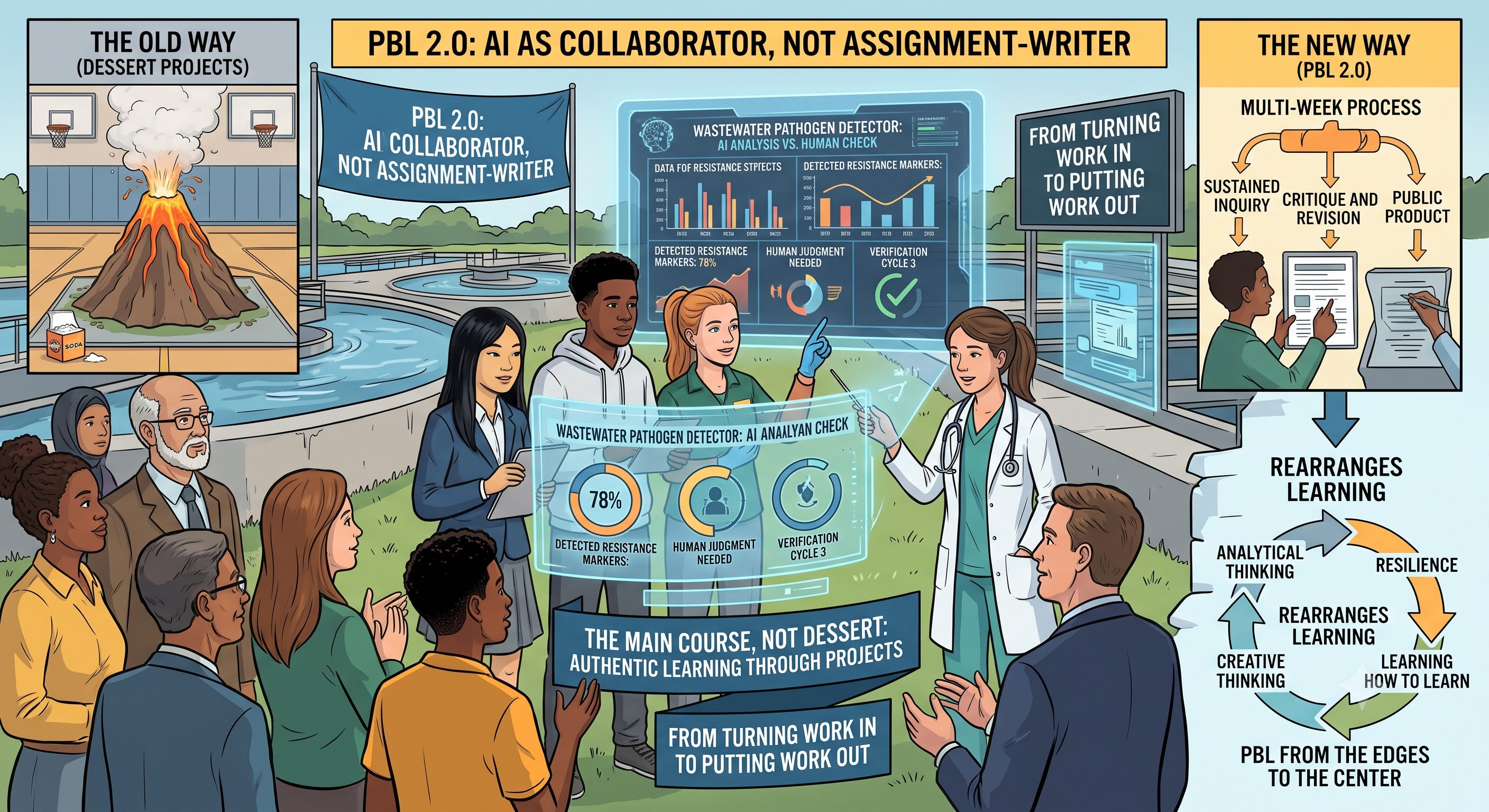
In one of my recent programs, a team of students set out to detect antibiotic resistance in wastewater. They worked alongside a medical student. They used AI — not to write a paper about antibiotic resistance, but as a collaborator in the detection work itself, and part of their job was judging what the machine got right and where it had to be checked. Their project took first place in New York State.3 The principle behind that work — the machine inside the project, directed and checked by the students, not handed the assignment — is one a growing number of teachers now build on by design; the educator Phillip Alcock calls his version of it PBL 2.0.4
Notice what that project did not involve. Nobody turned anything in. Nobody memorized a chapter and forgot it after the unit test. The students had a problem that mattered, a partner who knew things they didn’t, a tool that had to be supervised, and a public judgment waiting at the end.
Most school assignments end the same way: the student hands the work to the teacher, the teacher hands back a grade, and the work dies in a folder. A project ends differently. The work goes out into the world — to a panel, a client, a competition, a community — and the world responds.
That single change, from turning work in to putting work out, rearranges nearly everything else about how learning happens. It changes what students are willing to do, how long they persist, what they remember, and what they can prove they know. This chapter is about that rearrangement.
The last two chapters made the case for debate and for entrepreneurship education. Both are, at bottom, projects: sustained work on a real problem, performed for an audience that isn’t grading on a curve. Debate is a project with an opponent. A venture is a project with a market. This chapter zooms out to the general case — project-based learning, the oldest and broadest member of the family, available in every subject and every grade.
The Main Course, Not Dessert
Start with what project-based learning is not, because the confusion is the biggest obstacle the field faces.
Every adult remembers “doing projects” in school. The shoebox diorama. The poster board. The model volcano that erupted baking soda in the gym. These arrived at the end of a unit, after the real teaching had happened through lectures, worksheets, and readings. The project was a reward, a craft session, a break.
The Buck Institute for Education — the organization that has done more than any other to define the field — calls those dessert projects. In project-based learning, the project is the main course: the vehicle through which the academic content itself gets taught.5 Students learn the history, the science, or the mathematics by working on the project, not before it.
The institute’s Gold Standard framework specifies what separates a real project from an activity: a challenging problem or question, sustained inquiry over weeks rather