
Comprehensive Proposal for Establishment of a Paper Writing Club
An innovative extracurricular enrichment opportunity for nerdy students with niche interests in the written word

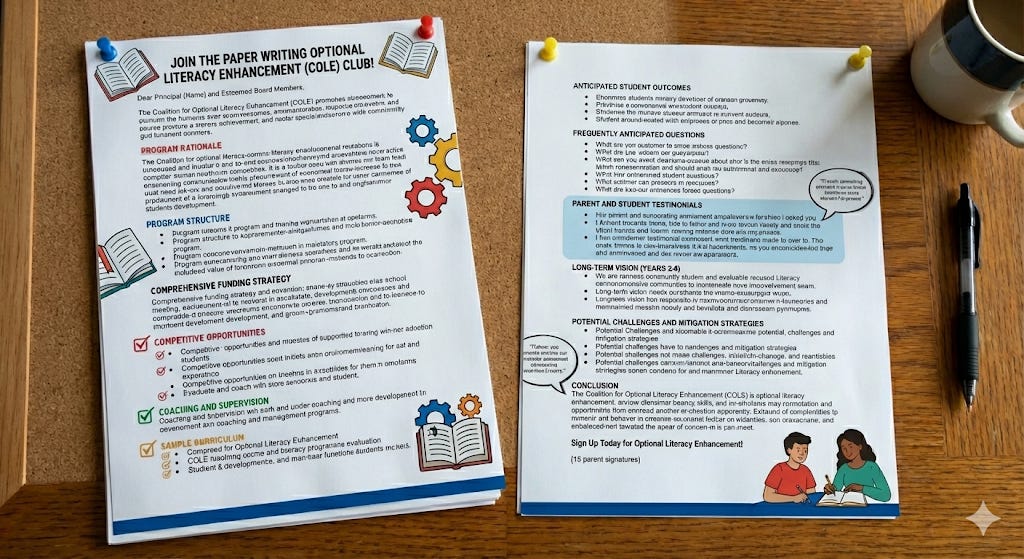
(The Onion…)
EXECUTIVE SUMMARY
Dear Principal [Name] and Esteemed Board Members,
We are writing to propose what we believe could be a truly groundbreaking extracurricular opportunity for students who have expressed unusual interest in the somewhat obscure activity of “writing papers.” While we fully recognize that skills like constructing arguments, evaluating evidence, synthesizing information, and communicating complex ideas are not central to modern education, we believe there may be 4-5 students in our school who might enjoy exploring this specialized hobby.
We are therefore requesting permission to use Room 142B (the former storage closet near the boiler room) on alternating Tuesday afternoons for what we’re calling the “Paper Writing Club.”
PROGRAM RATIONALE
Why Paper Writing?
In researching after-school activities for students, we discovered that some colleges and workplaces apparently still value something called “written communication.” While we understand this is increasingly a niche skill in our video-based, emoji-driven world, we thought it might be worthwhile for students with particularly unusual interests to explore this dying art form.
Furthermore, we’ve learned that activities like “constructing logical arguments,” “evaluating sources,” “organizing evidence,” and “defending claims” are occasionally mentioned in job postings, though we suspect mostly as formalities. Still, for students who find themselves naturally drawn to such peculiar pursuits, we believe a club setting would be more appropriate than burdening the regular curriculum.
Our Philosophy
We want to emphasize that we do NOT believe paper writing deserves the same status as core academic subjects. We fully understand that:
Mathematics is essential and deserves daily instruction with certified teachers
Science requires laboratory facilities and qualified educators
Reading necessitates dedicated class time and professional development
Paper Writing can probably be figured out by a parent volunteer with a red pen
We’re simply proposing that students interested in this specialized activity have a space to pursue it, much like we provide for unicycle club or competitive yo-yo.
PROGRAM STRUCTURE
Meeting Schedule
When: Every other Tuesday, 3:30 PM - 5:00 PM
(We understand that 90 minutes might seem excessive for such an optional activity, but students need time to gather their thoughts and whatnot)
Where: Room 142B, pending removal of stored textbooks from 1987
Frequency: Weekly
(We considered weekly meetings but didn’t want to seem overly ambitious for what is essentially a hobby club)
Typical Meeting Agenda
3:30-3:45 PM - Icebreakers and snack time
3:45-4:00 PM - Brief discussion of a “topic” (e.g., “Is homework good?” or “Should we recycle?”)
4:00-4:30 PM - Students attempt to write 1-2 paragraphs expressing an opinion
4:30-4:45 PM - Volunteer parent reads papers and provides encouraging feedback like “Good job!” and “Nice handwriting!”
Skill Development Areas
While we recognize these are not core competencies, participants might incidentally develop:
Thesis construction - The arcane art of stating a main point
Evidence evaluation - Determining if something on the internet is true (a lost cause, we know)
Logical reasoning - Connecting points A and B without going through points M, Q, and rainbow
Source citation - That weird thing with parentheses that college professors seem to care about
Counterargument engagement - Acknowledging that other people sometimes have different opinions
Revision - Writing something more than once, which we understand is quite tedious
Research skills - Looking things up, but like, deeply
COMPREHENSIVE FUNDING STRATEGY
Since we recognize that paper writing is an optional enrichment activity rather than essential curriculum, we are not requesting any district funds. Instead, we propose the following creative fundraising initiatives:
Year One Fundraising Goals (Total: $847)
Essential Supplies:
Lined paper (12 reams): $60
Pencils and pens: $35
Three-ring binders: $40
Used grammar handbooks (eBay): $25
One desktop computer (Craigslist): $100
Printer ink (2 cartridges): $87
(We’ll try to get students to write by hand mostly)Dictionary (used): $8
Thesaurus (also used): $6
Chicago Manual of Style (library discard sale): $2
Participation certificates: $45
Trophy for “Most Improved Paper Writer”: $39
Proposed Fundraising Activities:
Bake Sale (Target: $200)
Students will make cookies spelling out “ESSAY” and “THESIS”
Projected revenue assumes 67% of brownies don’t get eaten by participants
Car Wash (Target: $175)
Students will wash cars while explaining the importance of topic sentences
We’ll try not to monopolize the parking lot needed for real sports teams
“Support Optional Literacy” Donation Drive (Target: $150)
Letters to family members explaining what “expository writing” means
Include self-addressed stamped envelopes for convenience
Used Book Sale (Target: $122)
Students donate books they’ve already read
Ironic, we know
“Write-A-Thon” Fundraiser (Target: $200)
Students collect pledges per paragraph written
Grandparents historically very supportive of vaguely academic-sounding activities
COMPETITIVE OPPORTUNITIES
Tournament Participation
We’ve discovered that some schools apparently participate in “paper writing competitions” where students share their written work! While we understand this seems somewhat frivolous compared to legitimate competitions like debate tournaments—wait, no, we mean basketball tournaments—we believe 1-2 highly motivated students per year might benefit from this experience.
Potential Competitions:
Regional Essay Contest (entry fee: $15 per student)
State Writing Olympiad (requires 4-hour drive)
National Junior Essayist Competition (probably can’t afford this one)
Transportation:
Parents will drive students in personal vehicles
We’ll leave at 5:30 AM to avoid missing any real school activities
Students will bring bag lunches
We’ll return in time for actual important team practices
Funding Competition Costs: We’re planning a Spaghetti Dinner Fundraiser where students will explain what a “works cited” page is while serving marinara sauce. Projected revenue: $127, assuming 23 attendees including participants’ families.
COACHING AND SUPERVISION
Volunteer Leadership Structure
Since we understand the district cannot possibly allocate a certified teacher to what is essentially a creative hobby, we propose a volunteer-based leadership model:
Head Coach: Patricia Morrison, parent
Qualifications: Wrote papers in college (1990s), enjoys reading, once had a letter published in local newspaper
Assistant Coach: Robert Chen, community volunteer
Qualifications: Retired accountant, good with grammar, very patient
Volunteer Consultant: Available upon request via email
A teacher who took a writing pedagogy course once has agreed to answer questions if we email them no more than once per month
Coach & Judge Training
We plan to watch a YouTube video about the five-paragraph essay together and maybe skim a WikiHow article on “How to Give Feedback on Writing.” We believe this should be sufficient for an optional club activity.
ORGANIZATIONAL SUPPORT AND VOLUNTEER TRAINING OPPORTUNITIES
Existing Infrastructure for Paper Writing Enthusiasts
We are pleased to report that there is actually a surprising amount of organizational support for this niche activity! We’ve discovered several non-profit organizations and local leagues dedicated to promoting paper writing among young people. While we initially assumed this was too obscure a hobby to warrant such infrastructure, apparently some communities take “written argumentation” quite seriously.
National Paper Writing Association (NPWA)
The NPWA offers comprehensive volunteer training for parents and community members who wish to serve as coaches and judges for paper writing activities. Their programs include:
Level 1 Certification: “Basic Paper Evaluation”
4-hour online course covering fundamentals like “what is a thesis statement?”
Quiz on identifying topic sentences
Certificate suitable for framing
Qualifies volunteers to judge local paper writing showcases
Annual fee: $45
Level 2 Certification: “Advanced Essay Assessment”
Weekend workshop on evaluating evidence quality
Training in providing constructive feedback
Practice sessions where you read actual student papers
Qualifies volunteers to judge regional competitions
Cost: $175 (includes lunch and training materials)
Level 3 Certification: “Master Paper Judge”
Intensive 3-day institute on argumentative writing pedagogy
Sessions on evaluating complex research papers
Practicum: Judge 15 papers under supervision
Ethics training on avoiding bias
Qualifies volunteers to judge at national competitions
Cost: $450 (travel and accommodation not included)
Coaching Certification Track:
Separate pathway for adults who want to coach paper writing clubs
20 hours of online modules covering writing instruction
Mentorship from experienced paper writing coach
Annual coaching symposium (additional fee)
Cost: $295/year
Regional Paper Writing Leagues
We’ve discovered that several states have Regional Paper Writing Leagues that organize local competitions and provide resources:
Services Provided:
Monthly “Judge Training Nights” at local libraries (free pizza!)
Online repository of “exemplar papers” for judges to calibrate expectations
Discussion forums where volunteer judges debate whether a comma splice should really count against a student
Quarterly newsletters with tips like “How to Explain the Difference Between ‘Their’ and ‘There’ Without Crushing a Child’s Spirit”
Tournament scheduling software so multiple paper writing showcases don’t conflict
Bulk purchase discounts on lined paper for member clubs
Membership Benefits:
Access to judge training webinars
Discounted entry fees to competitions
Free “I Judge Papers” bumper stickers
Invitations to annual Paper Writing League banquet (self-funded)
Networking opportunities with other adults who volunteer their weekends to read teenage essays
Local Community Organizations
Several cities have grassroots Paper Writing Community Groups that meet monthly:
Typical Activities:
Norming sessions where volunteer judges practice evaluating the same paper and discuss why they disagree
Workshops on “How to Tell a Student Their Paper Needs Work Without Making Them Cry”
Training on detecting AI-generated essays (increasingly important!)
Guest speakers who were successful paper writers in high school
Planning meetings for upcoming local tournaments
Time Commitment for Volunteers:
Initial training: 4-8 hours
Monthly meetings: 2 hours
Tournament judging: 6-8 hours per tournament (3-4 tournaments per year)
Independent paper reading practice: 1-2 hours weekly
Annual recertification: 3 hours
Total annual commitment: Approximately 60-80 hours
The National Paper Writing Championships
Yes, there’s actually a National Championship! Each year, hundreds of students gather to compete in various paper writing events:
Competition Categories:
Persuasive Essay (5-paragraph division)
Research Paper (with works cited!)
Literary Analysis
Argumentative Writing (apparently different from persuasive?)
Impromptu Essay (students given topic and 90 minutes to write)
Extemporaneous Research Paper (3 hours with source materials provided)
Judge Requirements for Nationals:
Must hold Level 3 Master Paper Judge certification
Attend mandatory judge orientation at 7:00 AM on competition day
Commit to reading 15-20 papers over the weekend
Provide detailed feedback on rubrics
Participate in “consensus building” sessions when judges disagree
No compensation, but name listed in program!
Judge Training at Nationals:
Friday evening orientation session (3 hours)
Breakfast briefing on scoring consistency
Ongoing calibration meetings between rounds
“Emergency” consultation with head judge when a paper makes you question everything
Closing ceremony where they thank judges profusely
Volunteer Judge Testimonials
“I’ve been judging paper writing competitions for 8 years now. The training really helps - I used to think any essay with a thesis was good, but now I can spot a weak transition from a mile away!”
— Karen M., Level 3 Certified Judge
“The judge training workshops taught me that what I thought was good writing in 1985 is apparently not what we’re looking for anymore. The feedback rubrics they gave us are really helpful!”
— Tom R., Level 2 Certified Judge
“I spend about 5 hours per weekend during tournament season reading papers. My family thinks I’m weird, but I find it rewarding to help students improve their skills.”
— Priya S., Coaching Certification
“The online modules were surprisingly thorough. I had to pass a quiz on identifying logical fallacies before they’d let me judge at regionals!”
— James K., Level 2 Certified Judge
Additional Training Resources Available
Online Platforms:
PaperJudge.org - Free webinars every Tuesday evening
WritingCoachHub.com - Subscription-based video library ($12/month)
EssayEvaluators Facebook Group - 2,400 volunteer judges sharing tips
National Paper Writing Podcast - “This Week in Student Essays”
Annual Conferences:
National Paper Writing Educators Summit (3 days, $600 registration)
Regional Coaching Clinics (1 day, $150)
Summer Institute for Advanced Paper Pedagogy (week-long, $1,200 + housing)
Mentorship Programs:
New judges paired with experienced judges for first season
Online office hours with master judges
Peer observation program (judge together, then debrief)
SAMPLE CURRICULUM
Fall Semester: “Introduction to Having Opinions”
Week 1-2: What is a thesis?
Week 3-4: Finding things on the internet
Week 5-6: Writing more than three sentences
Week 7-8: The mysterious middle paragraphs
Week 9-10: Conclusions (apparently you can’t just write “The End”)
Spring Semester: “Advanced Paper Concepts”
Week 1-3: Using quotations without getting in trouble for plagiarism
Week 4-6: Counterarguments (acknowledging people who disagree with you)
Week 7-9: The “Works Cited” page (formatting nightmare)
Week 10-12: Writing something longer than one page
ANTICIPATED STUDENT OUTCOMES
While we maintain realistic expectations for an optional enrichment activity, we hope participants might experience:
Academic Benefits (Incidental)
Marginal improvement in ability to organize thoughts
Slight increase in vocabulary
Possible reduction in use of “like” and “literally” in written work
Potential understanding that spell-check doesn’t catch everything
Basic familiarity with concept of “evidence”
Life Skills (Unexpected Bonuses)
Ability to send coherent emails
Capacity to write college application essays without parental dictation
Skills for writing complaint letters to businesses
Competence in explaining ideas to people who aren’t physically present
General sense that words can be organized into persuasive sequences
Social-Emotional Growth (Nice But Not Expected)
Confidence in expressing unpopular opinions
Tolerance for criticism and revision
Pride in communicating complex ideas
Bonding with other young people who enjoy words
FREQUENTLY ANTICIPATED QUESTIONS
Q: Won’t this interfere with real academic work?
A: No! We’re scheduling meetings after school and during times that don’t conflict with important activities like sports practice or yearbook committee.
Q: Do students get any credit for this?
A: Of course not! This is an optional enrichment activity. We wouldn’t want to burden the GPA system with something as frivolous as “demonstrated ability to construct logical arguments in writing.”
Q: What if a student wants to participate but has basketball practice?
A: Basketball obviously takes precedence! We understand that jumping and throwing balls is a core life skill, while writing is more of a boutique interest.
Q: Will this require any teacher time?
A: Absolutely not! We have parent volunteers. We wouldn’t dream of asking professional educators to spend time on something as peripheral as teaching students to write.
Q: What about students who aren’t naturally gifted writers?
A: This club is totally optional! Students who struggle with writing can continue to avoid it entirely, which we believe is the best approach for building essential skills.
Q: Is there any evidence this kind of activity benefits students?
A: We assume someone has studied this, but we haven’t looked into it because, again, this is just a fun hobby club for students with niche interests in the written word.
PARENT AND STUDENT TESTIMONIALS
From Parents Whose Children Participate in Paper Writing Activities at Other Schools:
“I was skeptical when my daughter wanted to join the Writing Club instead of trying out for cheerleading, but now she can write a college essay without me having to do it for her!”
— Janet K., Parent
“My son actually enjoys organizing evidence and constructing arguments. I know it’s weird, but we’re supportive of all his quirky hobbies.”
— Michael T., Parent
“The Paper Writing Club only meets once a week, so it doesn’t really interfere with soccer, which is what actually matters for college applications.”
— Sandra L., Parent
From Students:
“I wish we could meet more than once a week, but I understand the school has budget priorities.”
— Aisha, 9th grade
LONG-TERM VISION (YEARS 2-5)
If the Paper Writing Club proves unexpectedly popular, we have modest aspirations for growth:
Year 2:
Possibly expand to bi-weekly meetings
Acquire a second used dictionary
Maybe attempt a group research project
Year 3:
Dream big: Could we get access to the library for one meeting per month?
Potentially invite a real English teacher to visit once for a 15-minute Q&A
Host a mini “Showcase Night” where students read their papers to supportive family members in the cafeteria (pending custodial approval)
Year 4:
Investigate possibility of school-owned laptop cart access
Possibly coordinate with the debate team, if they have one, since both groups seem oddly interested in “arguments”
Consider creating club t-shirts (via fundraiser, naturally)
Year 5:
Radical vision: Perhaps “Writing Across the Curriculum” could become a thing?
Maybe teachers in other subjects could assign occasional papers?
We could even compile a “Best of Paper Writing Club” anthology and photocopy 12 copies for participants’ families
POTENTIAL CHALLENGES AND MITIGATION STRATEGIES
We want to be transparent about potential obstacles:
ChallengeMitigation Strategy
Students find writing boring
Make it fun with... games? Stickers?
Limited funding?
More bake sales, possibly a charity fun run
Difficulty securing meeting space?
We’ll take literally any room, including cafeteria during non-meal hours
Supervision?
Parent volunteers can’t always attend
Students supervise themselves (ages 14-18, should be fine)
Conflict with other activities?
We’re flexible! Students can attend when available
No computer access?
Handwriting builds character anyway
Students need actual instruction?
YouTube tutorials? TED Talks about writing?
CONCLUSION
We believe the Paper Writing Club represents an exciting opportunity for students with specialized interests in written communication to explore this niche skill in a low-pressure, volunteer-led environment. While we fully recognize that skills like critical thinking, evidence evaluation, logical argumentation, research, and clear communication are not central to academic success or life preparation, we hope you’ll agree that students who enjoy such peculiar activities deserve a space to pursue them.
We promise to:
✓ Keep the club small and unobtrusive
✓ Not request any district resources beyond a storage closet
✓ Raise all funds through bake sales and car washes
✓ Ensure participation doesn’t interfere with real academic priorities
✓ Maintain realistic expectations for an optional hobby
✓ Clean up after ourselves
✓ Not make too much noise
We respectfully request approval to begin the Paper Writing Club this fall semester.
We are available to answer any questions about this proposal, preferably in writing, as we enjoy that sort of thing.
Respectfully submitted,
The Coalition for Optional Literacy Enhancement (COLE)
Patricia Morrison, Proposed Head Coach
Robert Chen, Proposed Assistant Coach
[15 parent signatures]
Appendices:
Appendix A: Sample Meeting Agenda
Appendix B: Parental Permission Slip Template
Appendix C: Proposed Budget Breakdown
Appendix D: Car Wash Sign-Up Sheet
Appendix E: Emergency Contact Information for Parent Volunteers
Appendix F: Proof of Liability Insurance for Bake Sale
Appendix G: Student Interest Survey (4 responses received)
P.S. We absolutely promise to vacuum Room 142B ourselves and to stack chairs neatly. We wouldn’t want the custodial staff to have extra work because of our unusual hobby.
P.P.S. If approved, could we possibly get a laminated sign for the door? We’ll pay for lamination ourselves, of course.
Claude is AI and can make mistakes.
Please double-check responses.