
Chapter 3: How Machines Learn (Humanity Amplified)

A roadmap before we begin. I’ll ask one thing of you as you read: hold on.
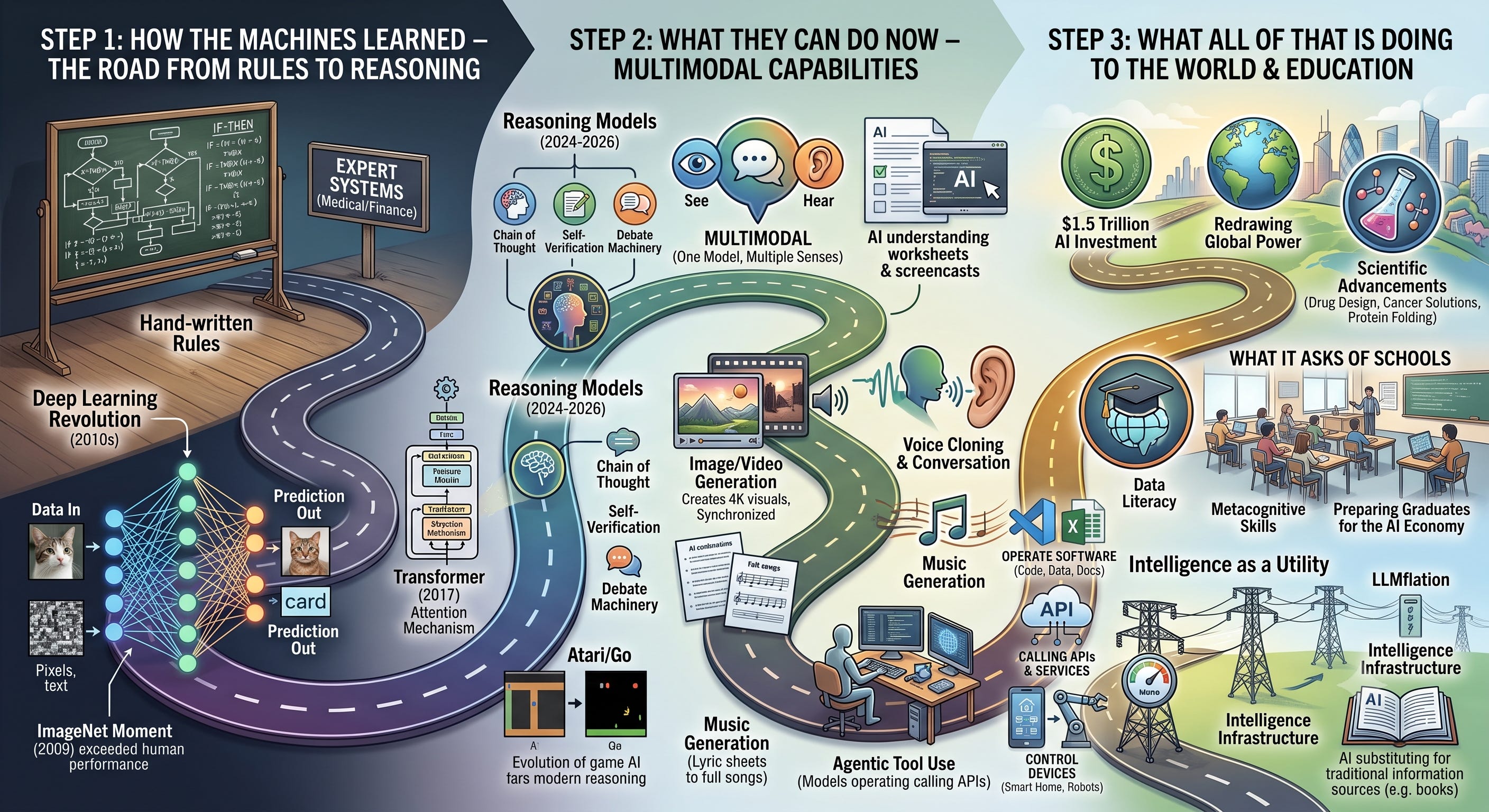
This chapter and the one after it move in three steps. The first is how the machines learned — the road from hand-written rules to systems that teach themselves, and from guessing the next word to something that reasons, checks its own work, and acts. If the last time you really looked at AI was 2023, this is the part that will pull your picture of it up to date. The second is what they can do now — see, hold a conversation, draw, shoot video, read a scan, argue a case, write working software. The third is what all of that is doing to the world these students are about to walk into: the money pouring in, the way it’s redrawing global power, what it’s doing to science, and — since this is a book for educators — what it asks of school. You won’t need a technical background. You will need to be willing to change your mind.
A Working Vocabulary
Token — the unit models read and write, roughly three-quarters of a word. Intelligence is now priced by the million of them.
Parameters (weights) — the billions of numbers inside a model that encode everything it has learned; “training” means adjusting them.
Deep learning / neural network — layered software, loosely inspired by the brain, that learns patterns from data instead of following written rules.
Transformer — the 2017 architecture behind every modern model; its “attention” mechanism lets it weigh which words matter to which.
Pretraining — the first phase of building a model: learning from a vast slice of human text, images, and code.
Fine-tuning / RLHF — the finishing school: shaping a trained model’s behavior with curated examples and human (or AI) feedback.
Reasoning model — a model trained with reinforcement learning to think before it answers; more thinking time buys better answers. Every 2025–26 frontier model is one.
Hallucination — a confident fabrication; collapsing as retrieval, verification, and debate machinery matures.
Agent — a model that doesn’t wait for the next prompt: it plans, uses tools, acts, and checks its own work — for minutes, now hours.
Multimodal — one model handling text, images, audio, and video together.
Open-weight — a model whose parameters are published for anyone to download and run (Llama, DeepSeek, GLM, Qwen) — and the reason no ban on intelligence stays airtight.
Distillation — training a small or rival model on a big model’s outputs; cheap imitation of expensive intelligence.
World model — a system that learns how environments behave, not just how text flows — the road to capable robots.
AGI / superintelligence — machine intelligence at, and then beyond, the level of a capable human across the board; the contested timelines get their own section (”How Close?”) below.
How Machines Learned to Learn
From Rules to Learning: Symbolic AI, Bayesian Methods, and the Deep Learning Revolution
The origins of AI can be traced back to the 1950s when pioneers like Alan Turing, John McCarthy, and Marvin Minsky formalized the field. Early AI research focused on rules-based symbolic approaches, aiming to create intelligent systems by encoding human knowledge and reasoning into symbolic representations and logical rules.
One prominent example was expert systems, which encoded human expertise into IF-THEN rules — IF the engine won’t turn over AND the battery is charged, THEN suspect the starter motor — and applied them to observed symptoms, emulating an expert’s reasoning in narrow domains like medical diagnosis and financial decision-making.
Symbolic AI worked where the rules could be written down, and broke where they couldn’t. Natural language is rife with ambiguity — “the chicken is ready to eat” could mean the bird is hungry or the dinner is served — and resolving it requires context and real-world knowledge that no rulebook can comprehensively encode. Bayesian methods eased the brittleness by replacing rigid rules with probabilities that update as evidence arrives (an old battery plus an engine that won’t turn over raises the odds the battery is dead; an engine that turns over slowly shifts suspicion to the starter), but for the hardest problems — language, vision, robotic control — the effort of hand-encoding enough knowledge proved intractable. That impasse catalyzed deep learning: instead of people writing the rules, systems that learn the patterns themselves, directly from the data.
Here is the whole idea, stripped of jargon (we met it briefly in the last chapter’s discussion of the fourth industrial era). A neural network is a stack of layers of simple units — loosely modeled on the human brain and its roughly 86 billion neurons, though it is nothing like a replica. Data goes in one end: the pixels of a photo, the words of a sentence. A prediction comes out the other: “cat,” or the likely next word. What makes it deep is everything in between. The early layers learn to notice tiny features — edges, corners, letter shapes. Middle layers combine those into bigger ones — an eye, a wheel, a word. Later layers combine those into whole concepts — a face, a stop sign, the gist of a sentence. And crucially, nobody programs any of it. The network starts out guessing at random, is told how wrong each guess was, and nudges millions (now trillions) of internal connection strengths so the next guess is slightly less wrong. Repeat that across enough examples and it teaches itself the patterns; give it more data and more computing power and it simply keeps getting better. Hold onto that one sentence — more data plus more compute equals more capability — because the rest of this chapter is the story of what happened when the world tested it at scale.
Small but significant advances in deep learning in computers occurred from the 1980s to 2010, but starting in the 2010s, deep learning ushered in a new era of technological advancements, which Stanford AI researcher Fei-Fei Li has described as a “deep learning revolution,” across various domains. ImageNet, which Li introduced in 2009, was a dataset of images, and each year a competition was held to determine which algorithm could best identify the objects in the images. Over time, the ability of machines to correctly identify objects in the dataset improved from 71.8% to 97.3%, exceeding human performance.
The improvement in deep learning was gradual until Alex Krizhevsky, Ilya Sutskever (the former Chief Scientist at OpenAI), and Geoffrey Hinton used a neural network, AlexNet, to achieve an error rate of 15.3, which was 10.8 percentage points lower than the runner-up in the ImageNet competition. This marked a turning point in computer vision, as their model significantly outperformed other models in image classification, something scientists had worked on for more than a decade. After that, deep learning, which is based on layers of neural networks, took off. DeepSpeech by Baidu revolutionized speech recognition with its high accuracy in transcribing spoken language. DeepFace (2014) set a new standard in facial recognition technology with its remarkable accuracy and subsequent improvements.
Games told the story in miniature. The “AI” in 1972’s Pong was a hard-coded algorithm moving a paddle; by the 1980s Atari titles had scripted difficulty curves and movement patterns; and then in 2013 DeepMind’s DQN learned to play Atari games, Pong included, from nothing but raw pixels and the score — trial and error, no explicit programming. The same shift, from rules written by humans to behavior learned by machines, was about to run through everything else.
The landmark was DeepMind’s AlphaGo, which in 2016 defeated a world champion at Go — a game with more possible positions than there are atoms in the observable universe. It learned in two stages: first supervised learning on expert human games to predict strong moves, then playing against itself millions of times, adjusting after each game to favor what won, with a Monte Carlo Tree Search algorithm simulating possible futures to evaluate the most promising lines. File that combination away — search, self-play, and a verifiable win signal — because, as we will see shortly, it is exactly the thread the field picked back up in 2024 to teach language models to reason.
Later iterations (AlphaGo Zero) demonstrated that, given enough computing power and time, it’s possible for AI to train a Go-playing agent from scratch with only teaching it the rules, without any preexisting human game data, to learn on its own and win the game. This is the fundamental advance of deep learning in computers: they learn how to process massive volumes of data and discover patterns in that data with little to no human interference. Since the machines can learn on their own, simply supplying them with more data and compute power (chips) enables them to discover a variety of patterns, complex ideas, nuances, skills, possess knowledge, and develop capabilities.
Additional fine-tuning and reinforcement learning with human feedback (RLHF) and other methods that we will discuss below, improve the quality of the output, but this occurs after machines learn on their own. And like humans, they can learn only from a few examples (”few shot” learning) and even from prompts alone rather than training data (”zero shot learning”). In this case, machines learn to generalize from previous data and apply it to a new situation.
The approach then leapt domains. CICERO won at Diplomacy (2022), a game of natural-language negotiation, persuasion, and occasional betrayal — so effectively that many human players preferred it to human partners. AlphaFold predicted the structure of nearly every known protein (2022). Deep learning came to power self-driving perception and planning, medical imaging and drug discovery, and translation across two hundred languages in real time, tones and vocal styles included; Stanford’s Fei-Fei Li argues there is a good chance AI will help solve cancer. Each of these systems learned its competence from data rather than having it programmed in.
It is impossible to overstate both the pathway to the development of deep learning in computers and how important it is to note that these advances occurred without any changes to our educational system and largely outside the public eye. All these efforts have now served to benefit the machines and those who own them.
Today’s Large Language Models (LLMs)
Deep learning has been pivotal in the development of AIs that you are likely familiar with, including large language models (LLMs) that have now become multimodal models. The pace of releases is itself part of the story. OpenAI’s line ran from GPT-1 (2018), GPT-2 (2019), and GPT-3 (2020) to ChatGPT, launched to the public on November 30, 2022 atop GPT-3.5, then GPT-4 (March 14, 2023), GPT-5 (August 2025), GPT-5.5 (April 2026), and GPT-5.6 (a government-vetted limited release in June 2026). Google’s Gemini arrived in December 2023 and moved just as fast — Gemini 3 Pro (November 2025), Gemini 3.1 Pro (February 2026), and the Gemini 3.5 family (May 2026). Anthropic’s Claude ran from Claude 3.5 Sonnet (June 2024) to Opus 4.8 and the frontier Fable 5 and Mythos 5 (2026); xAI’s Grok from its November 2023 debut through Grok 4 (July 2025) to the Grok 4.3 beta flagship of 2026, with the long-promised Grok 5 still in training as of mid-2026; Meta’s open Llama from 3.1 (July 2024) to Llama 4 (April 2025), after which Meta broke from its open-weight lineage — in April 2026 its new Superintelligence Labs launched the closed, proprietary Muse Spark, the first of a new “Muse” series; and a wave of powerful, cheap, openly licensed