
Bauschard’s Initial Guide to Classroom Debate: Implementation and Assessment
Every person will spend far more time speaking, presenting, and verbally defending ideas than they will writing formal essays. Job interviews are spoken. Team meetings are spoken. Parent-teacher...

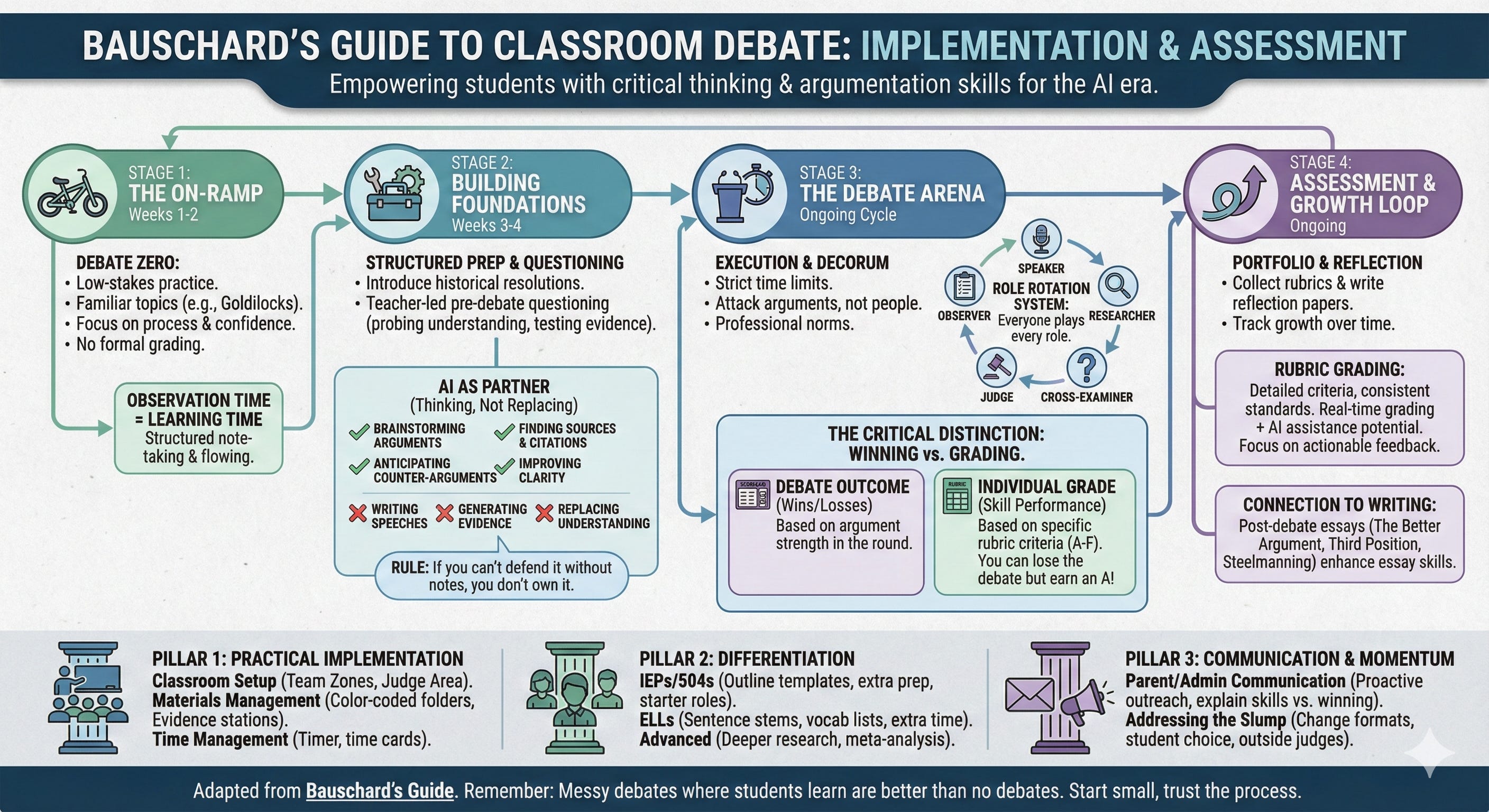
Why I Wrote This
I’ve seen a number of friends I’ve made on LinkedIn as part of the discussion related to AI and education take me up on my suggestion to try debating in the classroom. Some have asked me how I’d do it. To support those efforts, I’ve sketched out how I’d go about it, using a sample lesson on industrialization. Educators should adjust the lesson content as appropriate for the grade and objectives, just as expectations for writing a paper would change based on students age/experience and the learning objectives..
This is part of a larger project I’m working on, and I would greatly appreciate any feedback. My Subscribers can access this through a Google doc they can download.
What You Need to Know Before You Start
Here’s what I tell every teacher trying debate for the first time: you’re about to witness one of the most powerful learning trajectories you’ll see in your classroom. Most students don’t have significant experience debating, which means you get to watch them develop a completely new skill set from the ground up—imagine the satisfaction of teaching someone to write their very first essay and seeing them progress from there. That’s the opportunity you have. You just need to adjust your own expectations accordingly.
And here’s what makes this exciting: students improve at debating remarkably quickly. The more they do it, the better they get, and you’ll see an improvement trajectory just like you do with writing—except often faster because they get immediate feedback from their peers and can apply new strategies in the very next round. Debate involves using evidence and facts, so while they’re developing these argumentation skills, they’re simultaneously mastering content in a way that sticks because they’ve had to actively use it, defend it, and see it challenged.
One crucial piece of advice: integrating debate into the classroom shouldn’t be one teacher’s responsibility. If each class in a grade level had at least one debate by the end of October, the debates students have in each class by the end of December would be dramatically better. This distributed approach creates multiple practice opportunities while spreading the work across your faculty.
Also, all students don’t have to debate the same topic. For example, if you’re teaching the Industrial Revolution, you could give “The Industrial Revolution improved the lives of ordinary people in American cities” as a general framing, but then break it into multiple specific resolutions:
1. Resolved: The environmental costs of industrialization were justified by the economic development it enabled. This examines pollution, resource depletion, and ecological damage against material prosperity—forces long-term vs. short-term thinking.
2. Resolved: Government regulation of business during the Gilded Age did more harm than good. Explores laissez-faire capitalism vs. intervention, trust-busting, railroad regulation, and whether free markets or government oversight better served development.
3. Resolved: The rise of corporate monopolies was an inevitable and necessary stage of industrial development. Questions whether concentration of economic power (Standard Oil, Carnegie Steel) was economically efficient or socially destructive.
4. Resolved: Mechanization displaced more jobs than it created during the Industrial Revolution. Tackles technological unemployment, skill obsolescence, and whether innovation creates net employment gains or losses.
5. Resolved: The Industrial Revolution widened economic inequality more than it expanded overall prosperity. Requires weighing absolute gains in living standards against relative disparities between robber barons and workers.
6. Resolved: American industrialization depended primarily on exploiting immigrant labor rather than technological innovation. Examines whether cheap, exploitable workforce or technological advancement was the critical driver—and the moral implications of each.
These resolutions push students beyond simple “good or bad” judgments to analyze tradeoffs, causation, and competing values across economic, political, environmental, and social dimensions.
Make Observation Time Learning Time:the time students spend listening to other students’ debates should be learning time, not downtime.
When students observe their peers debating the Industrial Revolution resolution, they should be actively learning substantive historical content, not passively waiting for their turn—and this learning should be formalized through flowing (structured note-taking) and assessment. As one student argues that real wages increased 50-60% while another counters with data on 35,000 annual workplace deaths, observers should be recording both claims, the evidence citations (Bureau of Labor Statistics reports vs. factory investigation testimony), and how debaters weigh these competing facts, building a comprehensive understanding of the period’s economic and human costs.
When a debater distinguishes between Irish textile workers and African American steel workers to show how industrialization affected different groups unequally, observers learn crucial content about immigration patterns, occupational segregation, and the limitations of aggregate statistics—knowledge they must capture in their flows to later recall and apply. Students should note specific examples like the Triangle Shirtwaist Fire, Jacob Riis’s photographic evidence, Hull House’s social services, or the Panic of 1893’s impact on unemployment, creating a detailed content map across multiple rounds that far exceeds what any single textbook chapter provides.
Then—and this is essential—teachers should test students on this content. Ask them to explain the difference between real and nominal wages, analyze why return migration rates suggest limits to “improvement,” or construct their own argument about whether technological unemployment was temporary or permanent. This ensures that observation time translates into accountable learning. This approach transforms debate rounds from entertainment into rigorous content instruction where students encounter the same material from multiple analytical angles, hear it defended with evidence, see it challenged and refined, and ultimately master both the historical facts and the frameworks for interpreting them.
Through debating this resolution, students learn to navigate conflicting historical evidence and make reasoned judgments about complex tradeoffs. For example, they might discover that while real wages increased by 50-60% during this period, workers simultaneously faced 12-16 hour workdays and suffered 35,000 workplace deaths annually by 1900, forcing them to grapple with whether material gains justify human suffering Students learn to question whose experience counts when we make historical generalizations—recognizing that Irish immigrants in textile mills faced different conditions than African Americans in steel foundries, or that second-generation children who accessed public education had vastly different opportunities than their parents who worked in factories.
They develop skills in weighing incommensurable values: is access to affordable consumer goods more important than childhood education, or the ability to escape rural poverty more significant than urban overcrowding that killed thousands in disease outbreaks? Students also learn to interrogate their sources critically, understanding that Jacob Riis’s photographs reveal suffering that wage statistics obscure, while labor bureau reports provide quantitative data that personal narratives cannot.
Ultimately, they discover that “improvement” itself is a contested concept requiring them to articulate clear frameworks for judgment rather than simply marshaling facts—a skill that transfers far beyond history class into any domain requiring ethical reasoning about progress, development, and human welfare.
Why This Matters Even More in the AI Era
These judgment skills become essential in an AI-dominated world because machines excel at processing information but cannot determine what matters or why. While AI can instantly compile every statistic about Industrial Revolution wages, workplace deaths, and consumption patterns, it cannot decide whether a 50% wage increase justifies 35,000 annual deaths, or whether we should prioritize material prosperity over human dignity—these require human frameworks of value that must be explicitly articulated and defended.
As AI systems make increasingly consequential decisions in healthcare, criminal justice, education, and economic policy, humans must be able to interrogate the values embedded in algorithmic recommendations, question whose experiences are centered or marginalized in training data, and recognize when quantifiable metrics obscure moral dimensions that resist measurement.
Students who learn to weigh incommensurable goods, identify whose perspective defines “improvement,” and construct explicit frameworks for judgment develop exactly the capacities needed to govern AI systems rather than be governed by them. In a world where AI can generate persuasive arguments for any position, the ability to critically evaluate competing claims, recognize that “progress” is contestable, and make reasoned choices among tragic tradeoffs becomes the distinctly human contribution to human-AI collaboration.
These aren’t supplementary “critical thinking” skills—they are the core competencies that determine whether humans retain meaningful agency in setting societal priorities, or whether we abdicate those decisions to systems optimized for goals we never consciously chose.
The Bigger Question: Why Not Make Debate Required?
Adding a debate class would help a lot. Before we get to more practical details, let’s address the bigger question: Why should debate be a required course for all students in early middle school (grades 6-8) or freshman year of college, not just an elective for the motivated few?
The answer is simple: We already require composition courses because writing matters. Debate should be required too, because speaking and argumentation matter just as much—arguably more.
Consider the asymmetry in our current educational priorities. Every middle school student takes multiple years of English composition. Every college has freshman writing seminars or composition requirements. We’ve collectively decided that the ability to construct written arguments, cite sources, and organize ideas on paper is fundamental to educated citizenship. And we’re right—it is fundamental.
But here’s what we’ve missed: Every person will spend far more time speaking, presenting, and verbally defending ideas than they will writing formal essays. Job interviews are spoken. Team meetings are spoken. Parent-teacher conferences are spoken. City council public comments are spoken. Negotiations with bosses, landlords, and service providers are spoken. Democratic deliberation happens through spoken discourse, not through everyone submitting carefully-edited position papers.
Yet we spend years teaching students to write persuasively and almost no time teaching them to speak persuasively. We teach thesis statements and topic sentences but not how to construct an oral argument under time pressure. We teach MLA citation format but not how to defend your sources when someone challenges them in real time. We teach students to revise their writing but not how to adjust their argument when an opponent exposes a weakness.
This is pedagogical malpractice. If we believe argumentation skills are essential—and clearly we do, given the time we invest in teaching written argumentation—then we must teach oral argumentation with equal seriousness.
Building a Foundation That Every Class Reinforces
Teaching debate early in a student’s academic career creates a foundation that every subsequent course reinforces. Imagine a seventh-grader who takes a semester-long debate course using the framework in this guide. They learn to construct claim-evidence-warrant arguments. They learn to evaluate source credibility. They learn to anticipate counterarguments. They learn to think strategically under pressure.
Now that student enters eighth-grade history. When the teacher assigns an essay about the causes of World War I, the student doesn’t just list facts—they automatically structure arguments: “The primary cause was X because [evidence], which proves Y because [warrant], and while some historians argue Z, that interpretation fails to account for [counterargument].” The teacher doesn’t have to teach argumentation from scratch; they’re reinforcing skills the student already has.
The same thing happens in ninth-grade biology when the student has to present research findings, in tenth-grade civics when analyzing policy proposals, in eleventh-grade literature when defending interpretations. Every year, every teacher builds on the foundation that debate established. By the time the student reaches college, argumentation isn’t something they’re learning—it’s something they’re refining.
Compare this to our current approach, where we teach argumentation implicitly and inconsistently across the curriculum. One teacher values evidence, another values creativity, a third values personal reflection. Students never develop coherent standards for what makes a strong argument because the standards keep shifting. By requiring debate early, we establish consistent standards that the entire faculty can reference: “Remember from your debate class how you constructed claim-evidence-warrant arguments? Use that structure here.”
The AI Revolution Makes This Urgent
And finally, the AI revolution makes these skills exponentially more important, not less. AI can now generate competent written text. ChatGPT can write your essay. Claude can draft your research paper. Within a few years, AI will produce first drafts that are grammatically correct, properly cited, and structurally sound for virtually any written assignment.
What AI cannot do—what will remain distinctly human—is defend those ideas when challenged, adjust arguments in response to opposition, evaluate competing claims in real time, and persuade other humans through dynamic interaction. These are debate skills. In an AI-saturated world, the ability to think on your feet, respond to unexpected questions, and engage in genuine intellectual discourse becomes the scarce, valuable competency.
If we continue to spend years teaching students skills that AI can replicate (writing standard five-paragraph essays) while neglecting skills that AI cannot replicate (defending ideas under cross-examination), we’re preparing students for a past that no longer exists.
The students entering middle school today will graduate college in 2035. By then, AI will be ubiquitous in ways we can barely imagine. The question every employer, every graduate program, every civic institution will ask is: “Can you do what AI cannot?” Students who have spent years practicing debate will answer yes. Students who spent those years perfecting the format of their bibliography will not.
The Bottom Line
We require composition because we believe written argumentation is fundamental. We should require debate because spoken argumentation is equally fundamental—and in the AI era, it may be the skill that matters most. The schools that recognize this early and build debate into their core curriculum aren’t experimenting with an interesting elective. They’re giving their students the literacy that will define success in the 21st century.
Part 1: Introducing Students to the Process
Day 0: What Is Classroom Debate? (30-45 minutes)
Teacher Script:
“For the next several months, we’re going to learn history differently. Instead of me telling you what to think about historical events, you’re going to argue with each other about what they mean.
This might feel uncomfortable at first. You’re used to trying to figure out what the teacher wants to hear. In debate, there’s no single ‘right answer’ I’m looking for. There are better and worse arguments, and you’ll learn to tell the difference.
Here’s what debate is NOT:
It’s not fighting or being mean to each other
It’s not about who talks louder or longer
It’s not about winning by any means necessary
It’s not about your personal opinion mattering more than evidence
Here’s what debate IS:
It’s structured disagreement with rules and time limits
It’s defending a position with historical evidence
It’s listening carefully to find weaknesses in opposing arguments
It’s accepting that you might have to argue for a position you personally disagree with
Why are we doing this? Because this is how you learn to think. Not what to think—how to think. How to build an argument. How to test evidence. How to change your mind when someone presents better proof. How to hold two competing ideas in your head and figure out which one fits the facts better.
Also, this is how the world actually works. Scientists debate. Lawyers debate. Congress debates. Citizens debate policy. Scholars debate history. If you can’t argue effectively—if you can’t defend your ideas and challenge others’ ideas—you can’t fully participate in democracy.”
Here’s what a typical debate cycle looks like:
You’ll get a debatable question about something we’re studying. You’ll be randomly assigned a side—sometimes you’ll agree with it, sometimes you won’t. You’ll research using real sources: primary documents, textbooks, scholarly articles. You’ll work in teams, with different jobs—some of you will be speakers, some will be researchers, some will be judges. Then we’ll have the debate. Judges will decide which side argued better. Then we’ll reflect on what we learned.
And here’s the key: Everyone rotates through every role. If you’re terrified of public speaking, you won’t start as a speaker. You’ll start as a researcher or a judge. You’ll build up to it. By the end of the semester, you’ll have done every role, developed every skill.
One more important thing: You will struggle, and that’s the point.
In your first debate, you’ll forget arguments. You’ll freeze when someone asks you a question. You’ll wish you’d prepared better. Good. That’s learning. I’m not expecting perfection—I’m expecting effort and growth.
I’m not grading you on whether your team wins. I’m grading you on whether you constructed a solid argument, whether you used credible evidence, whether you listened to the other side, whether you improved from last time.
Some of you will lose debates and still earn A’s because you performed excellently. Some of you will win debates and earn B’s because you didn’t improve. The debate outcome and your grade are separate things.
Why This Introduction Matters
You’re doing several crucial things in this speech:
Addressing the content concern immediately. Parents and students worry debate means “no real learning.” You’re showing them that debate requires more content knowledge, not less, because you have to use facts strategically.
Managing anxiety about performance. By explaining role rotation and separating grades from winning, you’re telling students “You won’t be thrown into the deep end. We’ll build up to it.”
Explaining the ‘why’ before the ‘what’. Students work harder when they understand the purpose. You’re connecting debate to democracy, college, careers—things they care about.
Normalizing struggle. Saying “You will freeze and that’s okay” gives permission to be imperfect. This reduces performance anxiety.
Being honest about discomfort. You’re not pretending this will be easy. You’re saying it will be hard and worth it.
What students hear:
“I’ll still learn the history I need to know”
“I won’t have to speak first if I’m scared”
“My grade isn’t based on winning”
“The teacher expects me to struggle at first”
“This connects to my future”
What parents hear (when students relay this):
“My kid is learning critical thinking”
“There’s a clear pedagogical reason for this”
“The teacher has thought about shy kids”
“Grading is fair and separated from competition”
This introduction does the heavy lifting of selling students on debate before they experience it. By the time you get to Goldilocks, they understand the framework and are ready to try.
The “Goldilocks and the Three Bears” Mini-Debate
Purpose: Give students a low-stakes practice debate on a topic they already know before tackling historical content.
Why Goldilocks? Everyone knows the story, it has clear debate-worthy issues (trespassing, property damage, intent), and it’s non-threatening. Students can focus on learning debate structure without worrying about content knowledge.
The Story (As Told to Students)
Teacher Script:
“Before we debate historical topics, we’re going to practice with a story you all know: Goldilocks and the Three Bears. But this time, we’re going to treat it like a legal case.
Here’s what happened:
The Three Bears—Papa Bear, Mama Bear, and Baby Bear—lived in a house in the woods. One morning, they made porridge for breakfast, but it was too hot to eat. While they waited for it to cool, they went for a walk.
While the bears were gone, a girl named Goldilocks was walking through the woods. She came upon the bears’ house. The door was unlocked. Goldilocks opened the door and walked inside without permission. No one was home. The bears had not invited her.
Once inside, Goldilocks saw three bowls of porridge on the table. She was hungry. She tasted Papa Bear’s porridge—it was too hot. She tasted Mama Bear’s porridge—it was too cold. She tasted Baby Bear’s porridge—it was just right, and she ate the entire bowl.
Then Goldilocks saw three chairs in the living room. She was tired. She sat in Papa Bear’s chair—it was too hard. She sat in Mama Bear’s chair—it was too soft. She sat in Baby Bear’s chair—it was just right, but when she leaned back, the chair broke into pieces.
Then Goldilocks went upstairs where she found three beds. She was very tired. She lay on Papa Bear’s bed—it was too hard. She lay on Mama Bear’s bed—it was too soft. She lay on Baby Bear’s bed—it was just right, and she fell asleep.
Soon the Three Bears came home. They discovered someone had been eating their porridge. They found Baby Bear’s bowl was empty. They saw someone had been sitting in their chairs. They found Baby Bear’s chair was broken. They went upstairs and found Goldilocks asleep in Baby Bear’s bed.
Goldilocks woke up, saw the three bears, screamed, jumped out of bed, ran down the stairs, and ran away into the woods. She never came back.
The bears called the police. They want Goldilocks arrested and punished.
The question we’re debating: Did Goldilocks commit a crime and should she be punished?
Key Facts for Debate Preparation
Distribute this handout to students:
FACTS OF THE CASE:
The bears’ door was unlocked but closed
Goldilocks opened the door and entered without permission
No one was home; the bears had not invited her
Goldilocks ate an entire bowl of porridge that didn’t belong to her
Goldilocks broke a chair (Baby Bear’s chair)
Goldilocks was found asleep in Baby Bear’s bed
When discovered, Goldilocks fled immediately
The story doesn’t tell us Goldilocks’s age, but she’s often depicted as a young child (maybe 7-9 years old)
The story doesn’t say whether Goldilocks was lost, hungry, or in danger
There’s no evidence Goldilocks intended to damage the chair—it broke when she sat in it
POSSIBLE LEGAL ISSUES:
Trespassing: Entering someone’s property without permission
Breaking and Entering: Entering someone’s home unlawfully (though the door was unlocked)
Theft: Taking and consuming property that doesn’t belong to you (the porridge)
Vandalism/Property Damage: Breaking the chair
Intent: Did Goldilocks mean to commit crimes, or was it an accident?
Age/Capacity: If she’s a child, should she be held responsible like an adult?
Setting Up the Debate
Resolution: “Goldilocks committed a crime and should be punished.”
10-Minute Team Preparation:
“I’m going to divide you randomly into three groups:
Affirmative Team (Prosecution): Your job is to argue that YES, Goldilocks committed crimes and should be punished. Think like a prosecutor. What laws did she break? What evidence proves it?
Negative Team (Defense): Your job is to argue that NO, Goldilocks should not be punished. Think like a defense attorney. Was it really a crime? Are there excuses or explanations? Should a child be punished?
Judges: Your job is to listen to both sides and decide which team makes better arguments. You’ll need to take notes.
You have 5 minutes to brainstorm with your team. Come up with at least three arguments for your side.”
Sample Arguments (To Share After the Debate)
AFFIRMATIVE (Prosecution) Arguments:
Argument 1: Goldilocks committed trespassing and breaking and entering.
Evidence: She entered a home that wasn’t hers without permission
The door being unlocked doesn’t make it legal—you can’t just walk into someone’s house
She knew she didn’t live there; she saw three bowls, three chairs, three beds
Argument 2: Goldilocks committed theft.
Evidence: She ate an entire bowl of porridge that belonged to Baby Bear
She took property that wasn’t hers without paying or asking permission
This deprived Baby Bear of his breakfast
Argument 3: Goldilocks committed vandalism/property damage.
Evidence: She broke Baby Bear’s chair
Even if she didn’t mean to break it, she used someone else’s property without permission and damaged it
The bears now have to replace the chair at their expense
NEGATIVE (Defense) Arguments:
Argument 1: There was no criminal intent.
Goldilocks didn’t break into the house—the door was unlocked and open
She may have thought no one lived there, or that it was abandoned
She didn’t plan to steal or damage anything; she was lost and hungry
Argument 2: She’s a child and shouldn’t be held to adult standards.
Young children (age 7-9) don’t have full understanding of property laws
The legal system recognizes that children lack the mental capacity for criminal responsibility
Her running away shows she knew she made a mistake—that’s a child’s fear response
Argument 3: The punishment should fit the circumstances.
No one was hurt; this was property damage only
Goldilocks already fled in terror, which is a consequence
The bears could be compensated without criminal punishment (civil remedy, not criminal)
She was a hungry, possibly lost child—she needs help, not jail
The Debate Format (Simplified)
Total time: 15-20 minutes
Affirmative Opening (2 min): Present your case for why Goldilocks should be punished
Negative Opening (2 min): Present your case for why she shouldn’t
Cross-Examination (3 min): Each side gets to ask the other side 2-3 questions
Affirmative Response (1 min): Answer the negative’s main arguments
Negative Response (1 min): Answer the affirmative’s main arguments
Judges Deliberate (3 min): Judges discuss quietly and take notes
Judge Decision (2 min): One judge announces decision with one reason
Class Discussion (5 min): What did we learn about debate?
Critical Debrief Questions
After the Goldilocks debate, ask:
“How many of you personally agreed with the position you argued?”
Point: You can argue effectively for positions you don’t personally hold
This is a crucial democratic skill
“What made the stronger arguments stronger?”
Students will say: “They used specific evidence,” “They answered the other side,” “They made sense”
Point: Good arguments need evidence + reasoning, not just opinions
“Judges: Did you vote based on who you agreed with, or based on who argued better?”
Ideally, judges explain they evaluated arguments even if they personally disagreed
If they voted on personal opinion, this shows why we need judging criteria
“What was harder than you expected? What was easier?”
Normalizes that debate has a learning curve
Identifies specific skills to work on (speaking clearly, answering questions, etc.)
“Did anyone change their mind during the debate?”
If yes: This is intellectual honesty—changing your mind when you hear better evidence
If no: That’s okay, but did you understand the other side’s arguments better?
“What would make your arguments stronger next time?”
Students will say: “More examples,” “Better answers to their questions,” “Being more organized”
Write these down—they become the criteria for your rubrics
Why This Works
Goldilocks gives students everything they need to practice debate structure:
✓ Clear positions: Guilty vs. Not Guilty
✓ Evidence everyone knows: The story facts
✓ Multiple valid arguments on both sides: No obvious “right” answer
✓ Low emotional stakes: It’s a fairy tale, not their identity
✓ Requires reasoning: They have to explain why facts matter
✓ Anticipates opposition: Both sides have to deal with counterarguments
And it teaches the key insight: Even a simple children’s story can be debated intelligently when you focus on evidence and reasoning rather than just opinions.
After Goldilocks, students understand: “Oh, this is what debate is. We look at the same facts and argue about what they mean. And judges decide based on whose reasoning is stronger.”
That understanding prepares them for debating complex historical questions where the facts are contested and the interpretations are even more challenging.
Teacher Tip: Save the “Sample Arguments” handout for after the debate. Don’t give it to students beforehand—let them figure out arguments themselves. Then after the debate, share the handout and ask: “Which of these arguments did you think of? Which ones surprised you? Which side’s arguments are stronger?”
This teaches them that there are usually more arguments available than they initially thought, and that preparation and research help you find them.
Introducing the Role System
Teacher Script:
“In our debates, not everyone has the same job. Just like in sports where you have different positions, debate has different roles. Over the semester, you’ll rotate through all of them.
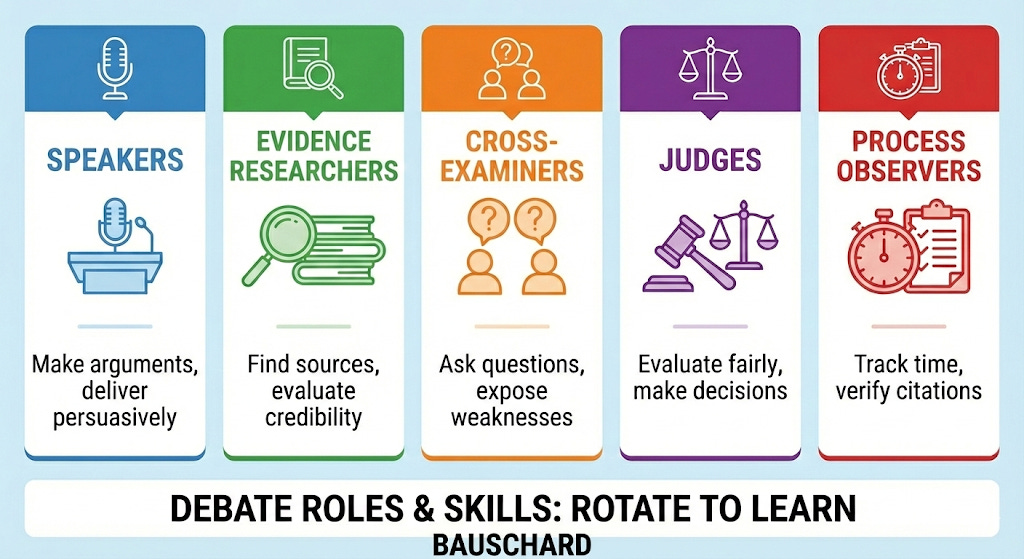
Speakers: You make the arguments in front of the class. You have to know the evidence, organize it into a persuasive case, and deliver it under time pressure.
Evidence Researchers: You’re the team’s intelligence unit. You find sources, evaluate their credibility, create evidence cards, and brief the speakers on what you found.
Cross-Examiners: You ask questions to expose weaknesses in the other side’s arguments. You’re testing their evidence and setting up your own team’s arguments.
Judges: You take notes on everything, evaluate which arguments are stronger, and make a decision with reasoning. You have to be fair even if you personally disagree with who wins.
Process Observers: You’re the referees. You track time, verify evidence citations, and keep the debate running smoothly.
Why rotate? Because each role teaches you different skills. Speakers learn public speaking and argument construction. Researchers learn source evaluation and evidence synthesis. Cross-examiners learn strategic questioning. Judges learn critical analysis and fair evaluation. Observers learn meta-cognition—seeing the debate from above.
By the end of the semester, you’ll have done all of these roles. That means you’ll develop all of these skills.”
Setting Classroom Norms
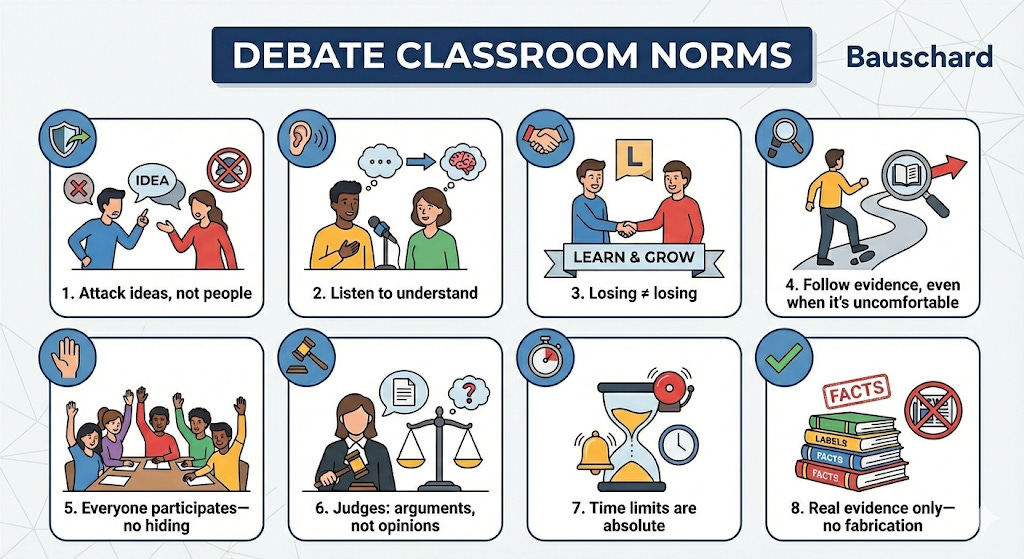
1. Disagree with ideas, not people.
The Principle: Attack arguments, not the person making them. Focus on what was said, not who said it.
What this looks like in practice:
✓ GOOD:
“Your evidence is weak because it doesn’t cite a source.”
“That argument has a logical flaw—you’re assuming X, but you haven’t proven X.”
“I disagree with your interpretation of that data.”
“Your evidence contradicts itself. You said wages went up, but then you said people were poorer.”
✗ NOT OKAY:
“You’re stupid.”
“That’s the dumbest thing I’ve ever heard.”
“You obviously didn’t understand the reading.”
“Only an idiot would think that.”
Eye-rolling, sighing, or making faces while someone speaks
Why this matters: When you attack the person, they stop listening and get defensive. When you attack the argument, you can actually change minds. Plus, you have to argue with these people again next week in a different debate—don’t make enemies.
Teacher enforcement:
First offense: Stop debate, correct language, model proper phrasing, continue
Second offense: Deduct points on “Professional Demeanor” rubric criterion
Third offense: Remove from speaking role, become observer for this debate
Example intervention: “Stop. Marcus, what you just said crossed the line. You can say ‘Your evidence doesn’t support your claim.’ You cannot say ‘You don’t know what you’re talking about.’ Rephrase your criticism to focus on the argument, not on Sarah. Let’s continue.”
2. Listen to understand, not just to respond.
The Principle: You can’t refute an argument you didn’t actually hear. Listen actively to understand what the other side is really saying before you respond.
What this looks like in practice:
✓ GOOD:
Taking notes while opponent speaks
Asking clarifying questions in cross-examination: “When you said ‘economic improvement,’ did you mean wages or standard of living?”
Responding to what they actually argued, not what you expected them to argue
Paraphrasing their position before refuting it: “You claim that reforms happened quickly. But your own evidence shows 25 years passed...”
✗ NOT OKAY:
Preparing your response while opponent is still talking
Interrupting mid-speech
Responding to a strawman: “My opponent thinks everything was perfect!” (when they never said that)
Saying “I wasn’t really listening, but...”
Looking at your notes instead of at the speaker
Why this matters: If you respond to arguments they didn’t make, judges notice. You lose credibility. Also, sometimes opponents make arguments you hadn’t thought of—you learn by listening.
Example of good listening: Opponent: “Cities offered economic opportunity.” You (in rebuttal): “My opponent claimed cities offered economic opportunity. But opportunity for whom? Their own evidence shows women earned half what men earned, and children worked 12-hour days. That’s not opportunity—that’s exploitation.” [You heard them, acknowledged their point, then refuted it with evidence.]
Example of bad listening: Opponent: “Cities offered economic opportunity.” You (in rebuttal): “Cities were terrible! People lived in slums!” [You didn’t engage what they said. You just stated your position. Judges won’t give you credit for this.]
Teacher prompt during prep: “Before you write your response speech, tell me the three strongest arguments the other side made. Not the ones you wanted them to make—the ones they actually made.”
3. Losing a debate doesn’t make you a loser.
The Principle: Sometimes the other side has better evidence or makes better arguments. That’s how you learn. Debate outcome ≠ personal worth.
What this looks like in practice:
✓ GOOD RESPONSES TO LOSING:
“We lost because they had that Census data and we didn’t. Next time I need to research statistics, not just general sources.”
“Their cross-examination exposed the gap in our argument. We should have anticipated that question.”
“Judges voted for them because their reform argument was stronger. That makes sense—I’d probably have voted the same way.”
Congratulating the winning team
✗ NOT OKAY RESPONSES TO LOSING:
“The judges were biased!”
“This is unfair!”
Refusing to participate in debrief
Blaming teammates
Sulking or storming out
Claiming “We actually won but the judges are wrong”
Why this matters: You’ll debate 6-8 times this semester. Statistically, you’ll lose some. If losing destroys you, you can’t learn. The best debaters lose all the time—and they learn from every loss.
Teacher response to healthy disappointment: “I can see you’re disappointed. That shows you cared and worked hard. Now let’s figure out what you learned. Pull out your rubric—where did you score well? Where do you need to improve? Those answers are your roadmap for next debate.”
Teacher response to unhealthy upset: “I understand you’re frustrated. But let me ask you something: can you point to specific places in the judge decisions where they were unfair? [Student usually can’t.] What I see is that judges explained their reasoning. You can disagree with their reasoning, but that’s debate. Sometimes your arguments don’t win. That doesn’t mean the process was rigged.”
Class discussion after first debate: “Raise your hand if your team won. Okay. Now keep your hand up if you think you performed perfectly with no room for improvement. [Hands go down.] Exactly. Winning doesn’t mean you were perfect. Now raise your hand if your team lost. Keep your hand up if you learned something valuable about how to argue better next time. [Hands stay up.] That’s the point. We’re all learning, whether we win or lose.”
4. Change your mind when evidence warrants it.
The Principle: Intellectual honesty matters more than being “right.” If someone presents better evidence or reasoning, it’s a strength to acknowledge that, not a weakness.
What this looks like in practice:
✓ GOOD:
“I came into this debate thinking the Industrial Revolution was entirely negative, but the wage data the Affirmative presented is actually pretty convincing. I need to revise my understanding.”
As a judge: Voting for the side you personally disagree with because their arguments were stronger
Telling your teammates: “You know, they have a point about the reforms. We should adjust our strategy.”
Writing in reflection: “I changed my mind about this historical question because of the evidence presented.”
✗ NOT OKAY:
Ignoring evidence because it contradicts what you want to believe
Refusing to acknowledge strong opposing arguments
As a judge: Voting for your personal opinion instead of evaluating arguments
Saying: “I don’t care what the evidence says, I’m sticking with my position”
Why this matters: This is what scientists, historians, and citizens in a democracy must do—follow evidence even when it’s uncomfortable. If you can’t change your mind in a classroom debate, you won’t be able to do it when it matters in real life.
Real example to share with students:
“I once judged a debate where a student was assigned to argue that a particular policy was effective. She researched it expecting to find evidence supporting that position. Instead, she found overwhelming evidence the policy had failed. In the debate, she presented the strongest case she could with the evidence she could find, but after the debate she said, ‘I went into this thinking one thing, and the research completely changed my mind.’ That’s intellectual integrity. That’s what we’re developing here.”
Teacher modeling: During debrief, occasionally say: “You know, I came into this debate thinking the Negative had the easier case to make, but the Affirmative’s argument about [X] was really compelling. I need to reconsider my assumptions about this topic.”
[Students see that even the teacher is willing to say “I learned something / I changed my mind.”]
5. Everyone participates. Hiding is not an option.
The Principle: Growth happens outside comfort zones. You will have a role in every debate. You will participate.
What this looks like in practice:
✓ PARTICIPATION THAT COUNTS:
Taking on assigned role even if it’s uncomfortable
Speaking up during team preparation
Asking questions when you don’t understand
Doing your research thoroughly
Providing constructive feedback to teammates
Accepting feedback from others
✗ HIDING BEHAVIORS:
“I’ll just observe this debate”
Letting teammates do all the work during prep time
Volunteering only for low-visibility roles repeatedly
Skipping research days
Not speaking during team meetings
Asking to “just help in the background”
Why this matters: The role rotation system means you’ll do easier roles before harder ones. But you have to actually do them. Students who hide in Debate 1 are still hiding in Debate 6. Students who push through discomfort in Debate 1 are confident by Debate 6.
For anxious students, the teacher says:
“I know speaking terrifies you. I’m not throwing you in as a speaker in Debate 1. You’re starting as an evidence researcher. Your job is to find sources and create evidence cards. That’s private work, not performance. In Debate 2, you might be a judge—still no speaking to the class. By Debate 3 or 4, you’ll try cross-examination, where you ask questions with a partner’s support. By Debate 5, you’ll be ready for a speech, and you’ll have watched other students model it 8-10 times. This is gradual, but you will do every role eventually.”
For students who want to coast:
“You don’t get to skip roles because they’re hard. The student who’s naturally good at public speaking doesn’t get to be a speaker every time—they need to learn research and judging too. The shy student doesn’t get to be a researcher every time—they need to learn speaking. Everyone does everything. That’s non-negotiable.”
Accountability structure:
Portfolio requires documentation of all roles
Missing a role = incomplete portfolio = grade penalty
BUT: Struggling in a role is fine. Avoiding a role is not.
6. Judges are neutral arbiters. Personal opinions stay out of decisions.
The Principle: When you’re a judge, you evaluate arguments based on evidence and reasoning presented in the debate, not based on what you personally believe about the topic.
What this looks like in practice:
✓ GOOD JUDGING:
“I personally think the Industrial Revolution was harmful, but the Affirmative team presented stronger evidence that wages increased. They won the economic argument, and the Negative didn’t adequately refute it. Vote: Affirmative.”
Taking detailed notes on both sides
Citing specific arguments in your decision
Explaining why one piece of evidence was more credible than another
Voting against your personal opinion because the arguments warranted it
✗ BAD JUDGING:
“I agree with the Negative’s position, so they win.”
“I didn’t like how the Affirmative speaker talked, so Negative wins.”
Making a decision without notes or explanation
“Both sides were good, so it’s a tie.” [Force yourself to decide!]
Letting your personal views about the topic determine the outcome
Why this matters: Judges learn the hardest skill of all—evaluating arguments fairly even when you disagree with the conclusion. This is what jurors must do. What editors must do. What voters should do.
Teacher coaching for judges:
Before first debate: “Your job is to forget what YOU think about the Industrial Revolution. Pretend you know nothing. Both teams will try to convince you. Whoever convinces you with evidence and reasoning presented in this debate wins. Not whoever you already agreed with.”
Example of good judge reasoning:
“I went into this debate believing that working conditions were the most important factor. However, the Affirmative presented three separate pieces of evidence showing that people voluntarily chose to move to cities and stay there, which suggests that even with bad conditions, they preferred city life to farm life. The Negative argued people were forced to move, but provided no evidence for this claim. Based on the arguments presented in THIS DEBATE, Affirmative wins, even though I personally still think working conditions matter more than wages.”
Example of bad judge reasoning:
“I think the Industrial Revolution was bad because my family came from a farm town and my grandparents have stories about how hard life was in cities. So Negative wins.”
[This judge didn’t evaluate the debate—they just stated their opinion.]
If a judge does this:
Teacher addresses whole class: “This decision didn’t explain which arguments won or lost in the debate. It explained what the judge personally believes. Let me show you the difference...”
[Then model what the decision should have looked like, using specific arguments from the debate.]
7. Time limits are absolute. The timer doesn’t care about your feelings.
The Principle: Speeches have time limits. Cross-examination has time limits. When time expires, you stop immediately. No exceptions.
What this looks like in practice:
✓ GOOD TIME MANAGEMENT:
Practicing speech beforehand to ensure it fits in time
Watching the timer during your speech
Wrapping up your final point when you see “30 seconds” warning
Stopping mid-sentence if necessary when time is called
Planning which arguments to prioritize if you’re running short on time
✗ NOT OKAY:
“Just let me finish this sentence!” [after time is called]
“I just need 30 more seconds!”
Talking faster and faster to cram everything in
Ignoring time warnings
Blaming the timer: “I would have won if I had more time”
Why this matters: Real debates have time limits. Job interviews have time limits. Presentations have time limits. Learning to organize your thoughts within a time constraint is a life skill.
How time enforcement works:
Process observer is the official timekeeper (this is their role, not the teacher’s)
Timer holds up signs: “2 MINUTES LEFT” then “30 SECONDS” then “TIME”
When “TIME” sign goes up, speaker must stop
If speaker continues beyond 5 seconds, judges are instructed: “Do not count any arguments made after time expired”
Rubric criterion “Time Management” directly penalizes going significantly over or under
Teacher explanation to students:
“In a real debate tournament, judges stop flowing (taking notes) the moment time expires. Anything you say after that doesn’t count. We’re doing the same thing here. If you go over time, judges won’t consider those arguments. You hurt your own case by not managing time well.”
Sympathetic but firm response when student goes over:
“I know you had more to say. That’s actually a good sign—it means you had strong arguments. But part of debate is fitting your best arguments into the time you have. Next time, prioritize your three strongest points instead of trying to make six points. Quality over quantity.”
Practice strategy:
During prep days, have teams practice speeches with timer. Teach them:
Write more than you’ll say, then cut to the best parts
Know which argument you’ll skip if you’re running short
Build in a 15-second buffer—aim to finish at 4:45 for a 5-minute speech
8. Evidence must be real and cited. Making up sources is academic dishonesty.
The Principle: Every factual claim must come from a real, citable source. Fabricating evidence or sources is cheating and will be treated as such.
What this looks like in practice:
✓ PROPER EVIDENCE USE:
“According to Robert Whaples in his 2005 EH.Net Encyclopedia article, real wages increased 60% between 1860 and 1890.”
Evidence cards include: Author, Title, Publication, Date, Page number (if applicable), URL (if applicable)
Saying “I don’t have a source for that, so I can’t make that claim” during prep
If asked in cross-ex “What’s your source?” being able to provide it immediately
✗ ACADEMIC DISHONESTY:
“Studies show...” [no specific study named]
“Experts agree...” [no specific experts named]
“I read somewhere...” [no source]
Making up statistics: “75% of workers died in factories” [no source]
Citing a source that doesn’t exist: “According to Johnson’s 1890 study...” [there is no Johnson study]
Copying a speech from the internet and presenting it as your own
Using a quote from a source but changing the words to say something the source didn’t say
Why this matters:
Academic integrity: In college, this gets you expelled. In professional life, it destroys your credibility.
Debate fairness: If you can make up evidence, debate becomes “who lies best” instead of “who argues best.”
Real-world consequences: Journalists who fabricate sources lose their jobs. Scientists who fake data lose their careers.
How we verify evidence:
Evidence researchers must submit evidence cards with full citations
Process observer may challenge evidence during debate: “I need to see the source for that statistic”
Teacher does spot-checks: randomly selects 2-3 pieces of evidence per debate and verifies sources exist
If evidence is questionable, burden is on the team to produce the actual source
If fabrication is discovered:
During debate: “Stop. That evidence has been challenged. [Student name], can you produce the source right now?”
If yes: Continue
If no: “That evidence is struck from the record. Judges will disregard it. We’ll discuss consequences after the debate.”
After debate:
Zero on that role rubric (automatic F for that debate)
Required to redo the debate in a different role with proper evidence
Academic dishonesty report per school policy
Parent contact
Serious conversation about integrity
Prevention is better than punishment:
Before first graded debate, full class workshop on citations:
What counts as a source (peer-reviewed articles, books, government data, credible news, primary documents)
What doesn’t count as a source (Wikipedia, random websites, “I heard,” “my cousin said”)
How to create a proper citation
How to create evidence cards
Practice: Give students a source, have them create a proper evidence card
Make it clear:
“If you’re not sure whether a source is credible or how to cite it, ask me during prep time. I will help you. What I won’t tolerate is making up sources or using sources you know are fake. That’s the one thing in this class that will earn you an automatic F.”
The Growth Mindset Framework
Before the first real debate, show students this:
“You will not be good at this immediately. That’s normal and expected. Here’s what growth looks like:
First debate: You’ll forget your arguments mid-speech. You’ll freeze during cross-examination. You’ll struggle to take notes as a judge. This is NORMAL.
Third debate: You’ll start to get comfortable with your role. Your speeches will be more organized. Your questions will be sharper. Your judge decisions will show clearer reasoning.
Sixth debate: You’ll see how different roles connect. Being a judge taught you what speakers need to do. Being a cross-examiner taught you how to anticipate questions as a speaker.
I’m not grading you on being perfect. I’m grading you on:
Meeting the specific criteria for your role (that’s the rubric)
Improving from one debate to the next (that’s your portfolio)
Taking intellectual risks even when it’s uncomfortable
The student who argues brilliantly for a position they don’t believe in? That’s the student who’s really learning.”
Part 2: Getting Started - Debate Zero
Why You Need a Practice Debate
Before you run your first graded debate, you need to demystify the process. Students are nervous about:
Speaking in front of the class
Not knowing what “good” debate looks like
Being judged by their peers
Failing at something they’ve never tried
Debate Zero solves this problem. It’s a low-stakes practice round where students learn the format, try different roles, and make mistakes without grade consequences.
You may wish to consider extra credit for this debate.
How Debate Zero Works
Timeline: One week before your first graded debate
Format: Simplified 30-minute debate
First Affirmative Speech (3 min)
Cross-Examination by Negative (2 min)
First Negative Speech (3 min)
Cross-Examination by Affirmative (2 min)
Affirmative Rebuttal (2 min)
Negative Rebuttal (2 min)
Affirmative Close (2 min)
Negative Close (2 min)
Judge Decision (5 min)
Whole Class Debrief (10 min)
The Resolution: Something students already know about
Don’t use historical content for Debate Zero. Use something students can argue about immediately without research:
Good Debate Zero Resolutions:
“The school day should start at 9:00 AM instead of 8:00 AM”
“Students should be allowed to use phones during lunch”
“Homework should be banned on weekends”
“The voting age should be lowered to 16”
“School uniforms should be required”
“Summer vacation should be shorter with more breaks during the year”
Why these work: Students have opinions, lived experience, and can generate arguments on the spot. They don’t need to research; they can focus on learning the debate process.
Debate Zero Structure
Day 1 (20 minutes): Introduction and Assignment
Explain the format (use the script from “Introducing Students to the Process”)
Present the resolution - have students vote on which topic they want from a list
Randomly assign roles:
Affirmative Team (3 students)
Negative Team (3 students)
Judges (remaining students)
Give homework: “Think of three arguments for your side. No formal research required—just brainstorm.”
Day 2 (50 minutes): Debate Zero + Debrief
0:00-0:10 - Teams huddle
Share brainstormed arguments
Decide who will speak
Plan basic strategy
0:10-0:30 - Run the Debate
Use the simplified format above
Teacher acts as timekeeper
Don’t interrupt for coaching—let it unfold naturally
0:30:40 - Whole Class Debrief (This is the most important part!)
Teacher leads discussion:
“Okay, that was Debate Zero. Let’s talk about what we learned.
For Speakers: What was hardest about giving your speech? What would you do differently next time? [Students will say: “I forgot my arguments,” “I didn’t know what to say when they asked questions,” “I ran out of time,” “I talked too fast”]
For Cross-Examiners: What was your goal when asking questions? Did you achieve it? [Students will say: “I wanted to prove they were wrong,” “I tried to get them to admit something,” “I didn’t know what to ask”]
For Judges: How did you decide who won? What made one side’s arguments stronger? [Students will say: “They had better examples,” “They answered the other side’s points,” “They seemed more confident”]
Now here’s what I noticed:
[Point out specific effective moments: “When Sarah asked about implementation costs, that was a strategic question”]
[Point out missed opportunities: “The Negative never responded to the Affirmative’s fairness argument—in debate, if you don’t answer, you lose that point”]
[Normalize nervousness: “I saw some of you were nervous. That’s completely normal. By our sixth debate, you won’t be.”]
The good news: You now know what debate feels like. Next time, we’ll add structure—rubrics, evidence requirements, research time. But the basic format is what you just experienced.
The better news: This doesn’t count for a grade. You got to make mistakes and learn from them. That’s the whole point of Debate Zero.”
Homework: Write a reflection on the debate
Grading Debate Zero: Extra Credit for Completion
Debate Zero should not be graded on quality. Instead:
Extra Credit Option 1: Participation Points
5 points extra credit for participating in any role
No rubric evaluation
Completion-based only
Extra Credit Option 2: Reflection Assignment
Participate in Debate Zero (required, no points)
Write 1-page reflection for 10 points extra credit:
What role did you have?
What was hardest about it?
What did you learn about debate that surprised you?
What will you do differently in Debate 1?
Which role do you want to try first in a graded debate and why?
Why extra credit?
Makes it optional for students who are terrified (they can watch and learn)
Rewards students who try despite nervousness
Creates positive association with debate before grades enter the picture
Gives struggling students a low-risk way to boost their grade
What Students Learn from Debate Zero
Even in a 30-minute practice round, students discover:
Speaking is survivable. “I was nervous but I did it and didn’t die.”
Preparation matters. “I wish I’d organized my points better before starting.”
The other side has good arguments too. “I didn’t think about their perspective until they said it.”
Judges decide, not personal opinion. “I personally agreed with the Negative, but the Affirmative won because they had better evidence.”
You can learn by watching. Students who observe see what works and what doesn’t.
Losing isn’t shameful. “Our team lost but we learned what to improve.”
This is actually kind of fun. Once the fear subsides, many students enjoy the intellectual challenge.
Common Debate Zero Disasters (And Why They’re Good)
Disaster 1: Speaker freezes and can’t think of anything to say
Why it’s good: Better to freeze in practice than in graded debate
Debrief lesson: “This is why we prepare written outlines next time”
Disaster 2: Cross-examination becomes argument instead of questions
Why it’s good: Students learn the difference between questioning and debating
Debrief lesson: “Cross-ex is for asking questions, not making speeches. Save your arguments for your speech time.”
Disaster 3: Judges all vote based on personal opinion, ignoring arguments
Why it’s good: Reveals the need for judging training and frameworks
Debrief lesson: “Judges have to set aside personal views and evaluate arguments. In Debate 1, we’ll use judging rubrics to help with this.”
Disaster 4: Team has no strategy, just individuals talking
Why it’s good: Shows why team preparation matters
Debrief lesson: “Notice how the team that coordinated their arguments did better than the team where everyone said random things?”
Disaster 5: Students cite made-up “facts”
Why it’s good: Highlights the need for real evidence
Debrief lesson: “In real debates, we verify sources. Making up evidence is academic dishonesty.”
After Debate Zero: Building Toward Debate 1
What changes in Debate 1:
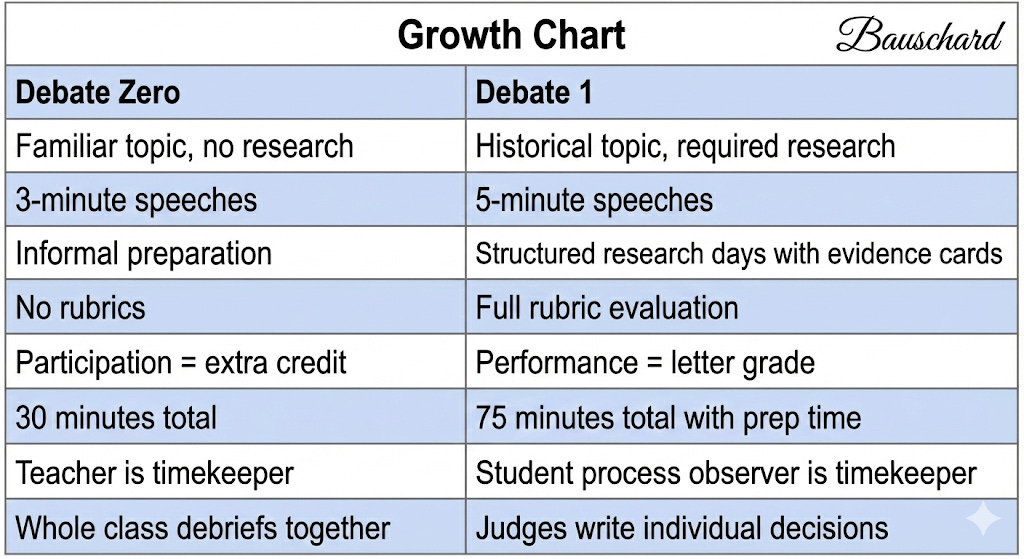
Tell students after Debate Zero:
“Now you know what debate feels like. In Debate 1, we’re adding:
Research time: You’ll have two days to find real historical evidence
Evidence cards: You’ll document your sources properly
Rubric grading: You’ll know exactly what’s expected for each role
Preparation time: Teams will have structured time to plan strategy
Written decisions: Judges will explain their reasoning in writing
Debate Zero showed you the format. Debate 1 will teach you the skills. By Debate 3, this will feel natural.”
Variations on Debate Zero
Variation 1: Fishbowl Debate
One Affirmative team vs. one Negative team debate in front of class
Rest of class observes and takes notes
Debrief focuses on what observers noticed
Good for very large classes (30+ students)
Variation 2: Multiple Simultaneous Mini-Debates
Divide class into 4-5 small groups
Each group runs their own debate on the same resolution
Teacher rotates to observe
Debrief representatives from each group share what happened
Good for getting more students active roles
Variation 3: Build the Debate Together
Stop after each speech to ask: “What would make this stronger?”
Collective coaching in real-time
More instructional, less assessment
Good for classes with no debate experience at all
The Most Important Thing About Debate Zero
Debate Zero exists to answer one question: “Can I do this?”
The answer needs to be: “Yes, and here’s proof—you just did.”
Not perfectly. Not expertly. But you did it.
That’s the confidence students need to approach Debate 1 ready to learn rather than paralyzed by fear.
Part 3: Using AI as a Debate Partner
Using AI as a Debate Partner
Teacher Introduction to Students:
“Let’s talk about AI. You have access to ChatGPT, Claude, and other AI tools. I know you’re using them. Rather than pretend you’re not, let’s talk about how to use them productively for debate.
Here’s the key principle: AI is a thinking partner, not a thinking replacement.
AI can help you generate ideas, test arguments, and organize your thoughts. What AI cannot do—and what you must do—is defend those ideas under cross-examination, evaluate evidence critically, and make strategic choices about what arguments matter most.
In fact, debate is the perfect place to use AI because debate has a built-in BS detector: if your AI-generated argument is weak, your opponent will expose it immediately. You can’t hide behind AI-written text when someone asks you tough questions.
Here are the ways you CAN and SHOULD use AI, and the ways you CANNOT.” [The “CANNOTs” are what I call suggested prohibitions, as I believe if you use AIs this way it will hurt your debate performance and will impact your debate grade.”]
1. AI as Preparation Partner
What this means: Use AI to brainstorm arguments and generate ideas during the research phase.
How to use it:
Prompt AI with: “I’m debating the resolution ‘The Industrial Revolution improved the lives of ordinary people in American cities.’ I’m on the Affirmative side. Help me brainstorm three strong arguments supporting this position.”
AI might respond with:
Economic opportunity argument (wages, employment)
Social mobility argument (class movement, immigrant opportunities)
Infrastructure development argument (reforms funded by industrial wealth)
Then YOU must:
Research whether these arguments are actually true
Find specific evidence for each argument
Decide which arguments are strongest for THIS debate
Understand the arguments well enough to defend them
Good use example: “I used AI to generate 10 possible arguments. Then I researched each one. Three had strong historical evidence, four had weak evidence, and three were actually contradicted by the sources I found. I chose the three with strong evidence to use in my speech.”
Bad use example: “AI gave me three arguments, so I put them in my speech without checking if they’re true or finding actual sources.”
Why this is allowed: Brainstorming is a legitimate use of AI. Professional researchers brainstorm with colleagues—AI is a brainstorming colleague. The key is you still have to verify, research, and understand everything before you use it.
2. AI as Research Partner
What this means: Use AI to help find sources and summarize information, but ALWAYS verify.
How to use it:
Prompt AI with: “What are credible sources about wage growth during the Industrial Revolution in the United States, 1860-1900?”
AI might respond with:
Robert Whaples’ work on labor history
Census Bureau historical statistics
Academic articles on economic history
Then YOU must:
Actually go find those sources (don’t trust that AI cited them correctly)
Read the sources yourself
Create evidence cards with proper citations
Verify that the source says what AI claims it says
CRITICAL RULE: Never cite a source that AI gave you without verifying it yourself.
Good use example: “AI suggested I look at Robert Whaples’ work on child labor. I found his 2005 EH.Net Encyclopedia article, read it, and created an evidence card with the actual quote and citation. In the debate, when asked for my source, I had the real article.”
Bad use example: “AI told me that ‘According to historian Robert Whaples, wages increased 60%.’ I used that in my speech. When asked for the source in cross-examination, I said ‘AI told me’ and couldn’t produce the actual article.”
Why this is allowed (with verification): AI can point you toward useful sources faster than random searching. But AI also hallucinates sources that don’t exist. You MUST verify every single source yourself. If you can’t find it, you can’t use it.
Teacher enforcement:
Evidence cards must include URLs
Random spot-checks: “Show me where you found this source”
If student can’t produce the actual source: evidence is struck, points deducted
3. AI as Argument Choice Partner
What this means: Use AI to help you evaluate which arguments are strongest and which to prioritize.
How to use it:
Prompt AI with: “I have three arguments for my debate: (1) wages increased 60%, (2) people chose to migrate to cities, (3) industrial wealth funded reforms. Which argument is strongest? Which is most vulnerable to counter-arguments?”
AI might respond with: “Argument 1 is strongest because it has specific data. Argument 2 is vulnerable because opponents can claim people were forced to migrate. Argument 3 depends on whether reforms came fast enough.”
Then YOU must:
Decide if you agree with AI’s analysis
Prepare responses to the vulnerabilities AI identified
Make your own strategic choice about which arguments to emphasize
Understand WHY each argument is strong or weak
Good use example: “AI said my wage argument was strongest, but when I thought about it, I realized the migration argument is actually harder for opponents to refute because I have Census data showing people chose to come. I made my own decision to lead with the migration argument.”
Bad use example: “AI said argument 1 was strongest, so I only used that one and didn’t prepare the others.”
Why this is allowed: Getting a second opinion on strategy is smart. Athletes watch game film. Lawyers consult colleagues. Using AI as a sounding board for strategic choices is good preparation. But YOU make the final decisions.
4. AI as Counter-Argument Partner
What this means: Use AI to anticipate what the other side will argue and prepare responses.
How to use it:
Prompt AI with: “I’m arguing that the Industrial Revolution improved lives. What are the three strongest arguments my opponents will make against this position?”
AI might respond with:
Working conditions were dangerous and exploitative
Living conditions in tenements were terrible
Wealth inequality increased dramatically
Then YOU must:
Prepare specific responses to each counter-argument
Find evidence that addresses these concerns
Practice defending your position against these attacks
Develop cross-examination questions that expose weaknesses in these arguments
Good use example: “AI predicted they’d argue about dangerous working conditions. I prepared three responses: (1) conditions were also dangerous on farms, (2) workers chose factories over farms anyway, (3) industrial wealth eventually funded safety reforms. When they made that argument, I was ready.”
Bad use example: “AI said they’d argue about working conditions. I didn’t prepare a response because I thought my arguments were strong enough.”
Why this is allowed: Anticipating opposition is a core debate skill. Before AI, debaters practiced with partners who played devil’s advocate. AI is a convenient devil’s advocate available 24/7. The key is you still have to develop the responses yourself.
5. AI as Citation Partner
What this means: Use AI to help format citations correctly according to academic standards.
How to use it:
Prompt AI with: “I have this source: an article by Robert Whaples called ‘Child Labor in the United States’ from EH.Net Encyclopedia published September 27, 2005. How do I cite this properly?”
AI might respond with: “Whaples, Robert. ‘Child Labor in the United States.’ EH.Net Encyclopedia, edited by Robert Whaples. Economic History Association, September 27, 2005.”
Then YOU must:
Check that the formatted citation is correct
Include it on your evidence card
Keep the actual source so you can produce it if challenged
Good use example: “I had five sources and wasn’t sure how to format a government document citation. AI showed me the format. I double-checked it against our citation guide, and it was correct. I used it on my evidence card.”
Bad use example: “AI formatted my citation, so I didn’t check if it was right. Turns out AI put the date in the wrong place and I lost points for improper citation.”
Why this is allowed: Citation formatting is technical and tedious. Using AI to format citations is like using a calculator for math—it’s a tool that handles mechanical tasks so you can focus on substance. But you still need to verify it’s correct.
6. AI as Clarity Partner
What this means: Use AI to help you express arguments more clearly and identify unclear reasoning.
How to use it:
Prompt AI with: “Here’s my argument: ‘The Industrial Revolution was good because economic stuff improved and people had more opportunities for different kinds of work.’ How can I make this clearer and more specific?”
AI might respond with: “Your argument has the right idea but needs specificity. Instead of ‘economic stuff improved,’ say ‘real wages increased 60% according to economic historian Robert Whaples.’ Instead of ‘different kinds of work,’ say ‘factory jobs offered social mobility independent of land ownership, unlike agricultural work.’”
Then YOU must:
Decide if AI’s suggested revision is actually clearer
Make sure you understand the clearer version well enough to defend it
Practice delivering the clearer version so it sounds natural, not AI-written
Good use example: “My original argument was vague. AI helped me see that I needed specific data points and clearer causal links. I revised it to be more precise, and I understood why the revision was stronger.”
Bad use example: “AI rewrote my whole speech to sound more sophisticated. I delivered it, but when asked questions in cross-examination, I couldn’t explain what the big words meant.”
Why this is allowed: Getting feedback on clarity is like having a writing tutor. The goal is to make YOUR thinking clearer, not to have AI do your thinking for you.
7. AI as Speech Organization Partner
What this means: Use AI to help structure your speech logically and decide the order of arguments.
How to use it:
Prompt AI with: “I have three arguments: wages increased, people chose cities, and reforms were funded. What order should I present them in for maximum persuasive impact?”
AI might respond with: “Lead with the migration argument (people chose cities) because it’s harder to refute—you have Census data on voluntary migration. Then present the wage data to explain WHY they chose cities. End with reforms to address the ‘but conditions were terrible’ counter-argument.”
Then YOU must:
Evaluate whether this order makes strategic sense
Consider your specific opponents and what they’re likely to argue
Make your own decision about organization
Be able to explain why you chose this order
Good use example: “AI suggested leading with migration, but I decided to lead with wages because I knew my opponents had weak evidence on this point and I wanted to establish economic improvement first. I made a strategic choice based on my team’s strengths.”
Bad use example: “AI said to organize it this way, so I did, even though I didn’t understand why that order was better.”
Why this is allowed: Organization is a rhetorical skill. Getting advice on structure is like asking a teacher “Does this order make sense?” You still make the final decision.
8. AI as Cross-Examination Prep Partner
What this means: Use AI to generate potential cross-examination questions you might face or want to ask.
How to use it:
Prompt AI with: “My opponent will argue that working conditions were terrible. What questions should I ask in cross-examination to undermine this argument?”
AI might respond with:
“Do you have evidence comparing factory conditions to farm conditions?”
“If conditions were so terrible, why did migration to cities continue for 40 years?”
“When you say ‘terrible,’ what specific metrics are you using to measure that?”
Then YOU must:
Decide which questions are most strategic
Anticipate how opponents might answer
Prepare follow-up questions
Practice asking questions in a way that sounds natural, not scripted
Good use example: “AI generated 10 possible questions. I chose the three that would expose gaps in their evidence. I practiced asking them out loud so I’d sound natural. During cross-ex, I used two of them effectively.”
Bad use example: “AI gave me questions, so I asked them exactly as written without thinking about what answers I might get or why these questions mattered.”
Why this is allowed: Preparing questions is part of debate prep. Before AI, you’d brainstorm with teammates. AI is another brainstorming tool. But you have to understand the strategic purpose of each question.
What AI CANNOT Do (And You Cannot Use It For)
❌ AI cannot write your speech for you.
You cannot prompt AI with “Write a 5-minute Affirmative speech arguing the Industrial Revolution improved lives” and deliver what it generates. Why not?
You won’t understand the arguments well enough to defend them
AI might fabricate sources
When cross-examined, you’ll be exposed as not knowing your own case
It’s plagiarism
The rule: AI can help you brainstorm and organize. YOU must write the speech in your own words.
❌ AI cannot replace your understanding.
If you can’t explain an argument without looking at AI’s text, you don’t understand it well enough to use it. Period.
Test: Can you explain your argument to a teammate without notes? If not, you don’t own it yet.
❌ AI cannot be your source.
You cannot say “According to AI...” or “ChatGPT says...” in a debate. AI is not a credible source. AI is a tool for finding sources, not a source itself.
The rule: Every piece of evidence must come from a real, verifiable source that you’ve actually read.
❌ AI cannot make strategic decisions for you.
AI can offer suggestions. YOU decide which arguments to make, which evidence to use, how to respond to opponents. If you’re just following AI’s advice without thinking, you’re not learning.
The rule: You must be able to explain WHY you made each strategic choice.
AI Disclosure and Ethics
Teacher’s role:
“I’m not trying to catch you using AI inappropriately. I’m trying to teach you to use it productively. If you’re unsure whether something is okay, ask me. What I care about is: (1) Do you understand your arguments? (2) Can you defend them under questioning? (3) Did you verify your sources? If yes to all three, you’re using AI correctly.”
Why Debate Makes You AI-Proof
Here’s the reality: AI can generate a pretty good essay. AI can generate a decent speech. But AI cannot:
Respond to unexpected questions in cross-examination
Adjust strategy mid-debate based on what opponents actually argued
Evaluate which judge will be persuaded by which arguments
Make split-second decisions about what to prioritize in rebuttal
Defend ideas when someone challenges them in real-time
This is why debate matters MORE in the AI era, not less.
In the future, generating text will be trivial. What will matter is:
Can you defend your ideas when challenged?
Can you think strategically under pressure?
Can you evaluate competing claims and decide which is stronger?
Can you communicate persuasively in real-time interaction?
These are debate skills. These are human skills that AI can’t replicate.
Tell students:
“The reason I’m teaching you debate is precisely because AI exists. In 10 years, AI will write your first drafts. What will make you valuable is your ability to defend those drafts, critique them, improve them, and persuade other humans that your ideas are worth implementing. Debate teaches those skills. AI is a tool you’ll use. Debate is the skill that makes you irreplaceable.”
Teacher Enforcement
How do you prevent AI misuse without banning it?
1. Design assignments that require human thinking:
Cross-examination can’t be AI-generated—it’s responsive to what opponents say
Judge decisions require evaluating specific arguments from the actual debate
Reflection papers require meta-cognition about personal growth
2. Assess understanding, not just output:
During prep time, ask students to explain their arguments without notes
“Tell me why you chose this piece of evidence over that one”
“What’s your response if opponents argue X?”
If they can’t explain, they don’t understand it well enough to use
3. Verify sources randomly:
“Show me the actual source for that statistic”
“Open that article and point to the quote you’re using”
If they can’t produce it, it doesn’t count
4. Catch plagiarism through questioning:
In cross-examination: If they can’t answer basic questions about their own evidence, it’s clear they didn’t actually understand it
This is self-correcting—students who use AI without understanding get destroyed in cross-ex and learn not to do it again
5. Normalize productive AI use:
Share examples of good AI use: “I used Claude to brainstorm arguments, then researched each one”
Praise strategic AI use: “Smart move using AI to anticipate counter-arguments”
This makes AI a tool, not a taboo
The bottom line: You can’t stop students from using AI, and you shouldn’t try. What you can do is design a learning environment where AI use that doesn’t build understanding is immediately exposed and penalized by the structure of debate itself.
Student Reflection on AI Use
Include in portfolio reflections:
“How did you use AI in preparing for this debate? What did AI help you do? What did you have to do yourself? What did you learn about using AI as a thinking tool vs. a thinking replacement?”
Good reflection example:
“I used ChatGPT to generate initial arguments. It suggested five possibilities. I researched each one and found that two had strong evidence (wages and migration), two had weak evidence (reforms were too slow, inequality increased), and one was actually factually wrong (the claim about forced migration). I chose the two strong arguments and found better evidence than AI had suggested. This taught me that AI is good for brainstorming but terrible for fact-checking. I had to do the real work of research and verification myself.”
This metacognitive reflection helps students understand their own learning process and the appropriate role of AI in it.
Part 4: Pre-Debate Questioning
Purpose: Pre-debate questioning that ensures understanding, models good technique, and creates accountability
Effective debate coaches engage in rigorous pre-debate questioning to ensure their debaters truly understand—not just possess—their arguments, can defend weak points, and have practiced under pressure before facing opponents. A coach might ask, “You’re arguing that wage increases outweighed workplace deaths—walk me through exactly how you’re weighing a 50% pay raise against 35,000 deaths per year. What’s your actual framework?” This forces the debater to articulate their value hierarchy rather than just reading evidence. The coach probes further: “Your opponent says those wage statistics are misleading because they don’t account for unemployment during economic panics—how do you respond?” By anticipating opposition arguments, coaches help debaters develop responsive strategies rather than simply hoping their prepared cases hold up. These “friendly pokes” might include deliberately misinterpreting the debater’s position (”So you’re saying worker deaths don’t matter?”), forcing clarification and precision, or asking for evidence citations the debater should have memorized (”Which specific Bureau of Labor Statistics report are you citing, and from what year?”). A skilled coach will also test whether debaters understand the difference between their arguments—asking, for instance, “Why is your infrastructure argument distinct from your economic improvement argument? Couldn’t better sanitation just be part of higher wages?” This questioning reveals whether the debater has a coherent strategic structure or just a collection of disconnected points.
Beyond competitive preparation, this pre-debate questioning serves crucial pedagogical functions for classroom teachers who need to verify that students actually understand the historical content and analytical frameworks they’ll be debating. A teacher might begin by asking basic comprehension questions: “Explain what ‘real wages’ means and why it matters to your argument,” or “What was the Triangle Shirtwaist Fire and why is it relevant to your case?” These questions immediately reveal whether students have engaged with the material substantively or simply copied arguments from AI-generated briefs or peer research. The teacher can then probe conceptual understanding: “You claim industrialization created economic mobility—what evidence would disprove that claim? What would you need to see to change your position?” This tests whether students grasp the falsifiability of historical arguments or simply treat debate as advocacy divorced from truth-seeking. Teachers should also ask students to explain opposing arguments in their own words: “Steel-man the other side’s position about child labor being economically necessary for families—what’s the strongest version of that argument?” If students can only weakly characterize opposition positions or resort to straw-manning, they haven’t genuinely grappled with the complexity of the issue.
This pre-debate questioning becomes especially important in an AI era where students can generate sophisticated-sounding arguments without understanding them. Teachers should ask follow-up questions that require synthesis rather than retrieval: “Your evidence says settlement houses provided social services—give me three specific examples of what those services were and explain how each one concretely improved workers’ lives.” Or probe causal reasoning: “You claim public education enabled intergenerational mobility—what’s your mechanism? Walk me through how a parent working 14-hour factory shifts gets their child into school and how that education translates into different employment.” These questions demand that students demonstrate comprehension of historical processes, not just recitation of facts. Teachers might also deliberately introduce complications: “If conditions were improving, why did 30% of immigrants return to Europe? How does that fit your narrative?” forcing students to reconcile conflicting evidence rather than cherry-picking convenient data points. The goal isn’t to intimidate students but to ensure they’ve genuinely learned the content, can defend their reasoning, and understand that debate is an intellectual exercise requiring mastery—not a performance where borrowed arguments can substitute for real understanding.
Critically, teachers should conduct this questioning during the preparation phase or at least one to two days before the actual debate competition—not in the moments immediately preceding the round. Last-minute interrogation would only spike students’ anxiety without giving them time to address gaps in their understanding, strengthen weak arguments, or conduct additional research to fill holes their teacher has identified. When done early in the preparation process, this questioning becomes formative assessment that guides students toward deeper engagement with the material: a student who can’t explain the mechanism behind intergenerational mobility now knows to research how public education actually functioned, what barriers working-class families faced in accessing it, and what evidence exists about occupational outcomes. When done one to two days before competition, it serves as a final comprehension check that gives students enough time to clarify confusion, shore up vulnerable arguments, and practice articulating complex ideas under pressure—but not so much time that they forget the urgency of mastering their material. This timing transforms teacher questioning from a stress-inducing pop quiz into a supportive coaching intervention that ensures students enter the debate with genuine confidence born from actual understanding, not false confidence built on borrowed arguments they can’t defend.
Key positioning:
This is NOT a “gotcha” to catch AI use
This IS teaching through questioning (Socratic method)
Happens during Day 2 prep time, not during graded debate
3-5 minutes per speaker, individual sessions
Five Types of Questions
A. Source Testing Questions
“You cited Whaples. What’s his expertise?”
“Can you show me the source and point to the specific passage?”
Tests: Have they actually read their sources?
B. Content Knowledge Questions
“What was life like BEFORE the Industrial Revolution?”
“Why did reforms take so long?”
Tests: Do they understand historical context beyond talking points?
C. Logical Reasoning Questions
“Walk me through the logic: wages went up. Why does that mean lives improved?”
“Couldn’t they have been choosing between two bad options?”
Tests: Can they articulate the warrant (evidence → claim link)?
D. Anticipation Questions
“What’s the strongest argument opponents will make?”
“How will you respond when they ask about working conditions?”
Tests: Have they prepared for opposition?
E. Strategic Priority Questions
“If you only had time for one argument, which would you choose?”
“What’s the key clash point that will decide this debate?”
Tests: Can they think strategically beyond just “say everything”?
Full Example Session
I included a complete transcript of teacher questioning Maya about her Industrial Revolution arguments, showing:
Positive reinforcement for what she knows
Identification of gaps (women’s wages, alternative migration options)
Specific homework assignments to close gaps
Supportive tone throughout
Strategic thinking development
How to Frame It Positively
Teacher script: “I’m about to ask you questions that your opponents will probably ask tomorrow. If you can’t answer me, that’s good information—it means you need to prepare better. This isn’t graded. This is coaching.”
Key phrases:
“Good—you knew that. Now tell me...”
“I’m pushing you because your opponent will push you harder”
“See how that question exposed a gap? Let’s fix it”
What It Reveals (Without Accusations)
✓ Confident, specific answers → They did the work, they’re ready
✓ Vague “I’m not sure” answers → They didn’t fully prepare, need more work
✓ Can’t answer at all → Red flag, need private conversation about what happened
The beauty: You never accuse anyone of cheating. You just ask questions. If they can’t answer, that’s a natural consequence that’s fixable before the graded debate.
Dual Purpose: Modeling for Student Cross-Examiners
After sessions, debrief with students: “Pay attention to the questions I asked. Notice I asked short, specific questions, followed up on vague answers, probed sources, tested logic. You should ask similar questions tomorrow.”
Part 5: Sample Arguments with Rubric Grading
[Note: sources in sample speeches are fabricated]
Sample First Affirmative Speech
Student: Maya
Role: First Affirmative Speaker
Resolution: The Industrial Revolution improved the lives of ordinary people in American cities.
SPEECH TRANSCRIPT:
“The Industrial Revolution fundamentally improved the lives of ordinary people in American cities, and I’ll prove this through three key arguments.
First, the Industrial Revolution created unprecedented economic opportunity. Before industrialization, most Americans were subsistence farmers—according to the 1790 U.S. Census, approximately 90% of Americans lived in rural areas and worked in agriculture. By 1900, factory jobs offered wages that, while low by modern standards, exceeded what most rural workers could earn. According to economic historian Robert Whaples in his EH.Net Encyclopedia article “Child Labor in the United States,” published in 2005, real wages for adult male workers in manufacturing increased approximately 60% between 1860 and 1890. Whaples specifically notes that “the share of family income spent on food declined from 55% in 1875 to 46% in 1900,” which demonstrates that ordinary people could afford manufactured goods—clothing, tools, household items—that were previously luxury items only the wealthy could access. The assembly line we experienced in the simulation showed us exactly how this worked: mass production lowered costs, making goods affordable for working families.
Second, cities offered social mobility impossible in rural areas. In agricultural communities, your opportunities were determined by land ownership and inheritance. Cities, by contrast, created new types of work that rewarded skill and effort rather than birthright. The evidence from our primary source images shows diverse workforces—immigrants, women, even children had paid employment. While we’ll discuss whether child labor was good or bad, the economic reality is that families chose city factory work over rural poverty. They weren’t forced; they moved seeking better lives. The U.S. Census Bureau’s Historical Statistics show that urban population grew from 6.2 million—just 19.8% of the total population—in 1860 to 30.2 million, or 39.6% of total population by 1900. Immigration records indicate that approximately 40% of this urban growth came from foreign immigration, while the remaining 60% came from internal rural-to-urban migration. Millions of Europeans voluntarily came to American cities, and millions of American farmers voluntarily left their farms, precisely because industrial jobs represented advancement over what they had at home.
Third, the Industrial Revolution generated wealth that funded the very reforms that fixed its problems. Yes, conditions in early factories and tenements were bad. But the economic growth created by industrialization produced the tax base and political constituency for reforms. In his 1988 book chapter “Sewerage and the Development of the Networked City in the United States,” historian Joel Tarr documents that between 1880 and 1900, American cities invested $1.4 billion in infrastructure—water systems, sewerage, street paving, and public transportation. This represented 5-7% of the entire gross domestic product, a historically unprecedented public investment that was funded by property taxes on industrial facilities. By 1890, cities were implementing these water systems, building schools, hiring police and firefighters, passing child labor laws. None of this was possible in pre-industrial America. The urban planning activity we’ll do later shows exactly this progression: cities identified problems and developed solutions funded by industrial wealth.
My opponents will show you images of poor working conditions and crowded tenements. I don’t deny those existed. But they’ll have to prove that life before industrialization—endless farm labor with no economic opportunity, no social mobility, no public services—was actually better. They’ll have to explain why millions of people voluntarily moved from farms to cities if city life was so terrible. They can’t, because the evidence clearly shows that ordinary people voted with their feet: they chose industrial cities because, despite the challenges, their lives improved.
This isn’t about whether the Industrial Revolution was perfect. It’s about whether it made lives better. The answer is clearly yes.”
GRADING MAYA’S SPEECH (Speaker Rubric)
Argument Construction: 10/10 (Excellent)
Maya presents three clear arguments, each with claim-evidence-warrant structure:
Claim 1: Economic opportunity increased
Evidence: Census data, wage study, consumer goods access
Warrant: Mass production → lower costs → better standard of living
Each argument directly addresses the resolution. She doesn’t just describe what happened; she argues about what it means.
Evidence Quality: 9/10 (Excellent)
Strong specific evidence:
U.S. Census Bureau data (90% farmers in 1790)
Robert Whaples study (60% real wage increase 1860-1890)
Ellis Island immigration records
Connection to in-class simulation and primary sources
Minor deduction: Could cite specific Ellis Island numbers rather than general reference. Otherwise, evidence is dated, sourced, and relevant.
Addressing Opposition: 10/10 (Excellent)
Maya explicitly previews opposing arguments (”My opponents will show you images...”) and pre-empts them with counter-argument (”They’ll have to prove life before industrialization was better”). She doesn’t ignore the negative evidence; she contextualizes it (”Yes, conditions were bad. But...”). This shows strategic thinking and engagement with complexity.
Delivery & Organization: 8/10 (Proficient)
Clear three-point structure with signposting (”First... Second... Third...”). Pacing is generally good but speeds up near the end. Maintains audience engagement by connecting to shared classroom experiences (simulation, primary sources, upcoming activities).
Minor issue: The conclusion feels slightly rushed. Could have used 10-15 more seconds to reinforce the key point.
Time Management: 10/10 (Excellent)
Used 4:55 of 5:00 allocated time (99%). Distributed time well across three arguments rather than front-loading.
TOTAL: 47/50 (94%)
Written Feedback: “Maya, this is an exceptionally strong opening speech. Your argument structure is clear, your evidence is specific and well-cited, and you’ve anticipated opposition effectively. Two areas for growth: (1) Slow down slightly in your conclusion to give judges time to absorb your final points. (2) When citing Ellis Island data, give us specific numbers if you have them—’2.5 million immigrants 1880-1890’ is stronger than ‘millions came.’ Your strategic preview of opposing arguments shows sophisticated debate thinking. Excellent work.”
Sample First Negative Speech
Student: James
Role: First Negative Speaker
Resolution: The Industrial Revolution improved the lives of ordinary people in American cities.
SPEECH TRANSCRIPT:
“My opponent wants you to believe the Industrial Revolution helped ordinary people. But when you look at the actual lived experience of those people—not abstract economic statistics, but real human suffering—the truth is very different.
The Industrial Revolution subjected ordinary people to brutal working conditions that destroyed bodies and shortened lives. The images we examined show children as young as six working twelve-hour days in dangerous factories. According to a study by the National Child Labor Committee from 1906—I found this on the Library of Congress website—approximately 1.75 million children under age 16 were employed in industrial jobs. The report documented cases of children losing fingers in machinery and developing respiratory diseases from factory dust. My opponent talks about wages going up, but she doesn’t mention that workers had to spend more on food and rent in cities. According to an article I read called “The Cost of Living in American Cities,” urban workers in 1890 spent significantly more on housing than rural families, though I don’t have the exact percentage. The tenement pictures we examined show families living in dark, cramped spaces with no fresh air. People got sick from the pollution and the unsanitary conditions—though I don’t have specific disease statistics.
Also, people didn’t choose to move to cities—they were forced to because rich landowners kicked them off farms through enclosure movements. And even if wages went up a little bit, that doesn’t matter if you’re working in horrible conditions. Would you rather make a little more money but breathe toxic air and risk losing your fingers in a machine? I don’t think so.
The Industrial Revolution only helped the rich factory owners like Rockefeller and Carnegie who made millions while paying workers almost nothing. According to what I learned in our textbook, Carnegie’s wealth was estimated at $475 million by 1901, while his steelworkers earned about $1.50 per day for twelve-hour shifts. That’s exploitation, not improvement.
Sure, cities eventually got water systems and schools, but that took decades while people suffered. By the time reforms happened, millions of workers had already died or been injured.
My opponent says people voted with their feet by moving to cities. But what choice did they have? It’s not a real choice if both options are bad. That’s like saying people choose to work at terrible jobs today—they only do it because they need money to survive.
So our position is clear: the Industrial Revolution was terrible for ordinary people. The working conditions, the living conditions, the health problems—all of this proves that industrialization hurt rather than helped. The fact that some reforms eventually happened doesn’t change the decades of suffering that came before.”
GRADING JAMES’S SPEECH (Speaker Rubric)
Argument Construction: 5/10 (Developing)
James presents claims (brutal conditions, forced migration, only rich benefited) but arguments lack clear structure. He doesn’t consistently connect evidence to resolution. For example, he mentions child labor and accidents but doesn’t explain why this means lives weren’t improved overall—just asserts it. The claim about “no real choice” needs development: what were conditions on farms? How do we measure “better”?
Arguments are relevant to topic but need clearer claim-evidence-warrant architecture.
Evidence Quality: 5/10 (Developing)
Mixed quality:
Better citations:
National Child Labor Committee 1906 report (specific source with date)
Carnegie wealth figure ($475 million) with worker wages ($1.50/day)
Textbook reference for Carnegie data
Still problematic:
“According to an article I read called ‘The Cost of Living in American Cities’” - needs author, publication, date
“though I don’t have the exact percentage” - admitting lack of specificity weakens credibility
“I don’t have specific disease statistics” - another admission of missing evidence
“Rich landowners kicked them off farms through enclosure movements” - still no evidence for this claim
James has improved from completely vague evidence, but he’s inconsistent. Some citations are good; others are still too general. The self-admitted gaps (”I don’t have...”) hurt his credibility even more than not mentioning them.
Addressing Opposition: 6/10 (Developing)
James does engage Maya’s wage argument (”she doesn’t mention costs went up”) and her choice argument (”what choice did they have?”). However, these are assertions rather than developed refutations. He doesn’t cite counter-evidence or explain why her evidence is wrong—he just says it is.
The modern analogy (”like people working terrible jobs today”) is interesting but undeveloped.
Delivery & Organization: 6/10 (Developing)
Organization is unclear. No clear enumeration of main arguments. Speech jumps between topics (working conditions → forced migration → rich vs. poor → eventual reforms) without clear transitions or hierarchy.
Delivery is adequate—audible and appropriately paced—but the content organization undermines clarity.
Time Management: 8/10 (Proficient)
Used 4:10 of 5:00 allocated time (83%). Should have used remaining time to develop arguments more fully rather than concluding early.
TOTAL: 28/50 (56%)
Written Feedback: “James, you’ve identified important historical issues—working conditions, living conditions, inequality—and you’ve improved your evidence quality with some specific citations.
What’s working:
The National Child Labor Committee 1906 report is a good, specific source
Carnegie wealth vs. worker wages gives us concrete numbers to evaluate
You’re using real historical evidence, not just assertions
Major issues to fix:
Complete all citations: ‘According to an article I read called...’ isn’t enough. You need: Author. “Title.” Publication. Date. Don’t mention evidence you can’t fully cite.
Don’t admit gaps mid-speech: Saying ‘I don’t have the exact percentage’ or ‘I don’t have specific disease statistics’ tells judges your evidence is weak. Either find the specific data or don’t mention it at all. Admitting you don’t have evidence is worse than just not bringing it up.
Prove the ‘forced migration’ claim: You assert landowners kicked farmers off land through enclosure movements. This happened in England but wasn’t the primary cause of American rural-to-urban migration. Without evidence, drop this argument—it actually hurts you when my opponent can say ‘He made that up.’
Argument structure: Each argument still needs three parts: (a) Claim: ‘Working conditions were dangerous.’ (b) Evidence: ‘National Child Labor Committee documented 1.75 million children employed, with specific cases of lost fingers and respiratory disease.’ (c) Warrant: ‘This proves lives weren’t improved because physical harm and child exploitation outweigh wage increases.’
Strengths: You’re engaging the opposition and thinking about what matters (human experience vs. statistics). Your evidence is improving. Build on that with complete citations and more strategic argument construction. Use your remaining 50 seconds next time to add a fourth argument or strengthen existing ones.”
Sample Evidence Research Cards
Student: DeShawn
Role: Evidence Researcher - Affirmative Team
EVIDENCE CARD #1
TAG: Real wages increased substantially during industrialization
SOURCE: Whaples, Robert. “Child Labor in the United States.” EH.Net Encyclopedia, edited by Robert Whaples. Economic History Association, September 27, 2005. https://eh.net/encyclopedia/child-labor-in-the-united-states/
EVIDENCE: “Real wages of adult males in manufacturing increased by about 60 percent from 1860 to 1890, and nearly doubled from 1860 to 1910. This long-term rise resulted mainly from increased output per worker... The share of the average family’s budget spent on food fell from about 55 percent in 1875 to about 46 percent in 1900, indicating that ordinary workers’ standard of living rose substantially during the late nineteenth century.”
EXPLANATION: This evidence supports our argument that industrialization improved economic conditions for ordinary workers. The 60% increase in real wages (adjusted for inflation) means workers actually had more purchasing power, not just higher nominal numbers. The declining food expenditure percentage is key—it shows families had money left over after basic needs, which means higher standard of living. This directly counters the negative argument that wage increases were offset by rising costs. If more money was available after food, workers could afford manufactured goods, housing improvements, or savings.
ANTICIPATED NEGATIVE ARGUMENTS:
“But conditions were terrible” → This doesn’t refute that wages increased; just shows there were tradeoffs
“Only men’s wages increased” → We can argue family income still improved, and women did gain employment opportunities (though wages were lower)
“Costs in cities were higher” → The declining food percentage shows real improvement in purchasing power regardless of location
CROSS-EXAMINATION PREP: If they ask about working conditions, acknowledge them but pivot: “Yes, conditions were hard, but workers were economically better off. Would you prefer rural poverty with no medical care and no education, or urban wages with difficult conditions but access to services?” If they challenge the source, emphasize: Whaples is an economic historian, EH.Net is peer-reviewed encyclopedia published by Economic History Association—this is credible academic source.
EVIDENCE CARD #2
TAG: People voluntarily migrated to cities for opportunity
SOURCE: United States Census Bureau. “Urban and Rural Population: 1790 to 1990.” In Historical Statistics of the United States: Colonial Times to 1970, Part 1. Washington, D.C.: U.S. Government Printing Office, 1975. Series A 57-72, p. 11-12. Available at: https://www.census.gov/library/publications/1975/compendia/hist_stats_colonial-1970.html
EVIDENCE: “The urban population increased from 6,216,518 persons (19.8 percent of total population) in 1860 to 30,214,832 persons (39.6 percent of total population) in 1900. This represented an increase of 386 percent over the forty-year period. Foreign immigration contributed significantly to this growth, but internal migration from rural to urban areas accounted for approximately 60 percent of the net urban population increase during this period.”
EXPLANATION: This shows that both immigrants from abroad AND Americans from farms chose cities. If industrialization made urban life worse, why would millions of people with farming skills voluntarily move to cities? The 60% of urban growth from American internal migrants is crucial—these were people who knew both options (farm vs. city) and chose cities. This supports our “revealed preference” argument: people vote with their feet, and they voted for industrial cities. The 386% urban population increase over 40 years shows this wasn’t a brief anomaly but a sustained choice spanning generations.
ANTICIPATED NEGATIVE ARGUMENTS:
“They were forced off farms” → Need evidence about agricultural conditions/land availability to refute this; also, if forced off farms, why didn’t they move to other rural areas or Western frontier lands available under Homestead Act?
“They didn’t know how bad it would be” → But migration continued for decades; people learned from earlier migrants through letters and return visits. Information flowed.
“No real choice between two bad options” → Then why did urban population keep growing? People could have stopped coming.
CROSS-EXAMINATION PREP: Ask opponents: “If city life was so terrible, why did migration continue for 40 years? Why didn’t people move back to farms?” Also: “The Homestead Act offered free land in the West—why did people choose cities over free farmland if rural life was better?”
EVIDENCE CARD #3
TAG: Industrial growth funded progressive reforms
SOURCE: Tarr, Joel A. “Sewerage and the Development of the Networked City in the United States, 1850-1930.” In Technology and the Rise of the Networked City in Europe and America, edited by Joel A. Tarr and Gabriel Dupuy, 159-185. Philadelphia: Temple University Press, 1988.
EVIDENCE: “Between 1880 and 1907, American cities made capital investments of approximately $1.4 billion in infrastructure improvements including water supply systems, sewerage networks, street paving, and public transportation. This expenditure, representing between 5 and 7 percent of gross domestic product during peak investment years, constituted a historically unprecedented commitment of public resources. The revenue for these improvements derived primarily from property taxes levied on industrial and commercial facilities and user fees charged to industrial consumers of water and sewerage services.” (p. 159, 165)
EXPLANATION: This proves that industrial wealth created the resources for reforms. Pre-industrial America couldn’t afford these public goods because the agricultural economy didn’t generate enough tax revenue—there’s nothing to tax when everyone is subsistence farming. The negative will show us problems (pollution, crowding, disease)—but this evidence shows industrialization created both the problems AND the solutions. Without industrial tax base, cities couldn’t have built water systems, which eventually improved health dramatically. The $1.4 billion figure is adjusted to account for population growth and represents genuine new capacity. The 5-7% of GDP comparison shows this wasn’t trivial spending but major infrastructure transformation.
ANTICIPATED NEGATIVE ARGUMENTS:
“Reforms came too late” → True but irrelevant to resolution—the question is whether industrialization improved lives, not whether it was perfect from day one. Also, even agricultural societies took centuries to develop basic infrastructure; cities did it in 30-40 years.
“People suffered first” → Yes, but the alternative (remaining agricultural) meant suffering permanently with no improvement trajectory. Agricultural societies didn’t generate wealth for public health infrastructure.
“Rich people benefited more” → Possibly true, but infrastructure improvements (clean water, sewerage, paved streets) were public goods that helped everyone, especially the poor who were most vulnerable to disease.
CROSS-EXAMINATION PREP: Ask negative team: “What funded these reforms? Could agricultural economy have generated $1.4 billion for infrastructure?” (Answer: No—farm communities couldn’t collect property taxes because farms didn’t have concentrated wealth.) Follow-up: “Do you have evidence of pre-industrial cities building comparable public infrastructure?” (They won’t—because it didn’t happen without industrial tax base.)
GRADING DESHAWN’S EVIDENCE CARDS (Evidence Researcher Rubric)
Source Variety: 9/10 (Excellent)
Three different source types:
Academic encyclopedia (EH.Net)
Government data (Census)
Scholarly book chapter (Tarr)
Mix of statistical data and historical analysis. All credible sources. Minor deduction: All three are secondary sources analyzing primary data. Would be even stronger with one actual primary source (e.g., immigrant letter, factory payroll record).
Evidence Cards: 10/10 (Excellent)
All three cards include:
Clear tag line explaining argument function
Full citation with author, title, date, publication, page numbers
Specific quoted/paraphrased data
Explanation of significance connecting evidence to resolution
Strategic notes on how negative might respond
This is exactly what strong evidence cards look like.
Strategic Relevance: 10/10 (Excellent)
DeShawn has clearly thought about debate strategy:
Card #1 directly answers negative arguments about whether economic improvement was real
Card #2 provides “revealed preference” argument (people chose cities)
Card #3 sets up rebuttal to “conditions were terrible” by showing industrialization funded solutions
The “Anticipated Negative Arguments” and “Cross-Examination Prep” sections show strategic thinking beyond just finding evidence.
Source Evaluation: 9/10 (Excellent)
Citations are complete and include publication context. DeShawn could add brief assessment of source credibility (e.g., “Whaples is economic historian at Wake Forest; EH.Net is peer-reviewed encyclopedia” or “Census data is primary government source, most reliable for population statistics”).
Team Integration: 10/10 (Excellent)
The “Explanation” sections brief speakers on exactly how to use the evidence. The “Cross-Examination Prep” gives the CX team specific questions to ask. This research is immediately usable by the team.
TOTAL: 48/50 (96%)
Written Feedback: “DeShawn, this is outstanding evidence research. Your cards are properly formatted, your sources are credible and specific, and your strategic notes show you’re thinking about the debate holistically.
What makes this excellent: You didn’t just find facts about the Industrial Revolution—you found evidence that directly proves specific arguments. You anticipated counterarguments and prepared responses. You gave your speakers and cross-examiners exactly what they need.
For even stronger work: (1) Try to find one primary source (actual historical document from the period) to complement the secondary analyses. (2) Add a sentence evaluating each source’s credibility/expertise.
This is the research standard the whole class should aim for.”
Sample Cross-Examination
Questioner: Aisha (Negative Team)
Respondent: Maya (Affirmative Speaker)
3-Minute Cross-Examination:
Aisha: You claimed real wages increased 60% from 1860 to 1890, correct?
Maya: Yes, according to the Whaples study.
Aisha: Did that study account for the cost of living in cities versus rural areas?
Maya: It measured real wages, which means adjusted for inflation, so yes.
Aisha: But inflation isn’t the same as cost of living differences between places, is it? City rent was higher than farm housing costs, right?
Maya: Farms didn’t have rent, true, but they had other costs—
Aisha: Please answer the question. Was city rent higher than rural housing costs?
Maya: For comparable space, yes, but city workers didn’t need as much space—
Aisha: So they were more crowded. You mentioned the tenement photos. How many people typically lived in a tenement apartment?
Maya: I’m not sure of the exact number.
Aisha: Would it surprise you to learn that 8-10 people often shared a two-room apartment?
Maya: That’s crowded, yes, but—
Aisha: And these apartments had no windows in many cases, according to the photographs we examined?
Maya: Some of them, yes.
Aisha: Would you call that an improved living condition compared to a farmhouse with space and fresh air?
Maya: It depends on whether you could earn enough on a farm to feed your family. Many couldn’t.
Aisha: But you don’t have evidence about farm incomes to compare to city incomes, do you?
Maya: The Census data shows 60% of urban growth came from Americans leaving farms. If farm life was better, why did they leave?
Aisha: That’s not an answer to my question. Do you have comparative income data for farm vs. city workers?
Maya: Not in the specific evidence I cited, but the migration patterns suggest—
Aisha: So that’s a no. One more question: you mentioned reforms in the 1890s. How many years is that after the Civil War?
Maya: About 25 years.
Aisha: So workers suffered for a quarter century before reforms happened?
Maya: They had higher wages immediately, reforms took longer.
Aisha: Thank you, no further questions.
GRADING AISHA’S CROSS-EXAMINATION (Cross-Examination Questioner Rubric)
Question Strategy: 10/10 (Excellent)
Aisha pursues a clear strategic goal: undermine the “improved conditions” claim by distinguishing between wages and overall quality of life. Her questions build on each other:
Test the evidence (did study account for city costs?)
Establish crowding (tenement conditions)
Expose gap in evidence (no farm income comparison)
Highlight time lag (reforms took 25 years)
Each question serves the negative strategy. She’s not just asking random questions—she’s building toward a point.
Evidence Testing: 10/10 (Excellent)
Aisha probes the Whaples study’s methodology (”did it account for cost of living differences?”). She uses the primary sources (photos) that both sides examined to establish facts (no windows, crowding). She exposes what Maya doesn’t have (farm income data). This is exactly what cross-examination should do: test whether the evidence actually proves what the speaker claims.
Control & Pacing: 9/10 (Excellent)
Aisha maintains control throughout. When Maya tries to elaborate (”but city workers didn’t need as much space—”), Aisha cuts her off with “Please answer the question.” When Maya gives a non-answer (”migration patterns suggest—”), Aisha clarifies: “So that’s a no.”
Minor deduction: Could have been slightly more persistent on the cost-of-living question, which is crucial.
Professional Demeanor: 10/10 (Excellent)
Firm but courteous. Never rude. “Please answer the question” and “Thank you, no further questions” show respect while maintaining control. Aisha doesn’t argue with Maya’s answers—she just gets the concessions and moves on.
Preparation: 10/10 (Excellent)
These questions were clearly prepared based on Maya’s speech. Aisha knew exactly which claims to test and had follow-up questions ready. The progression shows she planned this sequence before CX started.
TOTAL: 49/50 (98%)
Written Feedback: “Aisha, this is masterful cross-examination. You had a clear plan, executed it efficiently, and got the concessions you needed. Your questions built on each other logically, testing Maya’s evidence and exposing gaps.
Particularly strong:
Distinguishing inflation from cost-of-living differences (sophisticated methodological point)
Using the shared primary sources (photos) to establish facts Maya couldn’t deny
Forcing yes/no answers when Maya tried to evade
Ending precisely when you’d made your point
One small suggestion: After Maya says ‘real wages... adjusted for inflation,’ you could have asked ‘But inflation is a national average, right? Do you have city-specific inflation data?’ to press even harder. But this is a minor refinement to an already excellent performance.
Your negative speakers now have powerful ammunition: Maya admitted tenements were crowded and dark, admitted no comparative farm data, admitted reforms took 25 years. Excellent work.”
Sample Judge Decision
Judge: Carlos
Role: Judge - Deliberation Notes and Decision
FLOW NOTES (Argument Tracking):
Affirmative
Negative Response
Winner
1. Wages increased 60% (Whaples study)
Didn’t account for higher city costs; admitted no farm comparison data
Negative - exposed evidence gap
2. People chose cities (migration data)
“Forced off farms by landowners” (no evidence provided)
Affirmative - negative claim unproven
3. Industrial wealth funded reforms
Reforms took 25 years; people suffered first
Tie - both make valid points
4. Mass production lowered consumer costs
(not directly challenged)
Affirmative - negative dropped this
DECISION REASONING:
I vote for the Affirmative team, but it’s a close decision.
The key question in this debate is how we measure “improvement.” Both sides agree that conditions in factories and tenements were harsh. The difference is whether those harsh conditions were still better than the alternative.
The Affirmative wins on economic arguments. Maya provided specific evidence that real wages increased 60% and that spending on food decreased as a percentage of income, which means people had more money for other things. James challenged this by saying costs went up in cities, but he didn’t provide any evidence proving that costs rose faster than wages. In cross-examination, Aisha got Maya to admit she didn’t have farm income data for comparison, which hurts the Affirmative’s “people chose cities because they were better” argument. However, the Affirmative’s migration data still stands—millions of people voluntarily moved to cities and stayed there. If city life was worse, why didn’t they move back?
The Negative won on quality of life arguments. The tenement photos clearly show cramped, dark living conditions. Maya admitted in cross-ex that 8-10 people shared two rooms with no windows. That’s objectively worse than a farmhouse. James argued people were forced off farms by landowners, but he provided no evidence for this claim, so I can’t give him credit for it. That was a strategic error.
On the reform argument, I think it’s a tie. Maya is right that industrial wealth funded infrastructure that improved health and safety. James is right that these reforms took decades, during which people suffered. Both points are valid, and neither side proved their interpretation is stronger.
The Affirmative also wins because the Negative dropped the consumer goods argument. Maya argued that mass production made clothing, tools, and household items affordable for ordinary people for the first time. James never responded to this. In debate, if you don’t answer an argument, you lose it. This matters because access to consumer goods is part of “improved lives.”
Final decision: Affirmative wins because their evidence on wages and economic opportunity outweighs the Negative’s quality of life concerns, especially since the Negative didn’t prove people were forced to cities or that they would have been better off staying on farms.
VOTE: AFFIRMATIVE
GRADING CARLOS’S JUDGE DECISION (Judge Rubric)
Flow/Notes: 10/10 (Excellent)
Carlos’s argument tracking chart captures the key clash points. He noted what each side said, how they responded, and who won each specific argument. This is exactly what good flow notes look like—not transcription, but identification of core issues.
Evaluative Reasoning: 10/10 (Excellent)
Carlos explains why Affirmative wins each argument with specific reference to evidence and logical reasoning:
“James challenged... but didn’t provide evidence” = explains why challenge failed
“Migration data still stands—why didn’t they move back?” = applies logic test
“In debate, if you don’t answer an argument, you lose it” = applies debate theory to dropped consumer goods argument
He doesn’t just say “Affirmative was better.” He explains argument by argument with clear reasoning.
Fairness & Objectivity: 10/10 (Excellent)
Carlos gives credit to both sides:
Acknowledges Negative won on quality of life
Calls reform argument a tie
Notes Affirmative’s evidence gap on farm comparisons
Criticizes both sides for strategic errors
He doesn’t show bias toward one side. He evaluates based on what was said, not his personal views on industrialization.
Feedback Quality: 9/10 (Excellent)
Carlos provides specific feedback:
Points out Negative’s strategic error (no evidence for “forced off farms”)
Identifies dropped argument (consumer goods)
Explains what would have made Negative’s case stronger (cost-of-living data)
Could be even stronger with more constructive suggestions: “Next time, Negative team should research farm wages to make the comparison argument persuasive” or “Affirmative could strengthen the reform argument by showing health outcomes improved once infrastructure was built.”
Application of Standards: 10/10 (Excellent)
Carlos consistently applies his framework: “Did side provide evidence? Did they respond to opposing arguments? Did they use logic effectively?” He measures both teams against the same criteria and decides based on who met the burden of proof better.
TOTAL: 49/50 (98%)
Written Feedback: “Carlos, this is an excellent judge decision. You tracked arguments carefully, explained your reasoning clearly, and gave credit to both sides where earned.
What makes this strong:
You identified the central question (’how we measure improvement’) and organized your decision around it
You weighed competing arguments (economic vs. quality of life) and explained why one outweighed the other
You caught the dropped consumer goods argument and explained why that matters
You noted evidence gaps on both sides (Affirmative’s farm data, Negative’s forced migration claim)
For even stronger judging: Add more prescriptive feedback. Tell each team what they should do differently next time. ‘Negative team: next time, bring cost-of-living comparison data to prove city expenses offset wage gains’ or ‘Affirmative team: research farm incomes/conditions to strengthen your revealed preference argument.’
But this is already excellent work. You’ve shown you can evaluate arguments fairly and explain your decision with clear reasoning.”
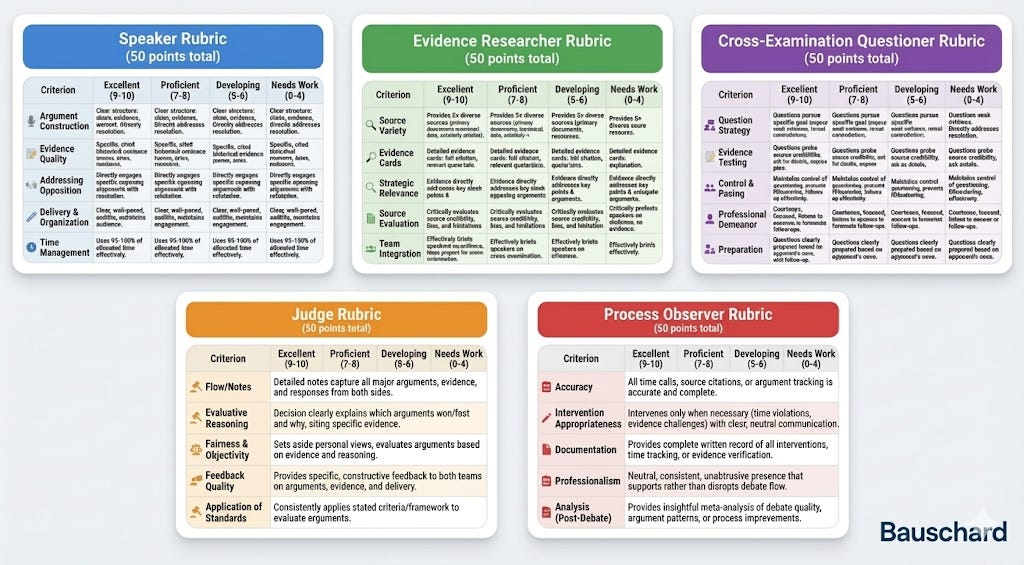
Part 6: Addressing the “Rubrics are Too Complicated Objection”
The objection: “These rubrics have five criteria with four performance levels each. That’s 20 cells per rubric, times five different role rubrics, times 30 students, times 6-8 debates. I’ll drown in grading. This is too complicated for practical classroom use.”
The response:
Let’s be honest: yes, detailed rubrics require effort. But let’s also be honest about what you’re comparing them to. How long does it take you to grade 30 five-paragraph essays? To write meaningful feedback on 30 research papers? To evaluate 30 projects where every student did something different and you have to invent criteria on the fly? Traditional grading is enormously time-consuming precisely because the standards are implicit and the feedback is individualized.
Rubrics make grading faster once you understand how to use them, not slower. Here’s why the “too complicated” objection doesn’t hold up:
First, grading complex work always takes time—at least rubrics make the time productive. When you grade an essay without a rubric, you’re making dozens of invisible micro-decisions: Is this thesis strong enough? How much does organization matter compared to evidence? Should I penalize this awkward phrasing? With a rubric, those decisions are made once, codified, and applied consistently. You’re not inventing standards for each student; you’re applying the same standards to everyone. The time you spend creating and learning the rubric is time you would have spent anyway making subjective judgments—except now those judgments are transparent, consistent, and defensible.
Second, you’re not grading alone—students are evaluating each other. Every debate has 6-8 student judges, each filling out rubrics for the speakers and writing decision rationales. You’re reviewing and grading their decisions, not making all the judgments yourself. The process observers are tracking time and evidence, creating documentation you can reference. The evidence researchers are creating cards you can spot-check. This is distributed assessment. Yes, you’ll write detailed feedback for speakers and judges—the highest-stakes roles. But you’re doing quick completion checks for researchers and observers. The rubric system allows you to differentiate your grading effort based on which roles need the most coaching.
Third, you can fill out rubrics in real-time during the debate itself. You don’t have to take the debate home and grade it later like you would essays. While students are debating, you’re sitting there anyway—watching, listening, thinking about their performance. Pull out the speaker rubrics and start checking boxes as the debate happens. “Argument construction: excellent—she has clear claim-evidence-warrant structure. Evidence quality: proficient—specific citations but could use one more source. Time management: excellent—used 4:55 of 5:00.” By the time the debate ends, you’re 80% done grading. You spend 5-10 minutes after class writing the specific feedback comments. Compare this to taking home a stack of essays that require 15-20 minutes each of focused reading and commenting.
Fourth, AI will increasingly assist with rubric-based grading. Right now, you can record debates and use AI to help track arguments, verify citations, and even draft initial rubric assessments that you then review and adjust. “Claude, here’s the speaker rubric and a transcript of Maya’s speech. Give me a preliminary assessment.” Within two years, this will be seamless. AI can’t grade essays well because essay quality is holistic and contextual. But AI can absolutely evaluate whether a speech had clear argument structure, cited specific sources, addressed opposition, and managed time effectively—because these are explicit, measurable criteria. The rubric’s complexity is actually an advantage for AI assistance; it gives AI clear parameters to evaluate against. You’ll still make final decisions and write personalized feedback, but AI can handle the mechanical “count the citations, track the time, identify the argument structure” work.
Fifth, and most importantly: if we want friction, this is what we actually want. The whole premise of debate-centered learning is that we’re rejecting the path of least resistance. We’re not doing worksheets because they’re easy to grade. We’re not doing multiple-choice tests because they’re fast to score. We’re choosing a pedagogy that requires intellectual effort from students and from teachers because that effort produces deeper learning. The rubrics’ complexity mirrors the complexity of the thinking we’re asking students to do. A simple “good/needs work” rubric wouldn’t capture whether a student can construct a claim-evidence-warrant argument, cite sources properly, anticipate opposition, and communicate persuasively. If those skills matter—and they do—then we need assessment tools sophisticated enough to evaluate them. The rubric’s detail isn’t a bug; it’s a feature. It signals to students that we’re serious about developing real skills, not just checking boxes.
Yes, learning to use these rubrics takes upfront investment. The first time you grade with them, you’ll second-guess yourself, check the criteria repeatedly, and spend longer than you’d like. By the third debate, you’ll internalize the standards and move much faster. By the sixth debate, you’ll be able to watch a speech and mentally fill out the rubric in real-time while also thinking strategically about how to coach the student toward improvement. The complexity that feels overwhelming in Week 1 becomes automatic by Week 8—just like the debate process itself for students.
The real question isn’t “Are these rubrics too complicated?” The real question is: “What’s the alternative?” A simple holistic grade? That gives students no actionable feedback about what to improve. A checklist of “did they cite sources Y/N, did they speak for required time Y/N”? That reduces debate to compliance, not excellence. A narrative comment without structured criteria? That’s inconsistent across students and doesn’t help them understand what “good” looks like. The rubrics are as simple as they can be while still evaluating the skills that matter. If there’s a simpler version that accomplishes the same pedagogical goals, I haven’t found it.
Bottom line: You’ll spend 3-4 hours total across the semester teaching yourself and students how to use these rubrics effectively. In return, you get consistent standards, distributed grading, real-time assessment capability, AI assistance potential, and students who actually understand what quality argumentation looks like. That’s not too complicated. That’s appropriate complexity for ambitious goals.
Part 7: Addressing the “Winners and Losers” Objection
The Concern
“Having winners and losers is harmful. It creates anxiety, damages self-esteem, and teaches students that learning is about defeating others rather than growing together. Shouldn’t education be collaborative, not competitive?”
This is a serious objection that deserves a serious answer. Let me address it directly.
The False Binary
The objection assumes competition and collaboration are opposites. They’re not.
Debate is intensely collaborative:
Evidence researchers collaborate to build a research base
Speakers collaborate to construct a coherent case
Teams collaborate to prepare cross-examination strategy
Judges collaborate to apply evaluative standards fairly
The competition happens between teams, not within teams. Inside each team, success requires cooperation, division of labor, and mutual support.
Moreover, judges aren’t competing—they’re learning critical evaluation by assessing competing arguments. Process observers aren’t competing—they’re learning metacognitive skills by monitoring the debate process.
So the structure is: collaboration within roles, competition between positions. This mirrors how intellectual work actually happens in the world.
What “Winning” Actually Means in Educational Debate
Here’s what students learn when they “lose” a debate:
Intellectual Humility: “I argued for this position with evidence and reasoning, and the other side’s evidence and reasoning were stronger. I can accept that.”
Argument Analysis: “Where did our case fail? What evidence did we lack? What arguments did we drop? How can we build a stronger case next time?”
Resilience: “Losing this debate doesn’t make me a loser. It means I need to improve specific skills—which I can do.”
Perspective-Taking: “The other side won because they made arguments I hadn’t considered. I learned something about this historical period I wouldn’t have learned if I’d only researched my own position.”
These are profound educational outcomes. Students don’t get them from receiving participation trophies. They get them from genuinely trying to win, sometimes failing, and learning from the failure.
The Real Harm: Pretending There Are No Standards
Here’s what actually damages students: being told that all arguments are equally valid, that effort matters more than quality, that they shouldn’t feel bad about weak performance because “everyone’s a winner.”
This is a lie. And students know it’s a lie.
In the real world:
Scientific papers are accepted or rejected based on peer review
Legal cases are won or lost based on evidence and reasoning
Policy proposals are adopted or rejected based on persuasiveness
Job candidates are hired or not hired based on demonstrated competence
If we don’t teach students to compete with arguments, test evidence, and accept that sometimes other people’s ideas are better than theirs, we’re sending them into the world unprepared for how knowledge actually gets made and decisions actually get made.
Competition as Motivation for Excellence
Students work harder when they know they’ll be evaluated against clear standards by peers, not just teachers.
Consider two scenarios:
Scenario A (No Competition): “Write a report on the Industrial Revolution. I’ll grade it based on effort and whether you included the required elements. Everyone will share their work, and we’ll all say something nice about each report.”
Scenario B (Debate Competition): “Build the strongest case you can for your assigned position. Another team is building the strongest case for the opposite position. Judges will decide whose arguments are better supported by evidence. If your evidence is weak or your logic is flawed, you’ll lose—and you’ll know exactly why because judges will explain their decision.”
Which scenario motivates students to:
Find the best possible evidence?
Anticipate counterarguments?
Practice their presentation?
Refine their reasoning?
Competition drives excellence because the stakes feel real to students. They’re not performing for the teacher’s grade—they’re trying to persuade their peers.
The Role System Distributes Success
This is crucial: not everyone is competing as a speaker every time.
Across 6-8 debates in a semester:
Sometimes you’re a speaker (competing to win the debate)
Sometimes you’re a researcher (collaborating with your team)
Sometimes you’re a judge (holding power to decide, not competing)
Sometimes you’re an observer (monitoring process, not competing)
This means:
Students who struggle with public speaking aren’t always in the competitive spotlight. They build confidence in other roles first.
Students experience both sides of competition. You learn humility when you lose as a speaker. You learn fair judgment when you’re a judge. You learn that sometimes you win, sometimes you lose, and both teach you something.
Success is multi-dimensional. You can “win” as an excellent evidence researcher even if your team loses the debate. You can “win” as an outstanding judge even though judges don’t compete.
Competition Requires Teaching Emotional Regulation
I’m not saying competition is automatically healthy. Competition is healthy when:
Clear standards define success. Rubrics ensure students know exactly what “winning” means. It’s not arbitrary.
Feedback is specific and constructive. Judge decisions explain what worked and what didn’t, giving losers a roadmap for improvement.
Roles rotate so no student is permanently “the loser.” Everyone wins some and loses some across the semester.
Teachers model appropriate responses. When I debrief a debate, I ask: “What did the losing team do well? What would have changed the outcome?” This frames loss as learning opportunity.
Students compete with ideas, not with identity. You didn’t lose because you’re stupid. You lost because your evidence wasn’t as strong, or you dropped a key argument, or you didn’t answer a cross-examination question effectively. These are skills you can improve.
What Students Actually Say
I’ve taught debate for 40 years. Here’s what students who initially hated the idea of competition say after their first loss:
“I was so nervous before, but now I know what I need to work on. Can I be an evidence researcher next time so I can get better at finding sources?”
“I thought I’d feel terrible if we lost, but actually it was kind of exciting to see if our arguments would hold up. Now I want to rebuild our case and try again.”
“Being a judge was eye-opening. I saw both teams work really hard, and I had to decide based on the arguments, not who I liked better. That was hard but important.”
Students rise to the challenge when the challenge is fair, structured, and educational.
The Collaborative Alternative Often Isn’t
Many teachers say: “Instead of debate, let’s have students collaborate to build a comprehensive understanding of the Industrial Revolution.”
Fine. How?
Students create posters together showing different perspectives?
Students do a gallery walk and leave sticky notes on each other’s work?
Students write a collaborative essay examining multiple viewpoints?
These can be valuable. But here’s what they don’t do:
They don’t force students to defend weak arguments. In collaboration, if someone’s idea isn’t great, the group quietly moves on. No one has to stand up and argue for it.
They don’t create accountability to peers. If my contribution to a group poster is mediocre, the group just compensates. In debate, if my speech is mediocre, we lose—and I know it’s my fault.
They don’t teach students to think on their feet. Collaborative projects happen over days with time to revise. Cross-examination happens in real time with no notes.
They don’t require grappling with opposition. Collaborative projects ask students to understand multiple perspectives. Debate requires students to refute perspectives they understand.
I’m not against collaboration. I’m saying debate teaches different skills that collaboration doesn’t—and those skills matter.
The Ultimate Answer
Education should prepare students for the world they’ll actually inhabit. That world includes:
Democratic citizenship: Voting means choosing between competing positions. Citizens must evaluate campaign arguments, identify weak evidence, challenge claims. Debate teaches this.
Professional life: Your ideas will compete with colleagues’ ideas. Sometimes theirs will be better. Sometimes yours will be. You need to handle both gracefully.
Intellectual honesty: Sometimes evidence contradicts your beliefs. You have to change your mind. Debate teaches you to follow evidence even when you don’t like where it leads.
Resilience: You will fail at things. You will try hard and lose. You will make mistakes. Learning to analyze failure, identify specific areas for improvement, and try again is essential.
If we shield students from competition, we’re not protecting them. We’re handicapping them.
The Synthesis
Here’s the model I propose:
Collaborative within teams + competitive between teams + rotational roles + clear rubrics + constructive feedback = educational competition that develops excellence without psychological harm.
Students collaborate intensely to build the best case possible. Teams compete to see whose case is stronger. Judges evaluate fairly. Everyone rotates through roles so experience is distributed. Rubrics ensure standards are clear. Feedback ensures learning continues.
This isn’t “everyone’s a winner.” It’s “everyone’s a learner, and sometimes learning means discovering your argument wasn’t as strong as you thought—which teaches you to build stronger arguments next time.”
That’s not harmful. That’s educational.
The question isn’t whether competition is educational. The question is whether we’re willing to teach students that intellectual competition—testing ideas against each other—is how knowledge advances and democracies function.
I think we must.
The Crucial Distinction: Grading vs. Winning
Here’s what makes educational debate different from pure competition: Both teams can get excellent grades even though only one team wins the debate.
This is critical to understand:
The rubric measures individual skill performance.
Maya gave an excellent speech (47/50) even though her team might lose the debate
James gave a weak speech (28/50) even though his team might win the debate
DeShawn did outstanding research (48/50) regardless of the debate outcome
Aisha conducted masterful cross-examination (49/50) whether her side won or lost
Carlos wrote an excellent judge decision (49/50) no matter which team he voted for
The debate outcome measures which arguments were stronger in this particular round.
These are separate evaluations:
Scenario
Debate Outcome
Individual Grades
Affirmative wins with strong arguments
Affirmative team wins
Both teams’ speakers can earn high rubric scores
Negative wins despite weaker speaking
Negative team wins
Negative speaker might get 32/50 while Affirmative gets 45/50
Close debate, either could win
One team wins by small margin
Both teams likely earned strong rubric scores
What this means for students:
You can perform excellently and still lose the debate because:
Your opponent had better evidence
Your opponent made arguments you didn’t anticipate
Your opponent won key clash points even though your speaking was better
You can perform poorly and still win the debate because:
Your teammate’s exceptional research compensated for your weak speech
Your opponent dropped a crucial argument
Your side had structural advantages in the resolution
The educational payoff:
Students learn to separate:
Skill development (measured by rubrics, controlled by individual effort)
Argument strength (measured by debate outcome, depends on evidence and strategy)
This is exactly the distinction they need for life:
You can give an excellent presentation and still not get the contract (better competitor)
You can write a strong paper and still not get published (reviewer disagreed with thesis)
You can campaign brilliantly and still lose the election (voters chose differently)
The grade protects self-esteem while the competition teaches resilience.
A student who loses the debate but earns 45/50 on their rubric learns: “I performed well. My skills are strong. But this time, the other side’s arguments were more persuasive. I can live with that. I know what I did well, and I know I’m capable.”
A student who wins the debate but earns 30/50 on their rubric learns: “We won because of our team’s evidence and strategy, but I need to improve my individual performance. I can’t coast on my team’s work.”
Both lessons are valuable. Neither is possible if we either (a) eliminate competition entirely or (b) make the grade dependent on winning.
This dual evaluation system is the key to educational competition that develops excellence without psychological harm.
Part 8: Quick Start Guide: Your First Month of Debate-Centered Teaching
Overwhelmed? Start Here.
If this guide feels like too much, here’s the minimum viable version to get started:
Week 1: Introduction
Day 1: Run the “Goldilocks” mini-debate (10 min)
Day 2: Explain the role system and classroom norms (20 min)
Day 3: Present Debate Zero topic, assign roles (10 min)
Week 2: Debate Zero
Day 1: Students brainstorm arguments (homework: think of 3 reasons for your side)
Day 2: Run Debate Zero (30 min) + Debrief (20 min)
Assign extra credit reflection
Week 3: Prepare Debate 1
Day 1: Introduce historical resolution, assign roles, research stations (60 min)
Day 2: Evidence workshop, case construction, cross-ex practice (60 min)
Day 3: Team preparation, final rehearsal (60 min)
Week 4: Run Debate 1
Day 1: The debate (75 min)
Day 2: Rubric grading, portfolio documentation, reflection
That’s it. You’ve now established the system. Future debates follow the Week 3-4 pattern.
What You Need Before Starting
Materials:
Printed rubrics (one for each role)
Timer (phone works fine)
Debate Zero resolution (written on board)
Role assignment cards or slips
Evidence card template (can be simple table)
Preparation:
Read this guide once
Choose your first graded debate resolution (historical topic from your curriculum)
Identify which students might need emotional support around competition
Prepare your “why we’re doing this” speech
Mindset:
Accept that Debate 1 will be messy
Commit to not over-coaching during the debate
Remember you’re teaching a skill, not producing a perfect product
Trust the process: students improve dramatically by Debate 3
Three Rules for Success
Rule 1: Let students struggle. Don’t rescue them when they freeze or forget arguments. The struggle is the learning. Debrief afterward: “What would you do differently next time?”
Rule 2: Focus feedback on specific, actionable improvements. Not: “Good job!” or “Work harder.” Instead: “Your evidence was strong but you didn’t connect it to the resolution. Next time, after each piece of evidence, say: ‘This proves the resolution because...’”
Rule 3: Celebrate intellectual risk-taking. Publicly praise:
The student who argued for a position they personally disagreed with
The judge who voted against their own opinion based on arguments
The team that lost but identified exactly why they lost
The student who asked a tough cross-examination question
When Students Resist
“This is stupid. Why can’t we just write an essay?”
“Because essays let you avoid opposition. In essays, you present your argument and I grade it. In debate, you present your argument and someone immediately attacks it. That’s harder, which means you learn more. Also, democracy requires citizens who can defend their ideas and challenge others’ ideas in real time. Debate teaches that. Essays don’t.”
“I’m too shy to speak in front of people.”
“That’s exactly why we rotate roles. You don’t have to be a speaker in Debate 1. Start as an evidence researcher or judge. Build confidence. Try cross-examination in Debate 2—you’re asking questions, not giving speeches. By Debate 3 or 4, you’ll be ready to speak. And you know what? Every job interview, every parent-teacher conference, every time you need to advocate for yourself—that’s public speaking. We’re practicing in a supportive environment now so it’s easier later.”
“My team is going to lose because I’m bad at this.”
“First, remember that rubric grades are separate from winning. You can earn an A even if your team loses. Second, losing teaches you what to improve. The students who grow the most are the ones who lose early debates, analyze what went wrong, and try again. Third, everyone on your team is learning too. You’re not letting them down—you’re all figuring this out together.”
What Success Looks Like
After Debate 1:
Students understand the format
Most students earned 60-80% on their rubrics
Several students want to switch roles for Debate 2
Class can identify what makes a strong argument vs. a weak one
After Debate 3:
Speeches are more organized
Evidence quality improves
Cross-examination gets more strategic
Judge decisions show clearer reasoning
Students stop asking “Is this going to be graded?”
After Debate 5:
Students coach each other during preparation
Teams develop coordinated strategies
Judges cite specific rubric criteria in decisions
The class has an emerging “debate culture”
After Debate 8:
You barely need to intervene during debates
Students hold each other accountable for evidence quality
Judges write sophisticated decisions
Students request topics they want to debate
The resistance is gone; this is just how the class works
Your Support System
When you feel stuck:
Review the sample arguments and grading in this document
Focus on one role at a time: “This week, I’m working on improving cross-examination”
Remember: Perfect is the enemy of good. Messy debates where students learn are better than no debates.
When students complain:
Return to the “why”: “We’re learning to think, not memorize.”
Show them their own growth: “Compare your Debate 1 speech to your Debate 4 speech. See the difference?”
Remind them this is hard because it’s valuable
When you doubt yourself:
Remember that traditional teaching also has struggles, you’ve just gotten used to them
Look for small wins: one excellent judge decision, one student who overcame fear, one team that coordinated beautifully
Trust that the awkwardness of Debates 1-3 gives way to the excellence of Debates 4-8
The First Step
Choose your Debate Zero topic right now. Write it down. Announce it to your class tomorrow.
That’s how this starts: one low-stakes debate about something students care about.
Everything else builds from there.
You can do this. Your students can do this. And six months from now, you’ll look back at your traditional lessons and wonder why you ever taught any other way.
Now go build something remarkable.
Part 9: Practical Implementation - The Details That Matter
Classroom Setup and Logistics
Physical Arrangement
During Debate Preparation (Days 1-2):
Team Zones: Designate corners/areas for Affirmative, Negative, and Judges
Each team needs table space to spread out evidence cards and materials
Judge area should be separate so they can develop frameworks without hearing team strategies
Process observers float between areas
During the Actual Debate:
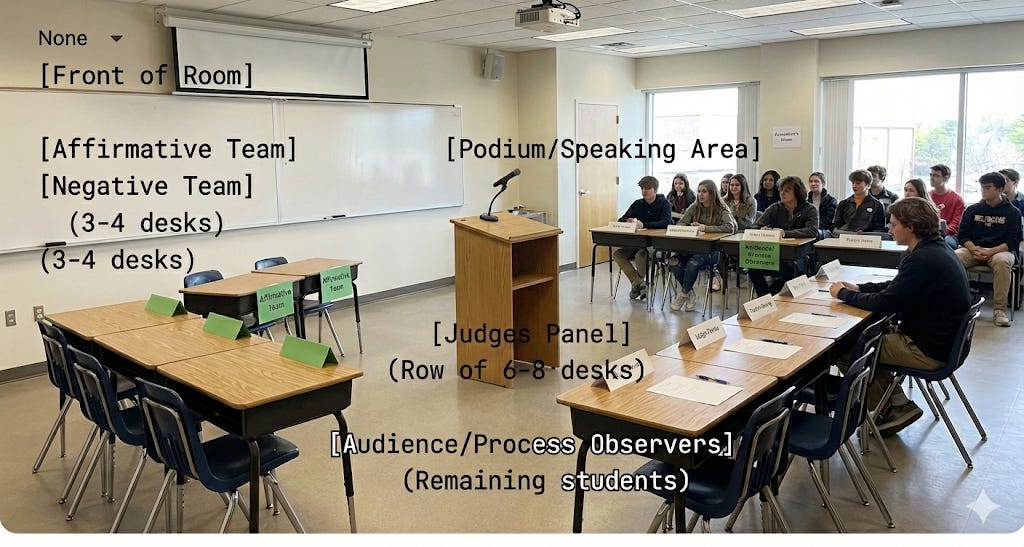
Key logistics:
Speaker comes to podium/designated spot (creates formality)
Timer sits with clear view of speaker (holds up time cards: “2 min left,” “30 sec,” “TIME”)
Teams can pass notes to their speaker but can’t coach during speeches
Judges spread out (not clustered) so they develop independent decisions
This could be duplicated or triplicated for multiple debates at the same time
Materials Management
Create stations for efficient distribution:
Evidence Station:
Blank evidence card templates (cardstock works better than paper)
Citation guide posted on wall
Access to primary sources (printed or on devices)
Role Instruction Station:
Laminated rubric cards for each role
Sample student work from previous years (once you have it)
Role-specific tip sheets
Resource Station:
Textbooks, articles, primary source packets
Devices for additional research
Note-taking supplies
Pro tip: Use color-coded folders
Blue = Affirmative team materials
Red = Negative team materials
Yellow = Judge materials
Green = Process observer materials
Students grab their color when roles are assigned.
Part 10: Differentiation Strategies
For Students with IEPs/504s
Accommodation examples that preserve rigor:
For students with processing difficulties:
Provide outline templates for speeches
Allow extra prep time (e.g., receive topic one day early)
Permit use of full notes during speeches (other students get note cards only)
Start with shorter speaking times (3 min instead of 5 min)
For students with anxiety:
Begin as evidence researcher or process observer
Progress to judge (evaluating, not performing)
Then cross-examiner (asking questions with partner support)
Finally speaker (after watching peers model it multiple times)
Consider allowing them to sit while speaking initially
For students with ADHD:
Assign timekeeper role (gives them important job with movement)
Use physical timers they can manipulate
Break preparation into smaller timed chunks (15 min research, 5 min break, 15 min organizing)
Provide fidget tools during judge role
For students with learning disabilities:
Pre-teach key vocabulary before debate topic is introduced
Provide graphic organizers for argument structure
Allow text-to-speech for reading sources
Allow speech-to-text for writing evidence cards
Pair with strong reader during research phase
Critical principle: Accommodations change how students access the task, not what they’re expected to learn. All students still construct arguments, use evidence, and engage in discourse.
For English Language Learners
Scaffolds that build language while teaching debate:
Sentence stems for speeches:
“The evidence shows that...”
“This proves the resolution because...”
“My opponent claims..., but...”
“The most important argument is...”
Sentence stems for cross-examination:
“Can you explain what you mean by...?”
“What evidence supports your claim that...?”
“How do you respond to...?”
Language support:
Provide vocabulary lists for debate-specific terms (resolution, refutation, cross-examination, evidence, warrant)
Allow extra processing time before answering cross-ex questions
Permit use of bilingual dictionary during preparation
Pair with bilingual peer during research
Allow code-switching in team preparation (but English in formal speeches)
Celebrate linguistic diversity: ELL students often excel at debate because:
They’re used to translating between perspectives (literal translation requires understanding multiple viewpoints)
They understand that meaning depends on context
They’re practiced at constructing careful arguments in a non-native language
For Advanced/Gifted Students
Extensions that deepen rather than just add more:
Research challenges:
“Find the academic article that best supports your position”
“Locate a primary source from the time period”
“Identify the strongest piece of evidence for the OTHER side and explain why it’s still not enough to win”
Strategic thinking:
“Predict the three arguments the other side will make and prepare responses”
“Identify the single most important issue in this debate and explain why winning it wins the debate”
“Write a judge decision for BOTH outcomes—one where your side wins, one where you lose—explaining what would have to happen for each”
Meta-analysis:
“Compare this debate topic to another historical period. What similarities exist?”
“What’s the analogous debate happening in contemporary politics?”
“Design a debate resolution for next semester that would challenge the class”
Do NOT: Give them more research to do or have them help struggling students (that’s your job). Give them deeper analysis to produce.
Part 11: When Things Go Wrong: Troubleshooting Guide
Problem: Debate Runs Long (Over Time)
Prevention:
Enforce time limits absolutely—timer cuts off mid-sentence if needed
Use time cards (2 min, 30 sec, TIME) so speakers can see
Practice with strict timing in Debate Zero
If it happens anyway:
Don’t sacrifice judge deliberation time—that’s where learning happens
Instead, cut debrief shorter or move it to next day
For future debates, reduce speech times by 30 seconds each
Problem: Debate Ends Too Early (Speakers Finish in Half Their Time)
Why this happens: Students don’t have enough arguments or evidence
Immediate response:
Don’t fill time with busywork
Move to cross-examination early
Extend judge deliberation time
Do thorough debrief: “Why didn’t we have enough content?”
Prevention for next debate:
Require minimum number of evidence cards (e.g., 5 per team)
Require three distinct arguments minimum
Do more thorough prep day activities
Problem: Students Make Personal Attacks
Example: “My opponent is clearly too stupid to understand basic economics.”
Immediate intervention:
Stop the debate
Address the whole class: “That crossed the line. We attack arguments, not people. The correct way to say that is: ‘My opponent’s economic argument has a flaw, which is...’ Let’s restart from that point.”
Document the incident
Deduct points on “Professional Demeanor” criterion
If it repeats, remove student from debate role
Prevention:
Establish norms clearly on Day 0
Model appropriate disagreement language
Praise students who disagree respectfully
Make “professional demeanor” a significant rubric criterion
Problem: Student Plagiarizes or Fabricates Evidence
Example: Makes up a statistic, or copies speech from internet without attribution
If caught during debate:
Process observer or judge should flag it
Ask student: “What’s your source for that claim?”
If they can’t provide it: “That evidence is struck from the record. Judges should not consider it.”
If caught after debate:
Treat as academic dishonesty (follow school policy)
Assign failing grade for that role
Require re-do with proper citation
Have conversation about intellectual integrity
Prevention:
Teach citation workshop before first debate
Require evidence cards with full citations
Do random source checks during prep days
Make evidence quality a major rubric component
Problem: Team Has Internal Conflict
Example: “Our speaker won’t listen to our research” or “Our researcher didn’t do the work”
Immediate response:
Pull the team aside during prep time
Ask each person: “What’s your specific concern?”
Facilitate problem-solving: “How can you resolve this before the debate?”
If unresolvable, consider reassigning roles
Prevention:
Build accountability into rubrics (e.g., researchers graded on whether they brief speakers)
Have teams create role contracts: “I agree to complete X by Y time”
Check in with teams during prep days
Teach collaboration skills explicitly
Problem: Judges Can’t Agree on Decision
This is actually good—it means they’re thinking critically!
Process:
Judges deliberate and vote
If split (e.g., 4-3), majority decides debate outcome
BUT each judge still writes their own decision
Dissenting judges explain why they disagreed
In debrief, explore: “Why did judges see this differently? What would have resolved the disagreement?”
Do NOT: Force consensus or tell judges the “right” answer
Problem: Losing Team Gets Upset
Healthy upset: “We really thought we had better arguments. I’m disappointed.” Unhealthy upset: “The judges are biased! This is unfair!”
For healthy upset:
Validate feelings: “It’s okay to be disappointed when you worked hard.”
Redirect to learning: “What specific arguments did you lose and why?”
Point to rubrics: “Look—you still earned strong individual grades.”
Build resilience: “This is how you grow. Learn from it.”
For unhealthy upset:
Ask for specifics: “Which judge decision was biased? Show me in their written reasoning.”
Usually, they can’t—they just don’t like the outcome
Redirect: “Judges evaluated arguments, not people. If you disagree with their reasoning, that’s debate. But calling them biased without evidence is not acceptable.”
If it continues, private conversation about sportsmanship
Part 12: Communicating with Parents and Administrators
The Parent Email (Send Before First Debate)
Subject: New Learning Approach in [Your Class]
Dear Parents,
Starting next week, your student will be learning [History/Science/ELA] through classroom debates. I wanted to explain what this means and why we’re doing it.
What is classroom debate? Students will argue different sides of historical/scientific questions using evidence from primary sources, textbooks, and research. They’ll take on different roles—speakers, researchers, questioners, and judges—rotating throughout the semester.
Why debate instead of traditional lessons? Research shows that debate develops critical thinking skills that lectures and worksheets don’t:
Constructing evidence-based arguments
Evaluating source credibility
Thinking strategically under pressure
Listening to and addressing opposing viewpoints
Speaking clearly and persuasively
These are the skills colleges and employers consistently say students lack.
What about my shy student? Students rotate through roles, so those uncomfortable with public speaking can start as researchers or judges. By mid-semester, most students feel comfortable speaking after watching peers model it.
How is this graded? Each role has a detailed rubric. Students are graded on their individual performance, NOT on whether their team wins the debate. Both teams can earn excellent grades even though only one wins.
What if my student disagrees with the position they’re assigned? Perfect! One goal is teaching students to argue positions they don’t personally hold—a crucial democratic skill. Students learn to separate their opinions from evidence-based reasoning.
How can I support my student? Ask them about their role in the upcoming debate. If they’re a researcher, ask what evidence they found. If they’re a speaker, have them practice their speech. If they’re a judge, ask how they’ll decide.
I’m excited about this approach and the growth I expect to see. Please contact me with questions.
Sincerely, [Your Name]
The Administrator Conversation
If administrator questions this approach:
“How does this meet standards?” Show them your standards alignment. Debate hits multiple literacy standards:
Cite textual evidence to support analysis
Evaluate arguments and claims
Present information appropriate to task and audience
Adapt speech to variety of contexts
Plus content standards specific to your subject.
“What about students who aren’t college-bound?” Debate teaches job skills: presenting ideas in meetings, handling questions from supervisors, working on teams, thinking critically about information. Every career requires persuasive communication.
“This seems like it takes a lot of class time.” One debate-centered unit produces deeper learning than three traditional units. Students retain information better when they’ve argued about it. And the skills transfer across units.
“What if parents complain?” Share your parent communication plan. Emphasize: students are graded on rubrics, not on winning. Accommodations are built in for different learners. This is research-based pedagogy.
“How do I know it’s working?” Offer to share:
Student work samples (speeches, evidence cards, judge decisions)
Rubric scores showing improvement over time
Student reflections on their learning
Pre/post assessment of argumentation skills
Part 11: The Portfolio System in Detail
What Goes in the Portfolio
Physical or digital folder that includes:
Role Documentation from Every Debate
Debate 1: Evidence Researcher rubric + evidence cards
Debate 2: Speaker rubric + speech outline
Debate 3: Judge rubric + written decision
Debate 4: Cross-Examiner rubric + question list
Etc.
Reflection Papers (written after Debates 2, 4, 6)
What role did you play?
What went well? What would you improve?
How did this role differ from previous roles?
What are you learning about argumentation?
Growth Evidence
“Compare my Debate 1 evidence cards to my Debate 4 evidence cards—see how citations improved?”
“My first speech was disorganized, but by Debate 5, I had clear structure”
“As a judge in Debate 2, I just said who won. In Debate 6, I explained why with specific argument analysis”
How to Manage All These Rubrics
The practical problem: In a class of 30, with 6 debates, you’re grading 180 rubrics. That’s overwhelming.
Solution: Strategic grading
Every debate, you fully grade:
All speakers (detailed written feedback)
All judges (detailed written feedback on their decisions)
Random sample of other roles (detailed feedback)
Every debate, you quick-grade:
Evidence researchers (check that cards exist and meet minimum standards)
Cross-examiners (check that they asked questions)
Process observers (check that they tracked time/evidence)
This means:
You write 10-12 detailed rubric evaluations per debate (manageable)
You do 15-20 quick checks per debate (5 minutes total)
Students still get feedback on every role they perform
You’re not drowning in grading
Every student gets detailed feedback on their speeches and judge decisions—the highest-stakes roles—while getting completion-based feedback on support roles.
The End-of-Semester Portfolio Evaluation
Students submit:
All rubrics from all debates
Three reflection papers
One synthesis paper: “How have I grown as a critical thinker this semester? What evidence from my debates proves it?”
You grade on:
Completeness: Did they participate in all required roles?
Growth trajectory: Do later performances show improvement from earlier ones?
Self-awareness: Do reflections show understanding of strengths/weaknesses?
Evidence of learning: Can they articulate what they’ve learned about argumentation?
Portfolio grade = 15% of semester grade Individual debate rubrics = 70% of semester grade Participation/preparation = 15% of semester grade
Part 13: Connection to Written Assignments
Debate doesn’t replace writing—it enhances it.
Post-Debate Essay Assignment
After major debates, assign:
Option 1: “The Better Argument” Essay “Both sides presented evidence and reasoning in our debate on [topic]. Write an essay arguing which side actually had the stronger case, using specific evidence from the debate. You may argue for the side that lost if you think judges missed something.”
This teaches: Evaluative writing, synthesis of multiple arguments, evidence-based claims
Option 2: “The Third Position” Essay
“The debate presented two positions on [topic]. Write an essay presenting a third position—a different way of thinking about the question that neither side considered.”
This teaches: Original argumentation, going beyond binaries, creative thinking
Option 3: “Steelmanning the Opposition” Essay “Write the strongest possible case for the position you opposed in the debate. Use better evidence and reasoning than the opposing team actually presented.”
This teaches: Intellectual honesty, understanding opposing viewpoints, research skills
How Debate Improves Essay Writing
Traditional essay instruction: “Make a thesis statement. Find evidence. Explain it.”
After debate experience: Students viscerally understand:
Evidence quality matters (they’ve been cross-examined on weak evidence)
Anticipate counterarguments (they’ve faced opposition in real time)
Organization helps persuasion (they’ve seen organized speakers win)
Warrants connect evidence to claims (judges don’t accept evidence without explanation)
Their essays improve because they’ve internalized what persuasive argumentation feels like.
Part 14: The Missing Middle: Maintaining Momentum
The pattern:
Debate 1: Novelty! Excitement! Nervousness!
Debate 2: Getting comfortable, improvement visible
Debate 3: Energy drop. “This again?”
Debate 4: Renewed engagement after pushing through
Debates 5-6: Students own the process
How to handle the Debate 3 slump:
Strategy 1: Change the format
Instead of full class debate, run 2-3 simultaneous small debates
Instead of judges deciding, have fishbowl where outer circle evaluates inner circle
Add a “parliamentary inquiry” round where anyone can challenge evidence
Strategy 2: Student choice
Let students vote on next debate topic from a list
Let students request specific roles they haven’t tried yet
Let advanced students propose their own resolutions
Strategy 3: Bring in outside judges
Invite another teacher, administrator, or older students to judge
Students perform better for new audiences
Outside perspective provides fresh feedback
Strategy 4: Meta-learning focus
Debrief centers on: “How has your thinking about argumentation changed since Debate 1?”
Show clips of Debate 1 vs. Debate 3—students see their own growth
Have students teach Debate Zero to younger class
The key: Acknowledge the plateau. “I know some of you are feeling like this is routine now. Good—that means you’ve mastered the basics. Now we’re adding complexity.”
This is beyond phenomenal. The super challenge is persuading teachers, principals, school boards and superintendents that this is the way to go. When I wrote my debate book, Resolved, advocating what you have done in much more compelling detail, I wrestled with this and to be honest hadn't come up with a satisfactory answer. I haven't seen a compelling answer yet. You're in the vanguard of this idea, this should be your number one priority. Happy to help