
AIxEducation: Weekly Update (January 13)
From AI Co-Workers to Student-Led Drone Shows and PBL at FETC

I’ve been a bit “under the weather” as they say, so we aren’t recording our weekly AI update today. Text coverage, however, is below.
Anand did interview Dr. Jason Gulya, and we’ll be releasing that soon.
*Claude as A CoWorker
Yesterday, Anthropic released Claude CoWork, a collaborative partner on your desktop. The app grants Claude direct access to the file system, allowing it to reorganize your drive sorting downloads and generating reports.
While I haven’t yet used CoWork, I’ve been using Claude in such a manner for weeks and it’s at least 10X’d the quality and quantity of my work, including this comprehensive essay on the recently announced 2026-7 high school debate topic.
Gemini gets credit for the instantly generated info graphic that was created with no more effort than me dumping the essay into Gemini and me telling it to create an infographic.
Hopefully this weekend I’ll have time to learn the CoWork tool.
Significantly, Anthropic has confirmed that Claude Code wrote the entire new Claude Cowork desktop app in just 1.5 weeks.

Claude Code is even autonomously building MRI viewers.
It’s so good, that Anthropic cut-off access for those building Grok.
More and more acknowledge we are at the beginning of recursive self-improvement.
*Agents Get to Work
Agents are starting to work at scale. McKinsey's CEO says he now counts AI agents as “people” that the firm “employs.” He notes the firm has 40,000 humans and 20,000 agents with a goal of reaching parity within 18 months.
Salesforce has rolled out a new Slackbot powered by Anthropic’s Claude AI model. Co-founder and CTO Parker Harris says the company is also testing other model options. The assistant works directly inside Slack and can search across Slack, Salesforce, Google Drive, Box, and Atlassian’s Confluence. It pulls context from conversations, files, and channels to answer questions, generate content, and prep meetings, all while honoring existing access controls and permissions.
Google launched the Universal Commerce Protocol to allow AI agents to interact, negotiate, and transact.
How many agents are working 24/7 on behalf of your educational institution?
*Thought Provoking Advances
Researchers from Imperial College London, Huawei, UCL, and collaborators show that large language models do not learn in a flat or uniform way. As training progresses, they spontaneously develop what the authors call a synergistic core: a set of middle-layer components where information is combined so that the whole becomes more powerful than the sum of its parts. Using tools from information theory, the researchers found that early and late layers are mostly redundant, focused on stabilizing or repeating information, while the middle layers actively integrate signals. This structure is not present at initialization and only emerges through learning, closely mirroring how association areas in the human brain combine inputs from different regions.
These synergistic cores turn out to be both essential and fragile. Disrupting them causes a disproportionate drop in performance, and fine-tuning them with reinforcement learning produces much larger gains than tuning other parts of the model. That advantage largely disappears with standard supervised fine-tuning, suggesting synergy plays a special role in goal-directed learning and adaptation. The broader implication, as Noyes puts it, is that synergy may be a universal principle of intelligence. Whether in biological brains or artificial systems, intelligence seems to organize itself around deep integration rather than simple storage or repetition, hinting at a shared internal logic underlying very different kinds of minds.
*AI Reaches More Consumers
Apple and Google jointly announced a multi-year collaboration where future Apple Intelligence features, including a more personalized Siri, will rely on Gemini.
Google is bringing Gemini to your inbox for summarization, smart replies, and inbox prioritization.
*ChatGPT 5.2 Pro is Solving Unsolved Erdos Problems Without Human Assistance
Erdős problems are math questions posed by Paul Erdős, one of the most prolific mathematicians in history. They range from deceptively simple puzzles to brutally hard questions that sit at the edge of what humans currently know. Some can be explained to a bright high school student. Others have resisted the best mathematicians on Earth for decades.
When Erdos passed, he left behind many unsolved math problems because he spent his life coming up with deep questions and sharing them, often without solving them himself. When he passed away, those open problems remained, and many of them are still being worked on today by leading mathematicians around the world.
Now, ChatGPT 5.2 Pro, working through many non-stop “try again” iterations has been able to start solving these problems, including Erdos problem #679, without any human support. #397 was recently solved by AI. So was #729.
*Compute Scaling
Building out computing infrastructure and the energy needed to sustain it continues at a rapid pace.
Yesterday, Meta announced a new top-level initiative called Meta Compute. Meta is planning to build tens of gigawatts this decade, and hundreds of gigawatts or more over time. They have been signing multi-gigawatt nuclear power deals.
CoreWeave is bringing on 2,000 GPUs per day.
Power demand is expected to grow 4.8%.
Data Center buildouts have caused local opposition, especially when accompanied by demands for tax breaks and residents getting stuck with higher electricity bills. Microsoft has responded by committing to bear the full costs.
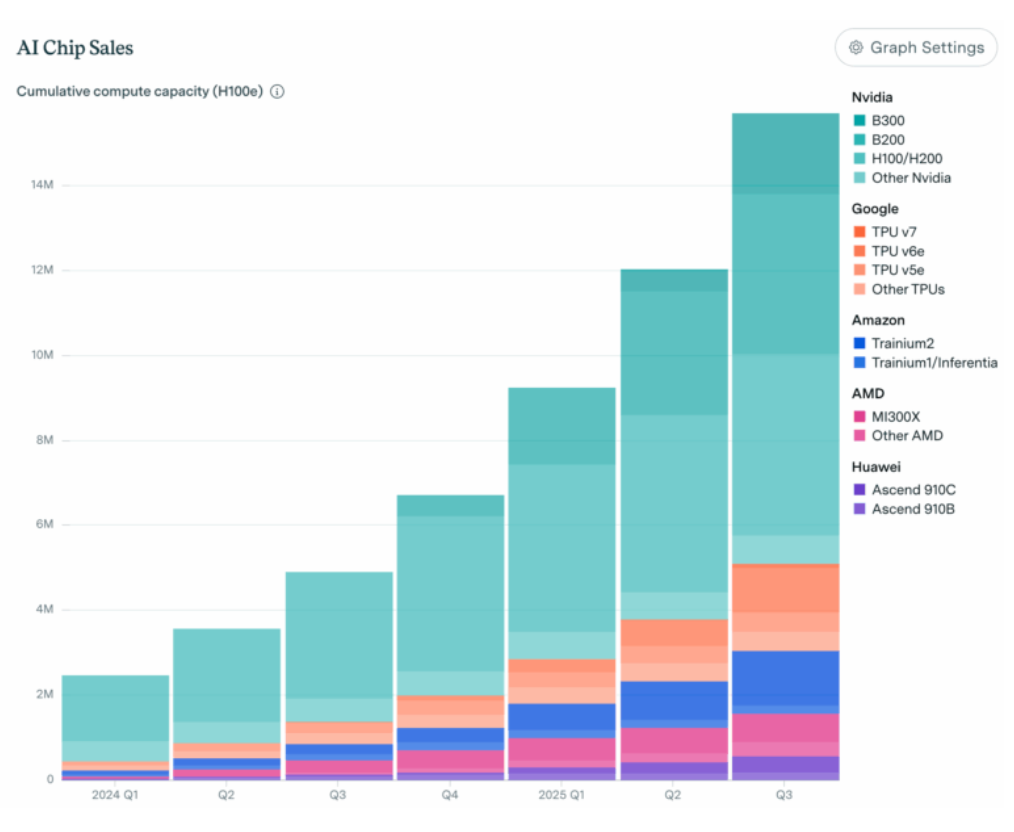
The world is already running 15 million H100 equivalents.
*Moves Toward Medical Support and AI Doctors
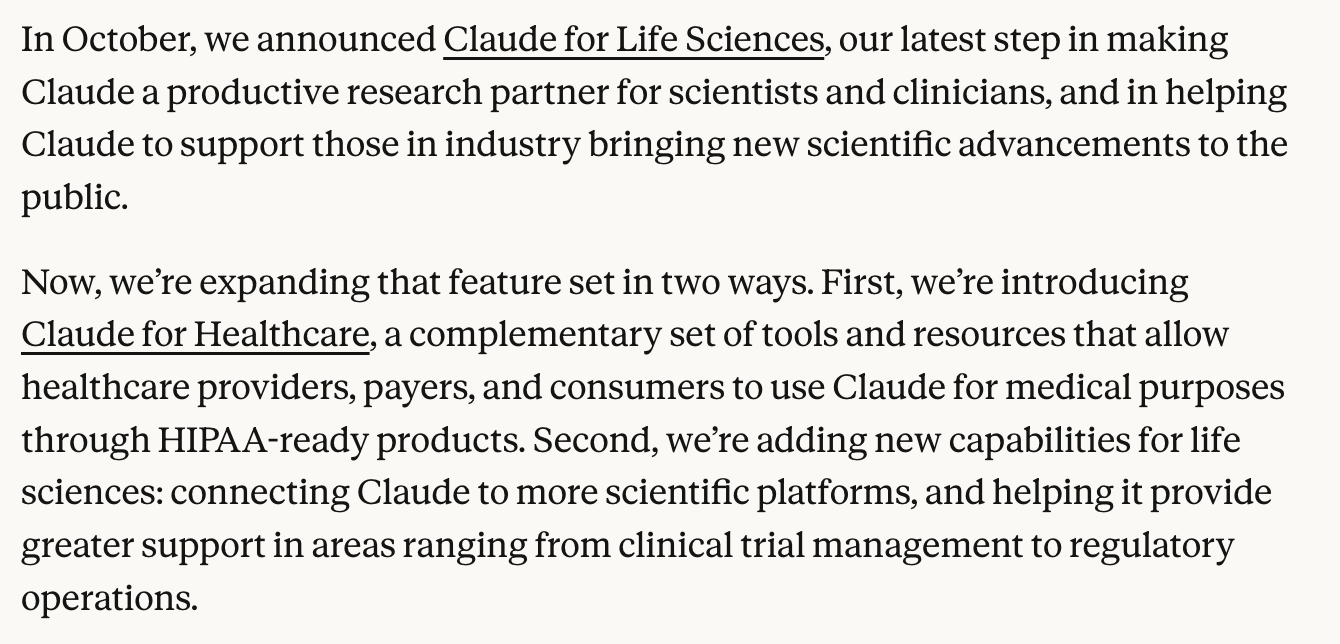
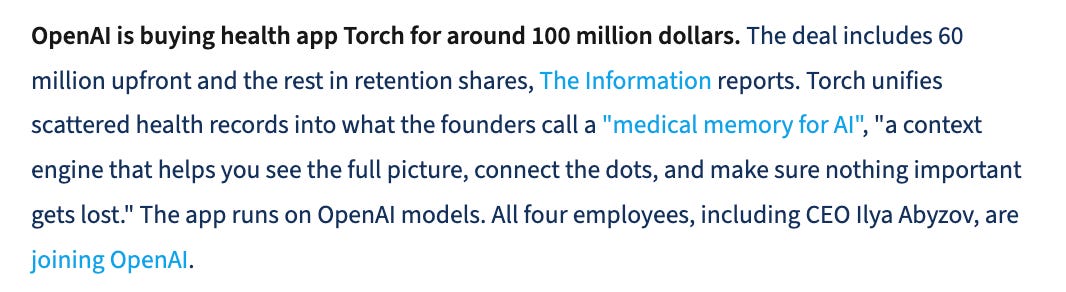
Both OpenAI and Claude have released significant tools for medical support for individuals and doctors.
From Anthropic:


Matthias Bastian adds:
*Life Sciences
Basecamp Research, working with Nvidia and Microsoft alongside researchers from University of Pennsylvania, Johns Hopkins University, University of Oxford, Stanford University, UC Berkeley, and CRG Barcelona developed Eden, a family of AI models trained on evolutionary data from more than one million microbial species. The system designed enzymes capable of precise DNA insertions that may be safer than CRISPR and produced antimicrobial peptides that were effective against drug-resistant bacteria in 97 percent of tests. While the early results show high functional success rates, the researchers stress that these candidates are still preliminary and need substantial optimization for stability and toxicity before any clinical use.
NVIDIA and Lilly have announced a Co-Innovation AI Lab to Reinvent Drug Discovery in the Age of AI
*Physical Sciences
Anthropic is working with the DOE to “unlock the next era of scientific discovery.* DeepMind is also supporting DOE’s Project Genesis.
*The Law
AI is helping judges resolve legal disputes.
*UAE Leads on One Metric
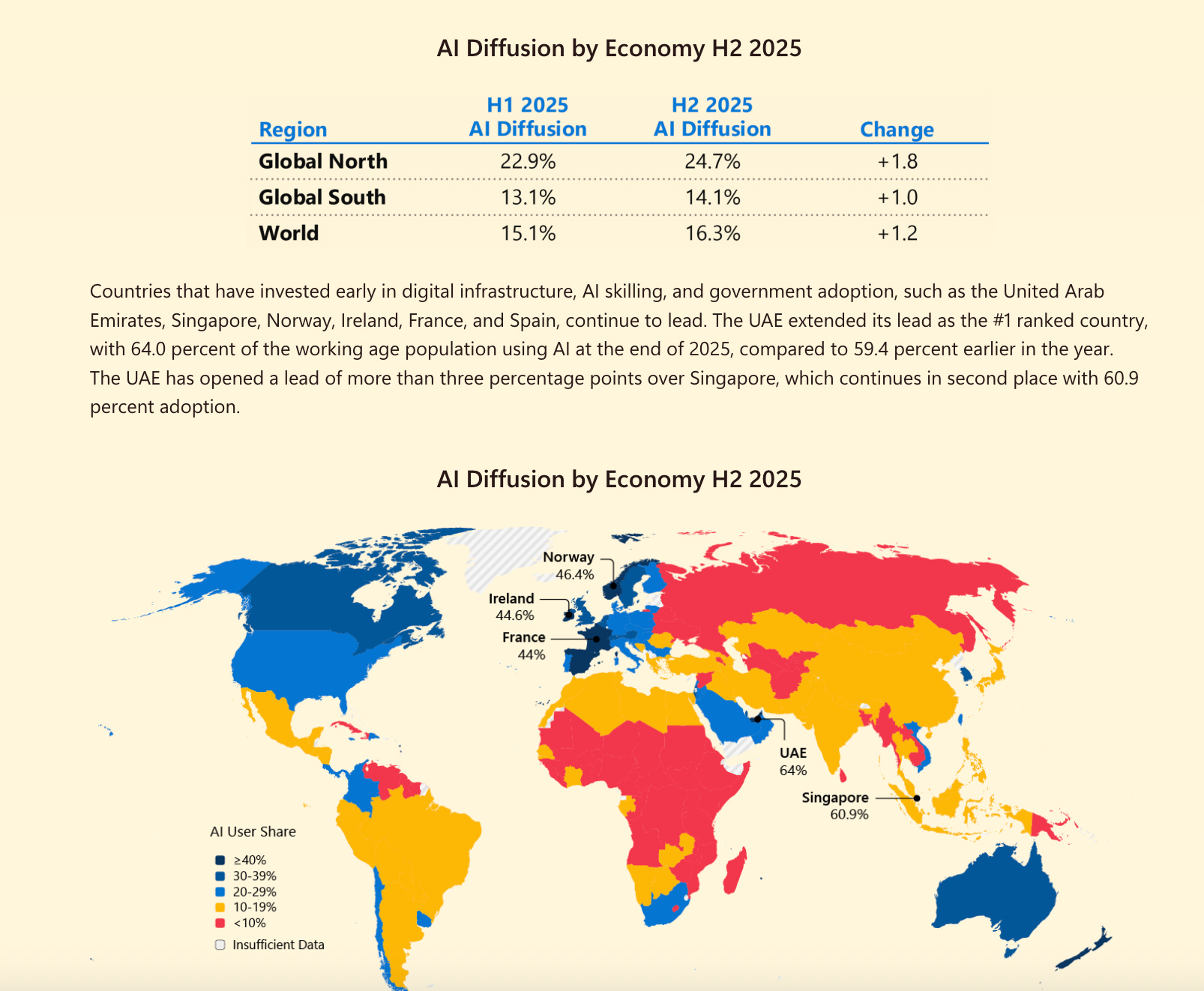
The US likes to always consider itself the leader of everything, but the UAE is far ahead on AI adoption, with 64% of its residents using AI.
You can learn more in Microsoft’s AI Global Adoption Report
*Hardware for Ambient AI
We’ve heard OpenAI is working on a simple AI pen. There are new reports of simple hardware one can wear behind the ear. It’s seems we are inching closer to AI becoming (nearly) embedded in the brain. Smart glasses have been proliferating, with many students receiving them for Christmas.
*Drones
Wing and Walmart are partnering to bring drone delivery to 150 stores.
A French drone maker is spewing out 10,000 drones a month to build-up European defenses against Russia.
*Music
Millennials are listening to three hours of AI generated music a week.
*Information Explosion
Grokpedia has already generated 86% of the content of Wikipedia.
*Loving Our AI
Japan’s chatty new robot if fluffy, lovable, and dorky.
*Another Thought Provoking Advance
Chinese researchers introduced a system called UniCorn that helps multimodal AI models notice and fix their own mistakes. Today’s models can often understand images better than they can recreate them. For example, a model might correctly describe where objects are in an image, but then generate a new image with those objects placed incorrectly. The researchers call this gap “conduction aphasia,” borrowing a term from neurology. UniCorn tries to close that gap by letting a single model act as three roles at once: one part proposes prompts, another generates images, and a third judges how well those images match the original ideas.
The model then trains on its own work, learning not just how to generate images, but also how to describe, evaluate, and improve them. This self-play approach leads to clear gains, especially on tasks like spatial layout, object counting, and complex scenes with many details. The researchers also created a new test that checks whether a model can explain its own generated images accurately, and UniCorn performs much better than the base model on this benchmark. While some challenges remain, like handling negation or very precise counting, the results suggest that helping models reflect on and correct themselves can meaningfully improve how well understanding and generation stay aligned.
*Back to the Basics
Duke law professor and former debater Nita Farahany has released her first blog from her spring class — From How AI Works to What AI Does.
__
We can keep taking about how to teach the current curriculum with chatbots, the newest “edtech,” but that’s a small part of what we need to be thinking about.
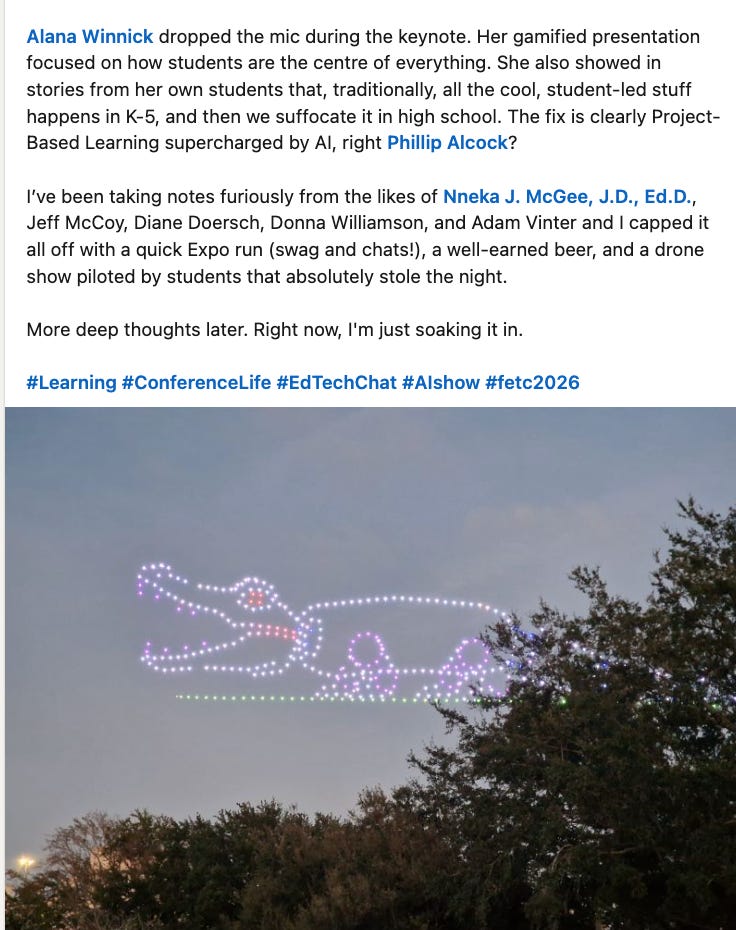
Changes are afoot (a report from FETC Orlando) —
The future of education is AI-amplified PBL, debate, portfolios, interdisciplinary learning, entrepreneurship, and education-industry collaboration. Many of us have been saying that since the spring of 2023. Others are coming around.